
Abdulqadir Adekunle

I am a Physics graduate with a strong academic interest in statistical mechanics, complex systems, computational physics, and the study of collective behaviour in interacting systems. During my undergraduate studies, I developed an interest in understanding physical phenomena not only through theoretical concepts but also through computational modelling and simulation. As part of my academic work, I explored the Ising model using Monte Carlo simulations and studied the Active Ising Model to investigate collective behaviour, density variations, and phase transitions in active systems. These projects introduced me to computational approaches in physics and strengthened my interest in understanding how simple microscopic interactions can give rise to complex macroscopic behaviour. Alongside my academic interests, I am passionate about education and science communication. I have experience helping students and peers understand concepts in physics and mathematics, with an emphasis on intuitive explanations rather than simply memorising formulas. I enjoy connecting scientific ideas to everyday experiences and presenting complex topics in a way that is clear, engaging, and accessible. I am also interested in the role of technology in education and the development of digital learning resources. Through writing, teaching, and educational projects, I hope to contribute to making scientific knowledge more accessible to students and curious learners. My broader interests include non-equilibrium statistical mechanics, active matter, phase transitions, computational modelling, complex systems, and science education. Through my work, I aim to continue developing as a researcher while contributing to science communication and education.

golden ratio pine cones

Golden Ratio Pine Cones and Their Impact on Discovery

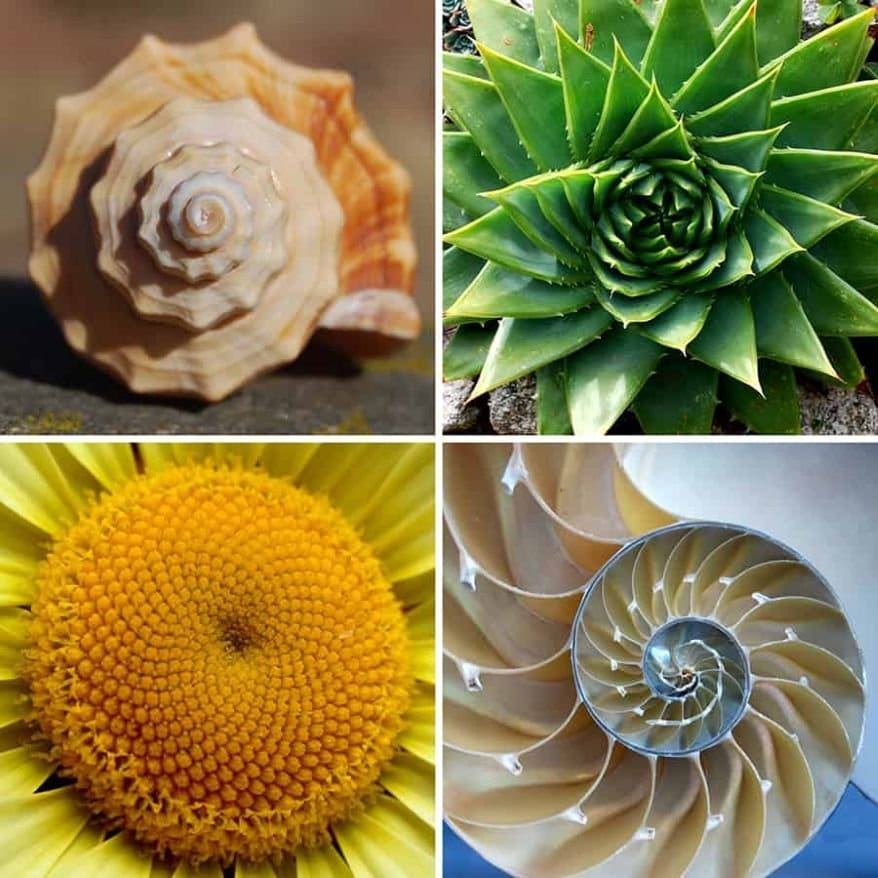
Have you ever noticed the spirals on golden ratio pine cones? Interestingly, these shapes often adhere to the golden ratio pine cone pattern. Furthermore, many pine cones exhibit spirals that correspond to Fibonacci numbers. In fact, research on the Golden Ratio and Fibonacci Sequence reveals that this pattern aids plants in growing efficiently and, consequently,

Golden Ratio Pine Cones and Their Impact on Discovery Read More »

feature image

Nature’s Math: The Golden Ratio and Fibonacci Sequence

A sunflower shows how mathematics in nature works. Specifically, its seeds form a spiral that follows a special pattern known as the golden ratio and Fibonacci sequence. This pattern is not random; in fact, nature often repeats it in a natural way. For example, people see the same design in another sunflower or even in

Nature’s Math: The Golden Ratio and Fibonacci Sequence Read More »