

Estimated reading time: 16 minutes
Have you ever wondered how your weather app predicts tomorrow’s rain or how GPS finds the fastest route? Behind these everyday tools, mathematical models turn data into useful predictions. But that’s not all. They also rely on mathematical constants, such as pi (π), which helps scientists describe circles and waves. Even more fascinating, Ramanujan’s pi formula shows how a single mathematical constant can connect simple calculations to some surprisingly deep ideas in mathematics.

In 1914, Srinivasa Ramanujan published 17 remarkable formulas for calculating 1/π. These formulas converge quickly, so even a few terms can produce highly accurate results. But their value goes beyond calculating pi. Although physicists do not usually use them directly to model matter, recent research has linked the mathematical structures behind Ramanujan’s formulas to ideas in theoretical physics, including logarithmic conformal field theories. In this article, we explore how these connections bring number theory and quantum physics together. How can a formula designed to calculate pi help us explore the mysteries of physics?

How this connects to mathematical modelling
Mathematical modelling means describing a real-world problem using mathematics, solving the mathematical problem, and checking whether the results make sense. Ramanujan’s formulas are not models of weather or matter; they are ways to calculate 1/π efficiently. Their mathematical structure has also inspired work in physics, where researchers use equations to describe systems and compare predictions with other results.

To learn more about modelling, see our Mathematical Modelling: Complete Guide. For examples of modelling in different fields, see Mathematical Modeling Applications Across Industries — Examples for Students. These guides explain how abstract mathematics can become a tool for studying real situations. In a broad sense, a model turns mathematical ideas into a way to describe or investigate something. Ramanujan’s work is remarkable because it reveals deep patterns in mathematics that researchers continue to study.

The following note is for the Advanced & Research section. If you want to begin with the basic concepts, refer to the pillar guide mentioned above.
The mathematics behind Ramanujan’s pi formula
In 1914, Ramanujan published 17 formulas for 1/π, but he did not include proofs in that paper. The pi formulas have a shared pattern: their terms involve factorials and other carefully chosen factors. The numbers may look unusual, but they are connected to deeper mathematics.

In 1985, R. W. Gosper used one of the formulas to calculate 17,526,100 digits of pi, a record at the time. The Borwein brothers later proved Ramanujan’s formulas. Related formulas developed by other mathematicians are often called Ramanujan–Sato series. These formulas connect to modular forms and converge very quickly, so a small number of terms can produce many correct digits. The exact number of digits gained per term depends on the formula.
Modular forms, elliptic integrals, and the Chudnovsky algorithm
Modular forms are mathematical functions with special patterns of symmetry under certain transformations. Elliptic integrals are another important part of this area; they arise in problems such as finding the arc length of an ellipse. Ramanujan’s work (Ramanujan’s pi formulas) connected these ideas through the theory of elliptic functions and modular equations.

The Chudnovsky algorithm, published in 1988, uses a related rapidly converging series to calculate pi. It is based on ideas connected to Ramanujan’s work, but it is a distinct formula—not simply Ramanujan’s own series with larger numbers. Each term adds about 14 correct decimal digits. The algorithm has been used in record-setting calculations of pi. The connection between these pi formulas and modular mathematics has also helped researchers explore further links between number theory and physics.

Students often meet these ideas for the first time in class, and the concepts can take time to understand. With practice, the patterns become easier to see.
How Ramanujan’s pi formula connects to hypergeometric series
A hypergeometric series is a sum whose terms follow a precise rule: the ratio of one term to the next can be written using a simple expression. Ramanujan’s formulas for 1/π can be expressed using hypergeometric-series ideas. Their terms shrink quickly, so only a few terms can give a highly accurate value of pi(π).

These formulas also connect to number theory through modular forms and special values of modular functions such as the j-invariant. These connections help explain why the formulas have their particular structure. Related mathematical tools also appear in physics, including in calculations involving partition functions and systems near critical points. The formulas are not themselves models of those systems, but some of the mathematics has a family resemblance. This shows how ideas from number theory can connect with other fields.
Conformal field theory and mathematical constants
Conformal field theory studies systems that remain unchanged under certain changes of scale. In simple terms, some features of the system can look similar when viewed at different sizes. This kind of scale symmetry can appear at critical points, such as the critical point of water, where liquid water and water vapour become indistinguishable. It also appears in models of magnets near a phase transition.

In two-dimensional conformal field theory, the Virasoro algebra describes important parts of the theory. Its central charge is a number that helps characterize the theory; it is not simply a count of “free steps.” Critical exponents describe how physical quantities change near a critical point. They depend on the system and its universality class—not just on symmetry alone. Conformal field theory links statistical physics with quantum field theory. In addition, it plays an important role in string theory.
How Ramanujan’s pi formula links to logarithmic CFT
Logarithmic conformal field theory, or LCFT, extends the usual conformal field theory framework. In some LCFTs, operators can mix in ways that lead to logarithms in correlation functions. LCFTs are studied in settings that include percolation, polymers, and aspects of the fractional quantum Hall effect.

In a 2025 study, Faizan Bhat and Aninda Sinha connected Ramanujan’s 1/π series to two-dimensional LCFTs. They reinterpreted the series through the lens of data that describe these theories, specifically the operator spectrum and the operator product expansion (OPE) coefficients. In addition, they introduced fresh ways to express LCFT correlation functions. These new representations often converge faster than the usual conformal-block expansion in the cases they examined. As a result, the connection supplies physicists with useful mathematical tools for their calculations. Still, it does not imply that Ramanujan’s formulas themselves directly describe quantum matter.
Critical exponents, central charge, and the Virasoro algebra
Researchers have studied how logarithmic conformal field theories relate to ordinary conformal field theories, including theories with central charge c=0. The so-called c=0 puzzle concerns how nontrivial physical models can arise when the central charge is zero. Percolation and self-avoiding walks are among the subjects studied using c=0 theories.

Many researchers have contributed to this area. Their work includes studying logarithmic couplings, modular properties, lattice models, and correlation functions. These approaches do not all describe one identical structure, but together they help researchers understand different examples of logarithmic conformal field theory. The Virasoro algebra and central charge are important tools in this work; they do not mean that one constant alone explains many different areas of physics.
Ramanujan’s pi formula in modern physics modeling
In some versions of string theory, extra dimensions are described as being compactified, or curled up into tiny shapes. The possible shapes are studied using mathematical tools that can include geometry and topology. Modular forms can also appear in calculations related to string theory, but they do not count every possible compactification shape on their own.

Ramanujan’s connection to string theory is indirect. His mock theta functions are part of a broader family of mathematical objects called mock modular forms, which have been studied in areas including black-hole entropy and quantum invariants of three-manifolds. These connections are mathematical and theoretical; they do not mean that Ramanujan’s formulas by themselves predict particles or prove string theory. Researchers continue to investigate how number theory and theoretical physics overlap.
How Ramanujan’s Pi Formula Reaches String Theory
Different ways of compactifying extra dimensions can produce different mathematical and physical models. However, finding and classifying all the possible shapes remains a challenging task. To help with these calculations, physicists use modular forms and related functions in string theory.
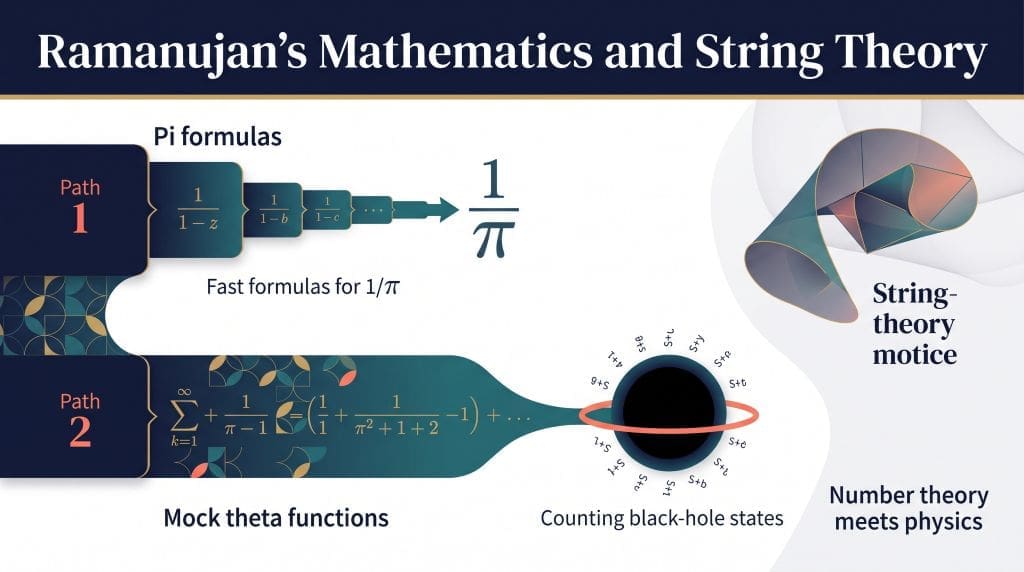
Ramanujan’s mock theta functions connect to modern research through their relationship with mock modular forms. For example, these forms appear in studies of black-hole entropy and quantum invariants linked to three-manifolds. As a result, they help researchers explore connections between pure mathematics and theoretical physics. However, these connections do not mean that a mathematical counting error would automatically lead to a specific incorrect particle prediction. Nor do they prove that string theory is correct.
Mock Theta Functions in Modern Physics Models
Ramanujan introduced mock theta functions in his final letter to G. H. Hardy. Their mathematical theory was developed further much later. In particular, Sander Zwegers showed how mock theta functions fit into the broader framework of mock modular forms.

Researchers have found interesting links between mock modular forms and quantum invariants, which help describe certain three-dimensional spaces called manifolds. For example, they have studied these connections in the Brieskorn sphere Σ(2,3,7). However, scientists have proven some results while leaving others as open questions. Researchers have also explored related ideas in black-hole physics, although each connection depends on the mathematical model they use. Similarly, Ramanujan’s pi formula shows how one mathematician’s ideas can lead to new questions and discoveries. Together, these examples show how mathematical ideas can reach beyond their original purpose and inspire research in unexpected areas.
Career Paths in Modern Physics and Mathematical Modelling
There are several career paths in this area. A mathematical physicist uses mathematics to study theoretical problems. A computational scientist develops software and numerical methods. Quantitative analysts use mathematical tools to study financial markets, while data modellers build models from data. These jobs value clear reasoning, patience, and strong programming and mathematics skills. Python and linear algebra are useful starting points, though the exact skills needed depend on the job.

I once taught a class on Ramanujan’s series, and a student asked why the terms get smaller so quickly. We plotted the error after adding each term. That simple experiment helped the student understand how the series worked. Learning often involves trying examples and checking what happens. For further reading, see our guide on sine and cosine. Newcomers to physics may also want to begin with our guide on quantum mechanics.
Computational Approaches to Ramanujan-Type Series
Fast algorithms help computers calculate these series efficiently. One method, called binary splitting, reorganizes parts of a sum so that large calculations can be carried out more efficiently, often using exact integer arithmetic. High-precision calculations also use careful numerical checks to catch errors.

The Chudnovsky algorithm has been used in record-setting calculations of pi. In late 2025, StorageReview reported calculating 314 trillion digits using the algorithm and the y-cruncher program. That record calculation depended on a large computing and storage system, not just on the series itself.
Researchers check large computations carefully because a small error can spoil many later digits. Teams may use independent checks or compare results from different calculations. Careful testing is important in both mathematics and physics software, although the specific methods depend on the calculation.
Implementing Ramanujan-Type Series in Python
A computer program can calculate a Ramanujan-type series by adding its terms to a running total. To get reliable results, use a library that supports high-precision arithmetic rather than ordinary floating-point numbers. The Leibniz series for pi converges very slowly, while Ramanujan-type series converge much faster, so they need far fewer terms for a similar level of accuracy.
The code for this calculation can be short, but it must use the correct formula and enough precision. Increasing the number of terms usually improves the result, though the number of correct digits depends on the particular series.
Further Reading and Research Directions
There are several open-access papers and reviews on this topic. The list below includes classic work and newer research, but the papers differ in scope and level of difficulty. Cardy’s 2013 paper explains one way logarithmic conformal field theories can arise as limits of ordinary conformal field theories. Campbell’s work on level-3 Ramanujan-type series proves several formulas that had previously been conjectured. These papers are useful starting points, but they do not all cover the same topic. A good approach is to begin with a review, then choose a research paper that matches your interests. Reading one paper carefully can be more useful than skimming several.
- Bhat and Sinha (2025): Link Ramanujan’s 1/π formulas to logarithmic conformal field theory
- Pang Ern and Wangsa (2024): Prove a famous Ramanujan formula for 1/π
- Campbell (2023 preprint; published in 2025): Prove several conjectures about level-3 Ramanujan-type series.
- Cheng, Ferrari, and Sgroi (2020): Explore connections between mock theta functions and quantum invariants of three-dimensional spaces.
- Hogervorst, Paulos, and Vichi (2017): Study the mathematical structure of logarithmic conformal field theory across different spacetime dimensions.
- Cardy (2013): Explains how logarithmic CFTs can arise as limits of ordinary CFTs and discusses applications.
- Creutzig and Ridout (2013): A review titled Logarithmic Conformal Field Theory: Beyond an Introduction.
- Guillera (2018 preprint; published in 2020): Presents a method for proving Ramanujan’s series for 1/π, building partly on an idea of James Wan.
Frequently Asked Questions
It is not a single one; in 1914 Ramanujan published 17 formulas for 1/π which converged rapidly. Each of these formulas has its own terms and its own rate of convergence.
The article from 2025 by Bhat and Sinha relates the mathematical structures that underlie Ramanujan’s 1/π series to data from two-dimensional logarithmic conformal field theories; while the paper deals with these structures, it does not merely use the formulas as direct models of physical systems.
It depends on the series. For example, one famous Ramanujan series gives about eight correct decimal digits per term. However, other formulas converge at different rates, so 14 digits per term is not a general rule.
Useful search phrases include “Ramanujan’s 1/π series and physics,” “Ramanujan-type series in mathematical physics,” and “Ramanujan’s formulas and conformal field theory.”
A knowledge of calculus would be helpful and, likewise, linear algebra is useful particularly in the physics sections. Although the research papers might involve more advanced mathematics, the main ideas can still be presented without first mastering all the technical details.
How This Guide Was Compiled
This guide draws on research papers and review articles about Ramanujan-type series and logarithmic conformal field theory. The references can help readers check the mathematical and physics claims. Some connections described in the research are established results, while others are interpretations or conjectures. The goal is to explain the ideas clearly without presenting open questions as settled facts.
Reference
- Bhat, F., & Sinha, A. (2025). Ramanujan’s 1/π series and conformal field theories. arXiv. https://doi.org/10.48550/arXiv.2503.21656
- Campbell, J. M. (2023). Proofs of conjectures on Ramanujan-type series of level 3. arXiv. https://doi.org/10.48550/arXiv.2310.05112
- Cardy, J. (2013). Logarithmic conformal field theories as limits of ordinary CFTs and some physical applications. Journal of Physics A: Mathematical and Theoretical, 46(49), 494001. https://doi.org/10.1088/1751-8113/46/49/494001
- Cheng, M. C. N., Ferrari, F., & Sgroi, G. (2020). Three-manifold quantum invariants and mock theta functions. Philosophical Transactions of the Royal Society A, 378(2163), 20180439. https://doi.org/10.1098/rsta.2018.0439
- Creutzig, T., & Ridout, D. (2013). Logarithmic conformal field theory: Beyond an introduction. Journal of Physics A: Mathematical and Theoretical, 46(49), 494006. https://doi.org/10.1088/1751-8113/46/49/494006
- Gainutdinov, A. M., Jacobsen, J. L., Read, N., Saleur, H., & Vasseur, R. (2013). Logarithmic conformal field theory: A lattice approach. Journal of Physics A: Mathematical and Theoretical, 46(49), 494012. https://doi.org/10.1088/1751-8113/46/49/494012
- Guillera, J. (2018). A method for proving Ramanujan series for 1/π. arXiv. https://doi.org/10.48550/arXiv.1807.07394
- Gurarie, V. (2013). Logarithmic operators and logarithmic conformal field theories. Journal of Physics A: Mathematical and Theoretical, 46(49), 494003. https://doi.org/10.1088/1751-8113/46/49/494003
- Hogervorst, M., Paulos, M., & Vichi, A. (2017). The ABC (in any D) of logarithmic CFT. Journal of High Energy Physics, 2017(10), 201. https://doi.org/10.1007/JHEP10(2017)201
- Mathieu, P., & Ridout, D. (2007). From percolation to logarithmic conformal field theory. Physics Letters B, 657(1–3), 120–129. https://doi.org/10.1016/j.physletb.2007.10.007
- Thang, P. E., & Wangsa, D. W. (2024). A proof of Ramanujan’s classic π formula. arXiv. https://doi.org/10.48550/arXiv.2411.15803