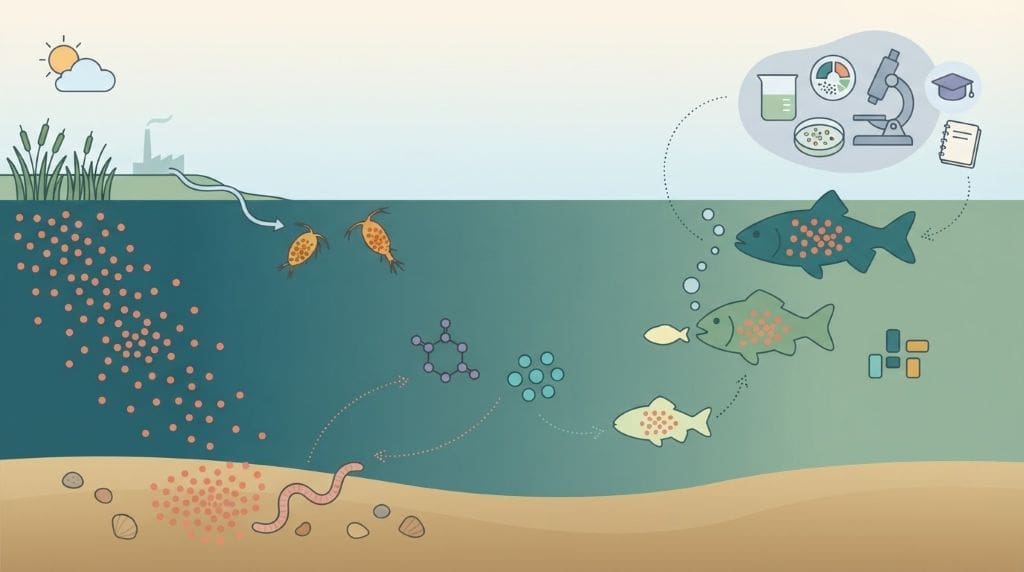
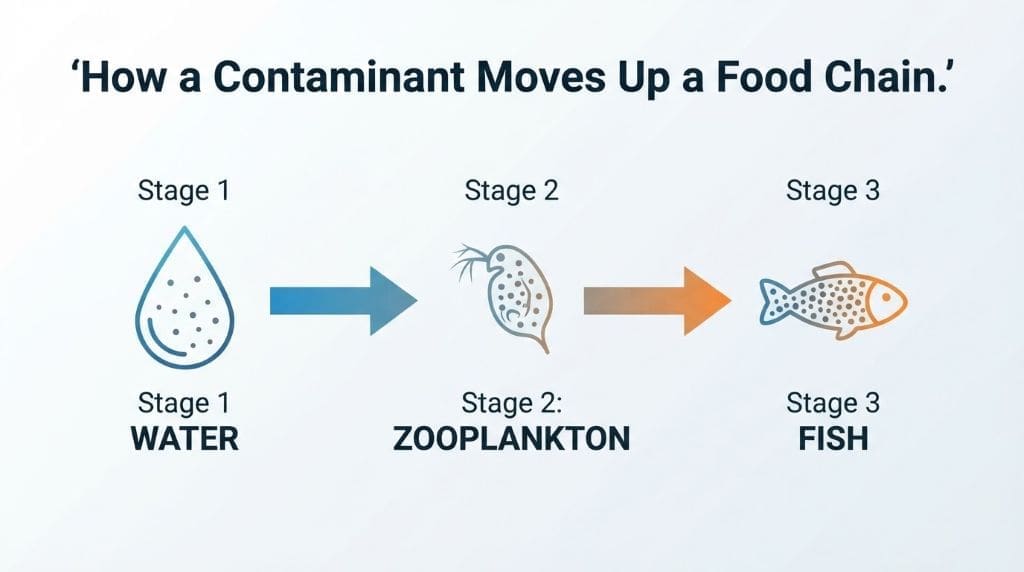
Bioaccumulation occurs when organisms take up and retain chemical substances faster than they eliminate them. At the same time, biomagnification is the process by which these substances concentrate as they move up the food chain. In this case, the first term applies to a single organism and the second to the entire food web. A chemical advances up trophic levels one stage at a time: plankton absorb mercury from the water, small fish then eat the plankton, and larger fish eat the small fish. At each stage, the amount stored per gram of body weight rises. A class can show this. Teachers also need equipment. Furthermore, teachers can compare bioconcentration, since this process involves no consumption. Generally, persistent organic pollutants, or POPs, cause the classic cases.
What Is Bioaccumulation?
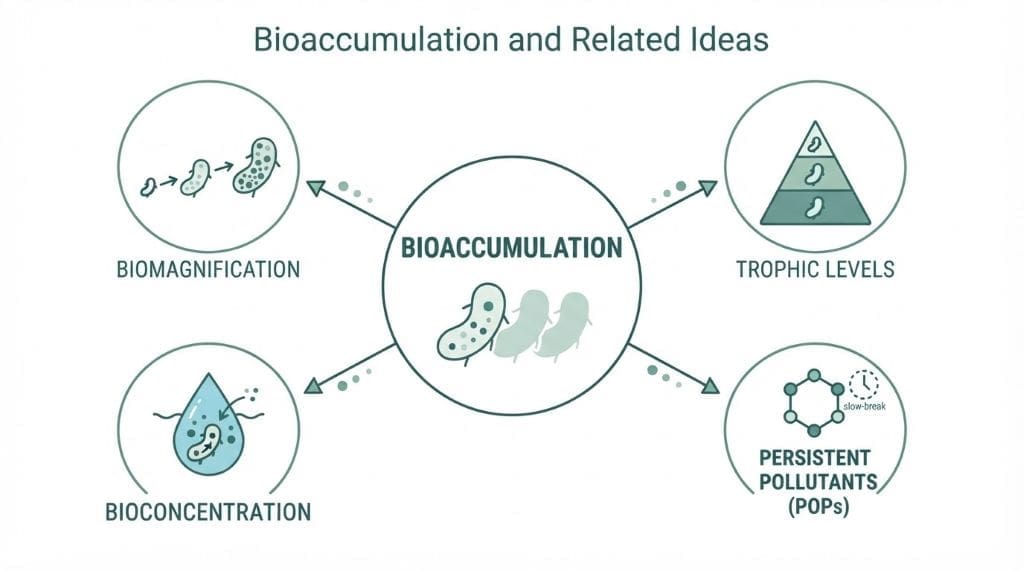
Bioaccumulation is the process by which organisms take up and retain chemical substances faster than their bodies can eliminate them. Meanwhile, biomagnification occurs when these substances concentrate as they move up the food chain. Bioconcentration, in contrast, involves taking up a chemical only from water or air and has nothing to do with food. Biomagnification occurs between trophic levels because predators accumulate the chemicals their prey has already taken up; as a result, top predators end up with the highest levels of these substances. Persistent organic pollutants clearly exhibit this pattern, since they resist degradation for decades and bind to fats, allowing them to move easily through food webs. Experts use this to differentiate between the three terms.
Three Terms, One Confusing Family

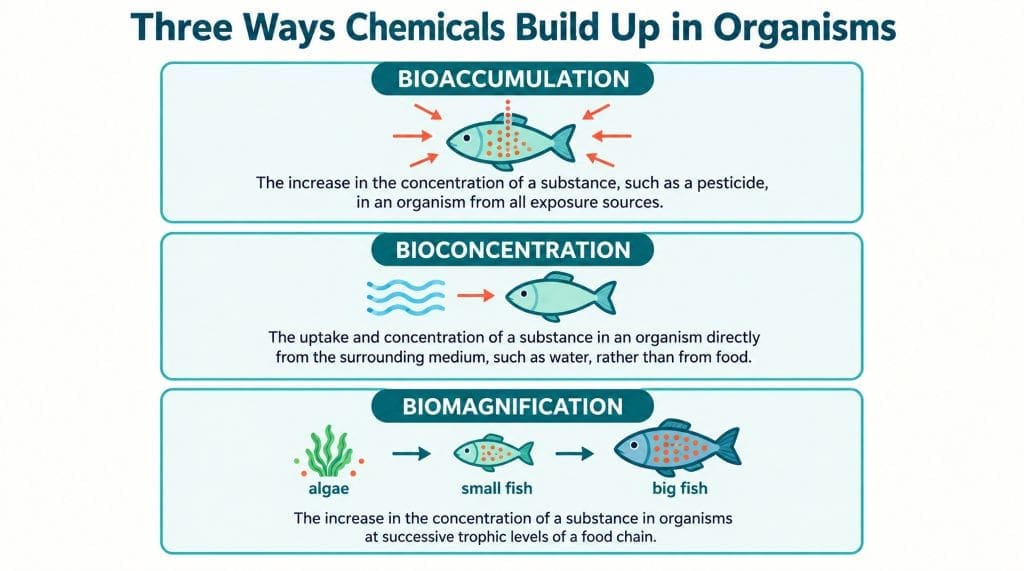
Bioaccumulation is the process by which a substance builds up in an organism over time. It occurs when an organism takes in more of a substance than it can eliminate. Simply put, the substance accumulates over time and becomes harder to eliminate.
Bioconcentration is the process by which a substance builds up in an organism directly from the surrounding water or air, rather than by ingesting it through food. For example, a fish can absorb a metal from the water via its gills.
Biomagnification is the process by which the concentration of a substance increases at every level of a food chain as predators accumulate what their prey has already taken up. The greatest concentrations occur at the top of the chain.
Importance of Bioaccumulation Experiments
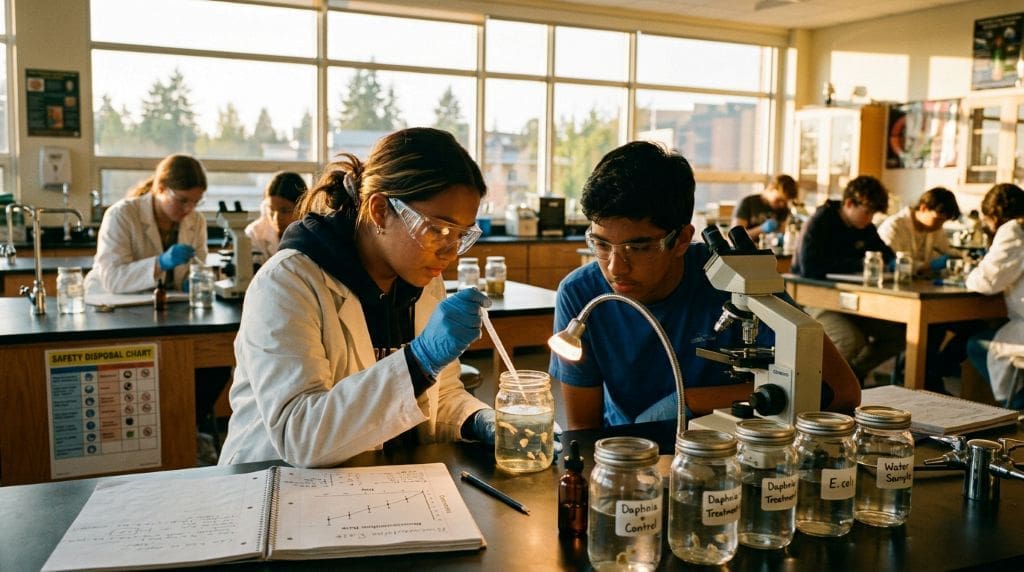
These laboratories go beyond covering the syllabus by helping build the habits STEM teachers expect year-round. Students learn to observe, take measurements, draw graphs, and discuss evidence-based findings, often involving uncertainty and real science. For example, a simple Daphnia jar produces real data within a few days. The topic also connects to public policy because regulators evaluate chemicals for their potential to bioaccumulate. Students therefore have the opportunity to work within a true scientific culture, not in a simplified version of it. That is why many STEM projects start right here.
- Students are taught that exposure can occur through several routes. Students can take in chemicals through water, food, and sediment. Each route results in a different outcome.
- Food webs show how one organism’s waste becomes another organism’s food. Students can follow one chemical through three links and apply this approach to entire ecosystems.
- In a well-designed experiment, one factor remains constant. Students vary only the amount of the substance or food.
- True data honesty means that live measurements tend to drift and vary. Students encounter noise from the beginning, not afterwards, and because of this, they learn to interpret error bars.
- Policy awareness: chemical agencies screen for bioaccumulation using frameworks like the EPA’s PBT framework.
- Safety literacy is essential because these labs require gloves, labels, and clear disposal rules; good bench habits begin at an early age. To sum up, they carry over into any lab career.
- Career signals. It indicates real-world jobs. Environmental toxicologists carry out similar tests every day, as do water-quality consultants. Hence, the classroom bench extends outward.
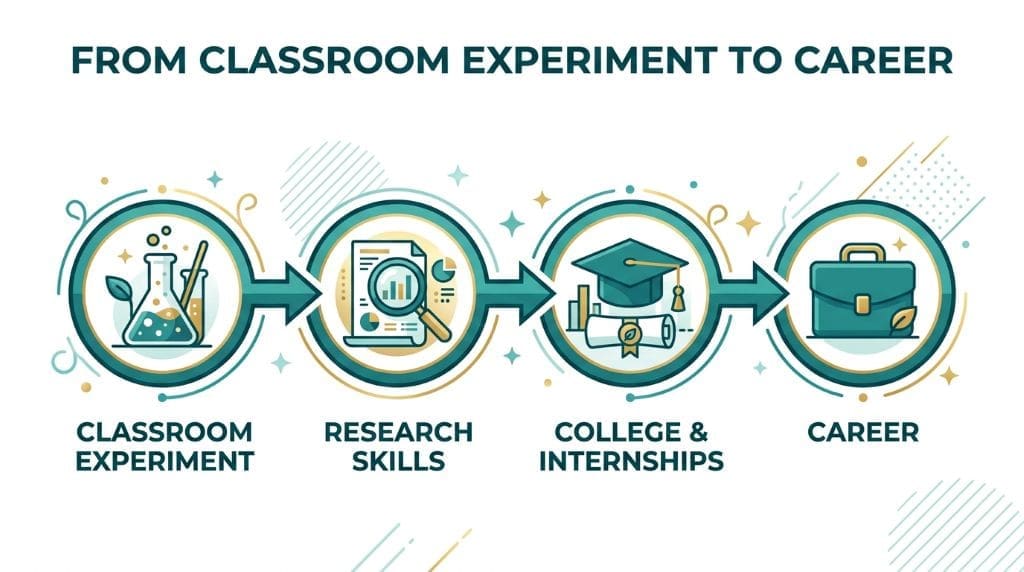
The list forms a complete sequence: it starts with basic science and ends with career opportunities, so that a teacher can work through it throughout the year.
A Classroom Scenario, Step by Step
Imagine a classroom in which a teacher sets up a simulated food chain. Nine-year-old students can work in groups of four. Each cup at their table represents one trophic level, and blue beads represent a metal. The students first transfer the beads from the ‘water’ to the ‘plankton’. They note how many remain in the ‘plankton’. Then the ‘fish’ eat the ‘plankton’. The number of beads increases at each level. In short, the activity demonstrates accumulation without any live exposure. At the same time, a more advanced class maintains real Daphnia. They add a chemical to one jar and keep another as a control. Students take samples from both jars twice a week and record only growth and survival. They do not carry out any chemical analysis. Generally speaking, the total cost of the setup is under twenty dollars.
How Do You Measure Bioaccumulation in Classroom Experiments?
Biomagnification occurs when toxin concentrations increase at each level of the food chain. For example, a small fish may contain a small amount of mercury. When a larger fish eats several smaller fish, the mercury concentration increases.
Bioaccumulation Factor or BAF
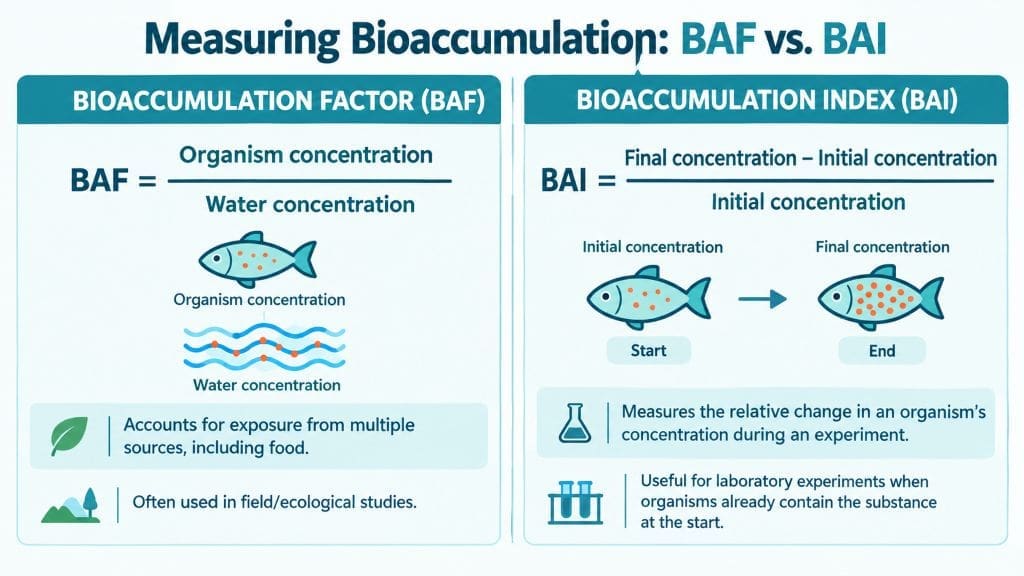
Scientists measure the bioaccumulation of substances using a ratio. The traditional bioaccumulation factor, or BAF, involves comparing two concentrations. One concentration is in the organism, and the other is in the water or sediment. If the ratio is above one, this indicates a net uptake. This method is suitable for field ecology because natural systems continue for months. By contrast, classroom experiments last only a few days. Moreover, the organisms used in the laboratory already have an initial amount of the chemical. This initial level can distort the BAF. In fact, the ratio may give rise to incorrect conclusions. For instance, a growing larva might dilute the phosphorus inside it. The BAF will still increase because the food contains less phosphorus. In short, the conventional measure can misinterpret a short-term experiment. That is where a more recent approach comes in.
Bioaccumulation Index or BAI
Proc and colleagues in 2021 introduced the bioaccumulation index, or BAI. It accounts for the initial level of contamination. The same organism is measured twice: once before exposure and again after exposure. In practice, the BAI is calculated by subtracting the initial concentration from the final one and then dividing by the initial concentration. A positive value indicates true uptake, a value of zero shows no change, and a negative value means dilution. This last possibility matters because the classic BAF cannot give a negative result. For example, consider a published study. Black soldier fly larvae were fed a low-phosphorus diet, and as they grew, their phosphorus level decreased. The BAF gave 14.85, whereas the BAI gave −0.32. Thus, the choice of metric altered the interpretation. For this reason, teachers should ask one question: did the organism start off clean or already loaded? The answer determines which index is appropriate.
Professional laboratories adhere to written protocols. Environmental testing laboratories check their results against other studies. The U.S. EPA and ASTM have described a 28-day sediment test (Ingersoll et al., 1998). This test uses the freshwater worm Lumbriculus variegatus. Adult worms are kept in chambers with a capacity of 4 to 6 litres and 1 to 2 litres of sediment. For each condition, five replicate chambers are used. The sediment can be taken directly from the field. Alternatively, the laboratories can add a known amount of substance to clean sediment. The organisms are fasted for the entire test duration and undergo a 24-hour purge of the gut contents to remove ingested sediment from the tissue results. The test aims to approach steady-state conditions, with a target of 80%. Students can adapt this design with fewer worms and simpler equipment while considering the resulting limitations.
Copepod Dye Tracing: A Visual Bioaccumulation Experiment
Metals accumulate in copepods mysteriously over many years. To investigate this, researchers carried out a neat experiment (Kadiene et al., 2019). They put a visible dye into the water, and two species drank it. Pseudodiaptomus annandalei and Eurytemora affinis. Within a few minutes, both had coloured guts—the dye accumulated in the midgut. Peristaltic contractions then push the dye toward the hindgut. About 30 minutes later, most of it had been moved in that direction. In contrast, the tropical species emptied their guts more quickly. Temperature accounts for the difference. Thus, the scientists showed that drinking water is important. Furthermore, the study compared metals that were dissolved in the water with those taken in through the diet. Uptake from the water usually prevailed. In brief, a low-cost dye can show the actual mechanism at work, and the same pattern can be observed using just a classroom microscope.
Daphnia magna: The Workhorse of Classroom Bioaccumulation Experiments
Water fleas make laboratory studies more practical. Daphnia magna reproduces rapidly and now has regulatory significance. Researchers used it as a fish substitute (Çelik et al., 2025), employing passive dosing via a silicone polymer. This method maintains a constant exposure level for weeks. Four nitrogen-sulfur-oxygen PAHs built up in the water fleas, but steady state was not reached within five days. Yet, depuration was much faster in the fleas than in fish. Because of this, the authors regarded the test as both ethical and high-throughput. In short, Daphnia is suitable for schools because it requires little space and does not need vertebrate permits. At the same time, a second study examined different exposure routes (Liu et al., 2022). ExposureContact between a substance and an organism. More through the water resulted in the quickest uptake. Except for Tris(2-butoxyethyl) phosphate (TBOEP), dietary exposure contributed less.
Following Contaminants Up a Food Chain
Food chains work very well when scaled down. Herman and his colleagues carried out a model system. They added iron and manganese to the water. The species Daphnia pulex took up the metals. Then, for 14 days, juvenile zebrafish ate the daphnia. Both metals moved up the chain. Furthermore, the metal-enriched diet reduced fish growth. Both the specific growth rate and weight gain decreased. Yet, no biomagnification was observed. The step from water to zooplankton remained the strongest. That step showed high bioconcentration factors. In contrast, metal transfer to fish was weak. In other words, the lower level retained most of the metals. This result should be a topic for class discussion. The metals stopped increasing up the chain because of both growth dilution and excretion. In brief, this study constitutes a true model experiment and can be simplified by teachers to just two links.
Sediment Worms and the Standardised 28-Day Test
Sediment hides most contaminants. So labs test burrowing worms. The blackworm Lumbriculus variegatus is a standard choice. Higgins and colleagues (2009) spiked sediment with triclocarban. This antimicrobial reaches streams and biosolids. Worms sat in the spiked mud for 56 days. Then they were purged in clean sediment for 21 more. Tissue levels rose quickly at first. Later, they fell as the sediment lost potency. Meanwhile, a breakdown product called DCC accumulated slowly. Model-derived BSAFs were 2.2 for TCC and 0.3 for DCC. In other words, the parent chemical built up. Its transformation product did not. That contrast shows why labs measure both. For a classroom, the lesson is simpler. Organisms absorb chemicals from mud, not just water. In addition, gut purging protects data quality.
Nanomaterials: A New Frontier for Bioaccumulation Testing
Nanomaterials are small particles deliberately designed for specific uses. Examples include silver and metal oxides. However, traditional tests have been developed for dissolved chemicals. Because nanoparticles tend to clump together and settle, fish tests may miss them. Therefore, the reviewers posed a key question (Kuehr et al., 2021): which freshwater invertebrate is the most suitable? They examined bivalves, gastropods, isopods, amphipods, and branchiopods. Amphipods emerged as the best choice. Hyalella azteca, in particular, allows for two separate routes of exposure—one through the water and one through the diet. Furthermore, amphipod tests provide a worst-case scenario, omitting other fish. This shift indicates the direction the field is moving. Students who study these models today will enter an evolving job market. For the most part, new contaminants require new testing methods.
From Classroom Experiment to Career: Where This Leads
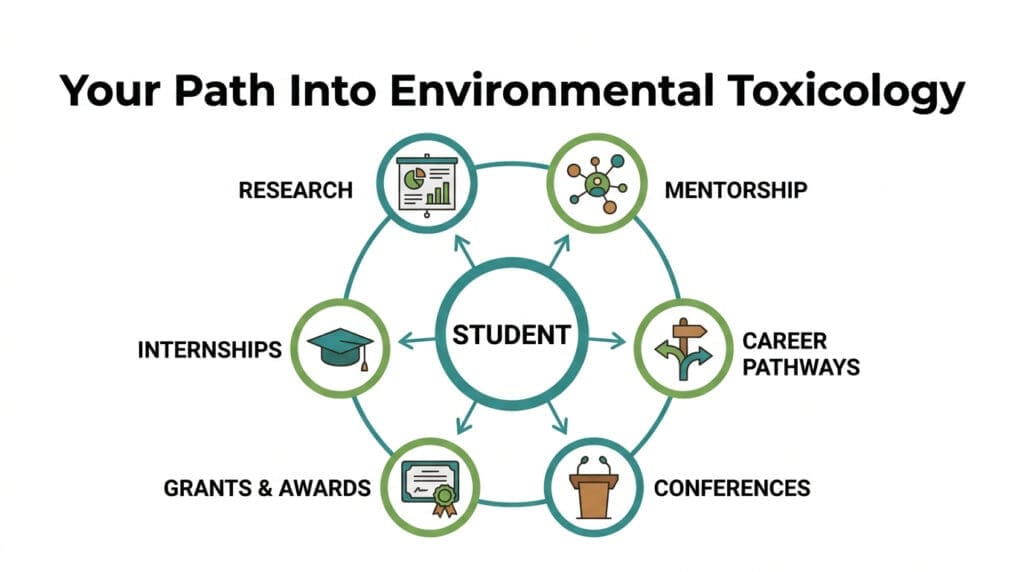
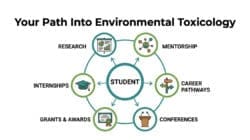
The practical work involved in bioaccumulation is directly related to actual careers. Environmental toxicologists face similar exposures each week and select the doses, organisms, and endpoints. Regulatory scientists carry out the same tasks in accordance with the law. For instance, the EPA’s TSCA PBT framework guides chemical screening. Ecotoxicology researchers publish studies just as the eight included in this guide do. Moreover, water-quality consultants analyse contaminants in field samples. The companies that carry out environmental testing operate the equipment that produces those figures. Industry profiles show what this work involves. Meanwhile, schools supply the workforce. STEM programmes give students their first hands-on experience at the bench. To sum up, a single classroom experiment can preview a range of careers. Most importantly, the key skills are transferable. Careful measurement, honest data recording, and clear writing are useful in all these roles.
How This Guide Was Compiled
The guide is based on two main points. The first of these is the U.S. EPA’s PBT framework set out in TSCA Section 6(h), outlining the criteria by which chemicals can be classified as persistent, bioaccumulative, and toxic. This framework supports the BAF and BSAF calculations discussed above. Simply put, students assess the same criteria regulators have already used to rank chemicals. The second foundation is eight peer-reviewed, open-access studies. These studies include research on copepods, Daphnia, zebrafish, sediment worms, and nanomaterials. All eight studies are listed in the references below. The classroom situation described above is merely illustrative and is not a personal account that has been claimed. Generally speaking, the experimental figures come directly from the published papers. Furthermore, the .edu and .gov links provided below give additional background reading. As a result, a teacher can check out every claim. The sources are listed here in APA format.
Frequently Asked Questions About Bioaccumulation Experiments
Daphnia magna. It reproduces quickly and needs only a jar of aged water; no vertebrate permits are required. A teacher can keep one for a test and another for a control. The students can then compare the organisms’ growth or survival.
Bioaccumulation occurs within a single organism and includes all the ways it takes up substances. In contrast, biomagnification occurs along a food chain because each predator accumulates more than its prey. One term refers to the individual, while the other refers to an ecological level.
Treat each dose as hazardous. Wear gloves and eye protection. All jars should be clearly labelled. Never use your mouth to pipette. Keep food away from the bench. Dispose of used water through approved channels. Spills should remain rare and contained.
Daphnia experiments last 1 to 3 weeks, while standard sediment tests take 28 days. A published zebrafish feeding trial lasted 14 days. Teachers should therefore make a timetable, since growth and uptake take time.
Certainly. Whether they are coloured beads or digital food-web models, they illustrate the same mathematics. Students are asked to move a chemical through the various trophic levels. In short, the concept can be maintained without using organisms.
Environmental toxicologists and water-quality consultants feature at the top of the list. Regulatory scientists check chemicals for their potential to bioaccumulate. Ecotoxicology researchers carry out published studies. Environmental laboratories also employ trained technicians.
The EPA’s TSCA program checks chemicals for their PBT characteristics. A bioaccumulative chemical can move up food chains and may reach people or wildlife at harmful levels. Because of this, tests such as the BAF have legal significance. Students copy that same line of reasoning.
Key Takeaways
- Bioaccumulation refers to build-up within a single organism, since the amount taken in exceeds the amount eliminated.
- Bioconcentration refers only to uptake from water, while biomagnification involves movement up food chains.
- The BAF compares an organism to its environment, while the BAI compares the final state to the initial state.
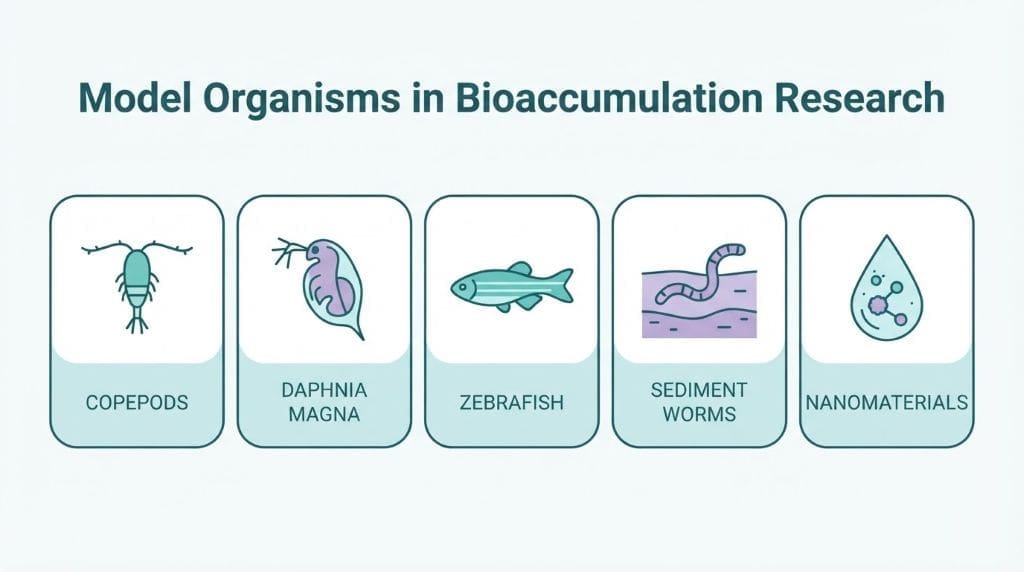
- Each chain involving Daphnia, copepods, worms, and fish teaches a different lesson.
- Standard protocols such as the 28-day test make results comparable.
- These skills can lead to careers in toxicology, regulation, and consulting.
Verified Resources
- U.S. EPA — Persistent, Bioaccumulative, and Toxic (PBT) Chemicals under TSCA Section 6(h): https://www.epa.gov/assessing-and-managing-chemicals-under-tsca/persistent-bioaccumulative-and-toxic-pbt-chemicals
- U.S. EPA — Persistent Organic Pollutants: A Global Issue, A Global Response: https://www.epa.gov/international-cooperation/persistent-organic-pollutants-global-issue-global-response
- NOAA National Ocean Service — Estuaries Tutorial (biomagnification): https://oceanservice.noaa.gov/education/tutorial_estuaries/est09_humandis.html
- University of Hawaiʻi at Mānoa — Exploring Our Fluid Earth (chemical module): https://manoa.hawaii.edu/exploringourfluidearth/chemical
- New York City Department of Education — STEM: https://www.schools.nyc.gov/learning/subjects/stem
- All eight peer-reviewed studies appear in the references below.ss
References
Çelik, G., Healy, S. A., Stolte, S., Mayer, P., & Markiewicz, M. (2025). Daphnia magna as an alternative model for (simultaneous) bioaccumulation and chronic toxicity assessment: Controlled exposure study indicates high hazard of heterocyclic PAHs. Environmental Science & Technology, 59(19), 8984–8996. https://doi.org/10.1021/acs.est.5c00384
Herman, P., Fehér, M., Molnár, Á., Harangi, S., Sajtos, Z., Stündl, L., Fábián, I., & Baranyai, E. (2021). Iron and manganese retention of juvenile zebrafish (Danio rerio) exposed to contaminated dietary zooplankton (Daphnia pulex)—A model experiment. Biological Trace Element Research, 199(2), 732–743. https://doi.org/10.1007/s12011-020-02190-z
Higgins, C. P., Paesani, Z. J., Abbott Chalew, T. E., & Halden, R. U. (2009). Bioaccumulation of triclocarban in Lumbriculus variegatus. Environmental Toxicology and Chemistry, 28(12), 2580–2586. https://doi.org/10.1897/09-013.1
Ingersoll, C. G., Brunson, E. L., & Dwyer, F. J. (1998). Methods for assessing bioaccumulation of sediment-associated contaminants with freshwater invertebrates. In National Sediment Bioaccumulation Conference proceedings (pp. 1-25–1-44). U.S. Geological Survey. https://archive.epa.gov/water/archive/polwaste/web/pdf/ingersol.pdf
Kadiene, E. U., Ouddane, B., Hwang, J.-S., & Souissi, S. (2019). Bioaccumulation of metals in calanoid copepods by oral intake. Scientific Reports, 9, 9492. https://doi.org/10.1038/s41598-019-45987-2
Kuehr, S., Kosfeld, V., & Schlechtriem, C. (2021). Bioaccumulation assessment of nanomaterials using freshwater invertebrate species. Environmental Sciences Europe, 33, 9. https://doi.org/10.1186/s12302-020-00442-2
Liu, W., Zhang, H., Ding, J., He, W., Zhu, L., & Feng, J. (2022). Waterborne and dietary bioaccumulation of organophosphate esters in zooplankton Daphnia magna. International Journal of Environmental Research and Public Health, 19(15), 9382. https://doi.org/10.3390/ijerph19159382
Proc, K., Bulak, P., Kaczor, M., & Bieganowski, A. (2021). A new approach to quantifying bioaccumulation of elements in biological processes. Biology, 10(4), 345. https://doi.org/10.3390/biology10040345
U.S. Environmental Protection Agency. (2009). Persistent organic pollutants: A global issue, a global response. https://www.epa.gov/international-cooperation/persistent-organic-pollutants-global-issue-global-response
U.S. Environmental Protection Agency. (n.d.). Persistent, bioaccumulative, and toxic (PBT) chemicals under TSCA Section 6(h). https://www.epa.gov/assessing-and-managing-chemicals-under-tsca/persistent-bioaccumulative-and-toxic-pbt-chemicals
National Oceanic and Atmospheric Administration. (n.d.). Estuaries tutorial: Human impact. https://oceanservice.noaa.gov/education/tutorial_estuaries/est09_humandis.html
University of Hawaiʻi at Mānoa, College of Education. (2011). Exploring our fluid Earth. https://manoa.hawaii.edu/exploringourfluidearth/chemical
New York City Department of Education. (n.d.). STEM. https://www.schools.nyc.gov/learning/subjects/stem
List of terms
- Exposure