
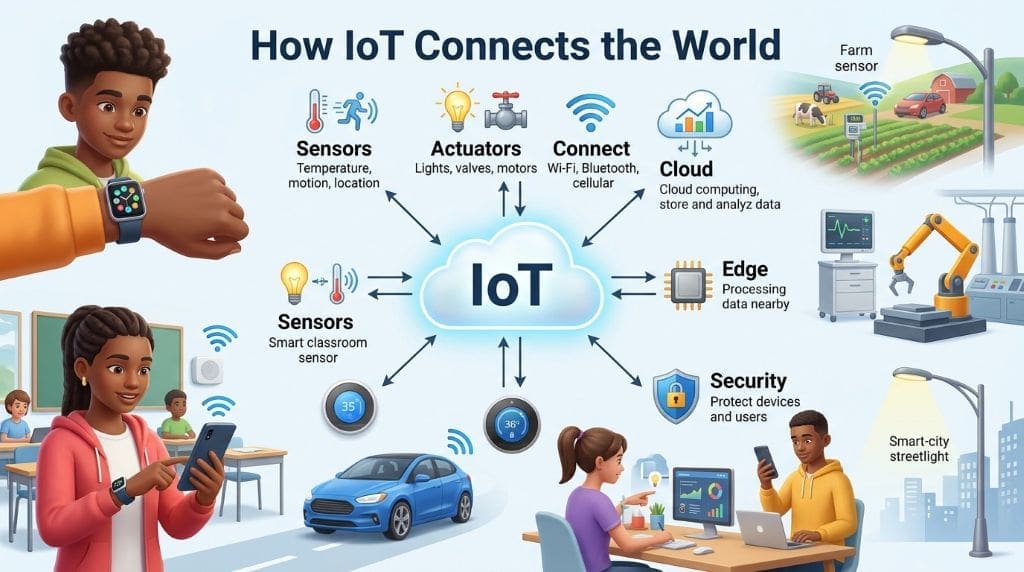
The Internet of Things (IoT) is a network of physical devices that collect, exchange, and act on data via the internet. First, to fully grasp how this technology works in practice, it is essential to understand how IoT devices connect. Specifically, these devices include sensors, appliances, vehicles, machines, and wearable technology. For instance, sensors measure conditions such as temperature, motion, pressure, or location, while actuators perform actions, such as opening valves or switching lights. In addition, connectivity links devices through Wi-Fi, Bluetooth, cellular networks, Ethernet, or low-power radio. To manage the data they produce, cloud computing services store and analyze large datasets remotely. Meanwhile, edge computing processes selected data close to the device. Furthermore, IoT platforms manage devices, data flows, rules, and dashboards. Crucially, data security protects identities, messages, devices, and users. Together, these parts create connected systems for homes, classrooms, farms, hospitals, factories, and cities.
Key Takeaways
- IoT devices sense conditions and share useful data.
- Networks carry messages between devices and services.
- Gateways connect local devices with wider networks.
- Cloud and edge computing support different workloads.
- Protocols define how devices exchange information.
- Security protects devices, data, and physical operations.
- IoT skills support many growing technical careers.
Students often meet IoT through familiar examples. A fitness band counts steps and sends results. A smart thermostat adjusts heating after sensing temperature. A factory sensor reports vibration before equipment fails. A connected irrigation system responds to soil moisture. Each example follows a similar pattern. A device senses something, communicates data, receives instructions, and acts. This pattern makes IoT useful for connected learning. Learners can observe physical systems, analyze data, and test decisions. They can also study programming, electronics, networking, statistics, ethics, and cybersecurity together.
What Does IoT Mean?
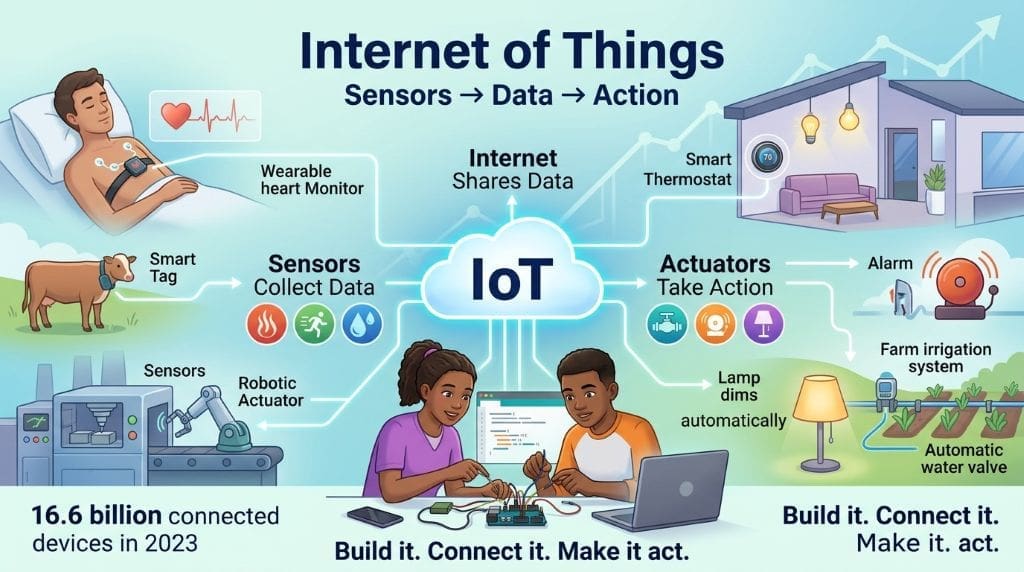
The phrase “Internet of Things” refers to physical objects with computing capabilities. These objects usually contain sensors, processors, software, and communication hardware. Some devices only collect and transmit information. Other devices also make decisions or control equipment. A connected door lock responds to commands via an application. It then activates a motor or locking mechanism.
Meanwhile, a soil sensor measures moisture inside a garden bed. Its system may trigger a water pump when conditions change. Therefore, IoT combines physical action with digital communication. This combination separates IoT from ordinary websites or standalone software.
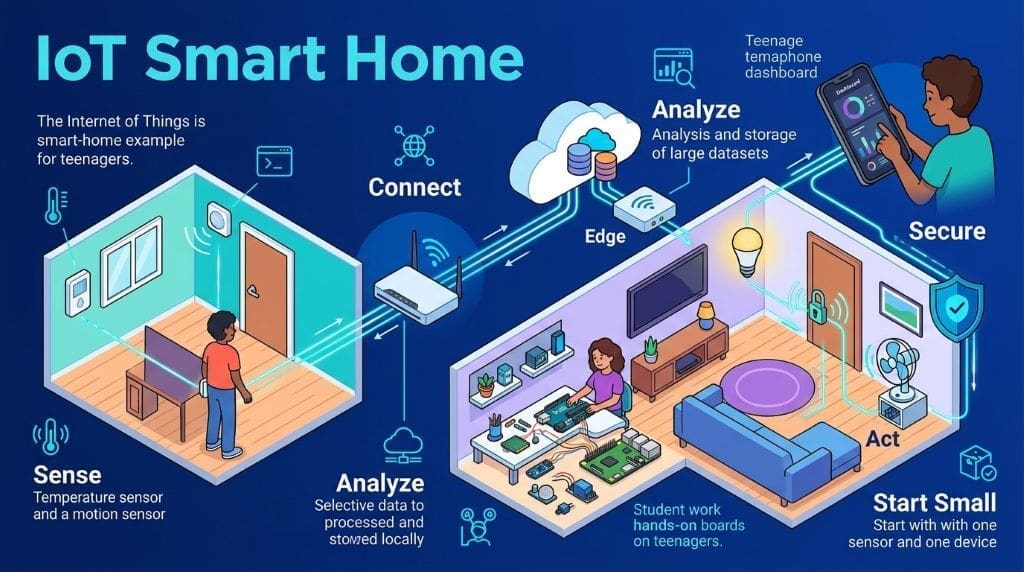
A typical IoT system contains several layers. The perception layer gathers information through sensors. The network layer carries that information between devices. The processing layer stores, filters, or analyses the data. The application layer presents results to users. Some models add a business layer for policies and decisions. These layers help students understand complex systems. They also reveal possible points of failure. A sensor may provide poor measurements. A network may lose packets. A cloud service may become unavailable. Good design considers every layer, rather than focusing only on applications.
How Do IoT Devices Connect?
In terms of connectivity, IoT devices connect through wired or wireless communication. Specifically, wired systems commonly use Ethernet, serial links, or industrial buses. Meanwhile, wireless systems use Wi-Fi, Bluetooth Low Energy, Zigbee, Thread, LoRaWAN, or cellular networks. Importantly, each method offers different speeds, ranges, energy use, and costs. For instance, Bluetooth suits nearby, low-power devices, whereas cellular networks support wide-area mobility. Similarly, Ethernet provides reliable connections inside many buildings, while LoRaWAN supports small messages across long distances. Therefore, students should compare trade-offs, not search for one perfect technology.
Connection usually begins with device discovery and authentication. A device identifies itself to a gateway or network. The network checks whether the device is trusted. Next, the device receives communication settings. These settings may include addresses, keys, topics, or service endpoints. Afterward, the device sends data according to an agreed protocol. It may use request-and-response communication. Alternatively, it may publish messages to a broker. The broker then delivers messages to subscribed applications. This process resembles postal delivery, but software handles routing automatically.
When it comes to data exchange, several protocols support IoT communication. First, MQTT uses a lightweight publish-and-subscribe model. Next, CoAP supports constrained devices and simple web-style messages. Additionally, HTTP remains common for cloud application programming interfaces, while WebSocket connections support ongoing, two-way communication. Beyond these, devices may also exchange data through industrial protocols. Consequently, protocol selection depends on device limits and system needs. For this reason, researchers often compare communication methods using reliability, delay, energy, and scalability. As a result, a useful student project measures these properties directly. Ultimately, that approach connects theory with observable evidence.
How Do IoT Devices Connect Through Gateways?
Many devices do not connect directly with cloud services. Instead, they communicate with a local gateway. The gateway collects messages from nearby devices. It may translate between incompatible protocols. It can also filter data before sending information elsewhere. For example, a home gateway may receive Zigbee messages. It then forwards selected information through Wi-Fi. Industrial gateways may connect sensors with factory networks. Gateways reduce device complexity and support local decision-making. They also create another security boundary requiring careful protection.
A gateway can improve performance in several ways. First, it can remove duplicate or irrelevant measurements. Second, it can combine readings from many sensors. Third, it can continue operating during temporary internet outages. Fourth, it can run local rules without cloud delays. These capabilities support edge intelligence. However, gateways need secure updates and strong authentication. A compromised gateway may affect many connected devices. Therefore, students should treat gateways as important computers. They are not merely cables with antennas.
What Are IoT, Industrial IoT, Consumer IoT, Edge Computing, and Cloud Computing?
- IoT: The Internet of Things connects physical devices that sense, communicate, process, or control data.
- Industrial IoT: Industrial IoT supports factories, logistics, energy networks, transport systems, and public infrastructure.
- Consumer IoT: Consumer IoT supports homes, wearables, vehicles, appliances, and personal devices.
- Edge Computing: Edge computing processes IoT data near where it is collected.
- Cloud Computing: Cloud computing stores and analyses IoT data using remote services.
These categories overlap in real projects. A connected vehicle may serve personal transportation and industrial logistics. A smart electricity meter may support consumers and energy operators. Edge computing may protect privacy before cloud storage. Cloud computing may compare readings across thousands of locations. Students should therefore view these terms as useful lenses. They describe system roles, rather than completely separate technologies.
What Happens When IoT Devices Communicate?
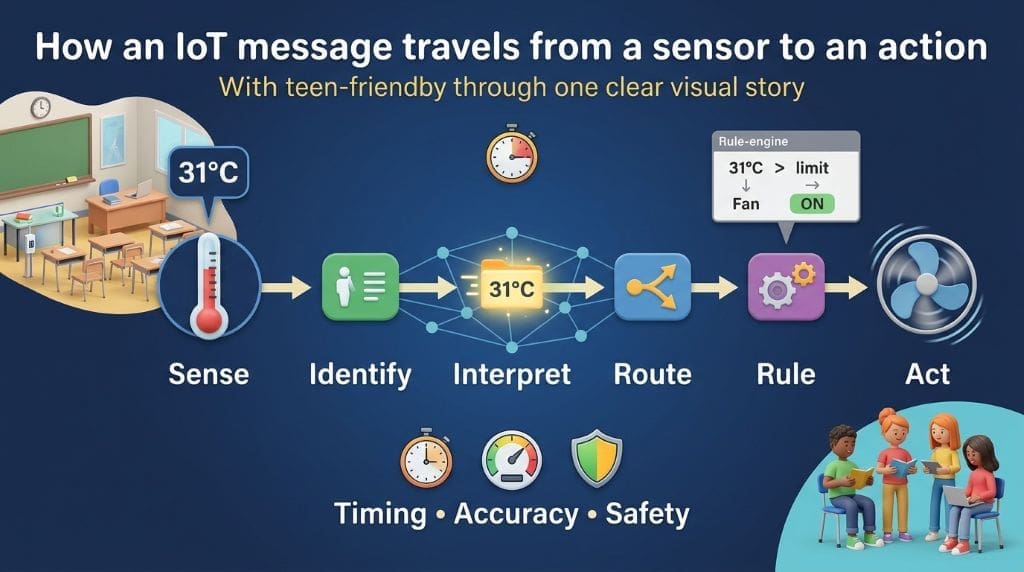
IoT communication involves more than sending a measurement. The system must identify the device and interpret its message. It must also decide where the message should go. Applications may store the reading, display it, or trigger an action. For instance, a temperature sensor may send 31 degrees Celsius. A rule engine may compare that value against a threshold. The system could then start a fan. Every stage introduces timing, accuracy, and safety requirements. These requirements make IoT a strong interdisciplinary learning area.
How IoT Devices Connect Using Sensors and Actuators
Sensors convert physical conditions into digital values; some produce analog signals that microcontrollers digitize, while others are digital. Actuators reverse this, transforming digital instructions into physical changes with devices like motors, relays, and pumps. Combined, sensors and actuators create feedback loops, which involve measuring the condition, comparing it to a target, choosing an action, and making a physical change. This cycle appears in thermostats, robots, and factories. For example, students can build a simple system that lights an LED when soil is dry, teaching sensing, control logic, and circuit safety.
Sensor data can contain errors or unusual values. Electronic noise may affect measurements. Poor placement may create misleading readings. Batteries may weaken during long experiments. Networks may also lose messages. Therefore, systems often validate and clean data. They may reject impossible values or calculate averages. They may also record timestamps and device identifiers. These steps support data quality. Without reliable measurements, advanced analytics can produce poor decisions.
In one classroom demonstration, I connected temperature sensors to microcontroller boards. Students predicted which sensor would respond fastest. They then compared readings after moving sensors between locations. The group noticed different results near sunlight and ventilation. Next, students inspected the code and wiring. They discovered one loose connection caused missing values. This observation changed their understanding of IoT. The system did not fail because of complicated software. It failed because of a simple physical issue. Such activities make systems thinking visible.
How IoT Devices Connect Through Data Protocols
Fundamentally, a communication protocol defines how devices format and exchange messages. In essence, it establishes rules for addressing, timing, structure, and error handling. Without shared rules, connected devices cannot communicate reliably. For instance, MQTT works well when small devices publish frequent messages. In this model, a broker receives those messages and forwards them. Meanwhile, CoAP supports constrained devices using compact web-like interactions. Similarly, HTTP provides familiar request-and-response communication. As a practical exercise, students can compare these protocols through small experiments. In particular, they can measure message size, delay, and energy use.
Beyond message formats, protocols also differ in their communication patterns. For example, in a device-to-cloud pattern, sensors contact remote services. Alternatively, in a device-to-gateway pattern, devices use local intermediaries. Furthermore, in a device-to-device pattern, nearby devices exchange information directly. Finally, in a publish-and-subscribe pattern, senders do not contact recipients directly. As a result, each pattern suits different system requirements. To illustrate, a smart light may use local control, whereas a weather station may upload readings periodically. Meanwhile, a factory may require immediate local responses. Consequently, choosing communication patterns requires engineering judgment.
First and foremost, messages need meaningful structure. For instance, a simple message might contain a device identifier. Additionally, it may include a value, a unit, a timestamp, and a status code. On one hand, JSON offers readable structures for many applications. On the other hand, binary formats reduce message size and processing demands. More importantly, good data design prevents confusion between units. Specifically, Celsius and Fahrenheit values should not appear without labels. Likewise, timestamps should include time zones or clear standards. Therefore, students should document message formats early. Ultimately, clear documentation supports team collaboration.
How IoT Devices Connect to Cloud and Edge Systems
Cloud platforms provide remote storage, computing, and management services. They can receive data from many locations. They also support dashboards, analytics, alerts, and machine learning. Cloud systems help organizations compare information across large deployments. However, cloud communication depends on network availability. It may also introduce delay or raise privacy concerns. Edge computing addresses some of these limitations. It processes selected data close to the source. This design can reduce bandwidth and response time.
Edge systems suit applications needing rapid responses. Industrial safety systems may not wait for distant servers. A traffic signal may process local sensor data immediately. A wearable device may analyze private signals locally. Cloud systems still provide valuable long-term analysis. They can compare patterns across months or locations. Therefore, many systems use a hybrid architecture. Edge devices handle urgent or sensitive tasks. Cloud services handle broader storage and analysis.
Students can model this difference with a simple project. A sensor sends readings to a local computer. The computer calculates an average every minute. It forwards only summaries to a cloud dashboard. Learners can compare network traffic before and after filtering. They can also temporarily disconnect the internet. The local system may continue making decisions. This exercise demonstrates resilience and architectural choices. It also introduces the idea of distributed computing.
Cloud services often provide device registries and software tools. A registry records approved devices and their identities. Device management tracks health, configuration, and updates. Rule engines create automated responses—dashboards present information for people. Data lakes store large collections for later analysis. These features support large IoT deployments. However, services differ in pricing and design. Students should understand concepts before choosing products. Vendor-neutral learning creates more flexible technical skills.
What Are the Main Uses and Risks of IoT?
Indeed, IoT applications appear in many sectors. For example, smart agriculture uses sensors for soil, weather, and irrigation. Similarly, healthcare systems may monitor equipment or patient conditions. In the same way, logistics systems track packages, vehicles, and storage temperatures. Meanwhile, buildings monitor energy use, occupancy, and air quality. Furthermore, manufacturing systems measure vibration, pressure, and production quality. Above all, these applications connect digital decisions with physical environments. Consequently, their value depends on accurate data and appropriate actions. In short, a connected device alone does not guarantee useful innovation.
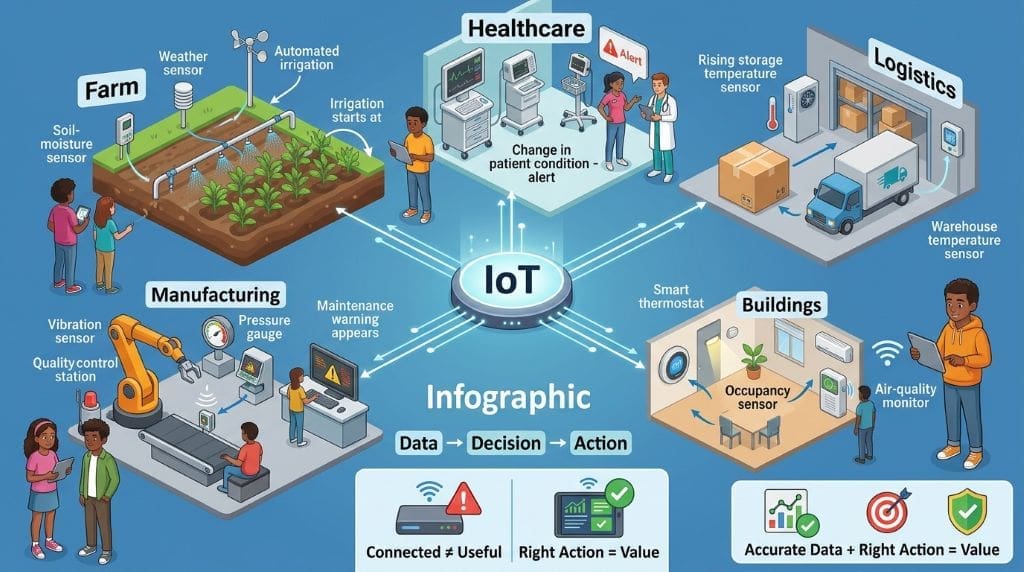
Education can leverage IoT for active learning. Students might construct environmental monitoring stations to measure classroom temperature and CO2 levels, analyze energy consumption via smart plugs, and create alerts for unusual data. They can also explore privacy issues related to occupancy sensors. Teachers integrate science with coding and math through these projects, which are enhanced when students explain their design decisions. Additionally, discussions should cover limitations, costs, and potential risks.
How IoT Devices Connect Safely
Device identity is essential to security because each IoT device must prove that it is trustworthy. Unique, strong credentials are safer than shared default passwords, while encryption protects data in transit and secure storage protects device keys. Access controls restrict actions to authorized users, and network segmentation limits damage if a device is compromised. Software updates are equally important because IoT devices may remain deployed for years and new vulnerabilities can emerge. Manufacturers should provide signed, verifiable updates, while operators should monitor device versions and update status. Students can safely study these practices using laboratory devices on a closed classroom network, but they must never scan or attack public systems. Together, these measures support defense in depth and responsible cybersecurity education.
Privacy requires careful data collection, so a system should collect only necessary information. Moreover, it should explain how data will be used, because people need meaningful choices where possible. For instance, location, health, voice, and behavior data can reveal sensitive details; similarly, even simple readings may identify routines. Therefore, data retention policies should define deletion periods. In addition, schools must also consider consent and student protection. Ultimately, good IoT design includes human expectations, not only technical functions.
Physical safety matters when devices control machinery. For example, a faulty command could open a gate or stop ventilation; therefore, systems need limits, fail-safe states, and manual overrides. In addition, critical applications require testing and monitoring. Furthermore, developers should separate convenience features from safety functions. Students can learn this principle through low-risk projects, because an LED or small fan provides a safer actuator. Moreover, classroom designs should avoid mains electricity and hazardous machinery. Ultimately, safety remains a core engineering responsibility.
How IoT Devices Connect in Responsible Projects
A responsible IoT project starts with a clear problem. Students should identify users, environments, and success measures. They should ask whether connectivity adds real value. A paper-based process may sometimes work better. Next, learners select sensors and communication methods. They should estimate power, range, cost, and maintenance needs. A prototype should test the riskiest assumption first. This approach prevents unnecessary complexity. It also develops practical decision-making.
Project documentation should include diagrams and test results. For instance, students can draw data flows from sensors to applications, and they can label networks, gateways, databases, and actuators. In addition, test tables should record conditions and observed results. Moreover, teams should note unexpected behavior honestly, and they should separate facts from assumptions. Consequently, teachers can assess both technical work and reasoning. Ultimately, clear documentation makes projects easier to improve, and it also resembles professional engineering practice.
Students seeking project ideas can review IoT project ideas from Entech Online. They can also explore electronics learning resources to support concepts. These resources should supplement structured lessons and safe testing. Learners must still check component ratings and privacy needs. A project copied without understanding offers limited learning. The strongest projects explain every connection and decision. They also show how the system handles failure.
A useful beginner project is to measure classroom air quality. The system can first record temperature and humidity. More advanced versions may add carbon dioxide sensing. Students can display readings on a local dashboard. They can compare readings near windows and doors. The project supports biology, physics, computing, and statistics. However, students should avoid making medical claims based on basic sensors. Measurements require calibration and careful interpretation. This activity demonstrates evidence-based design.
How Can Students Build IoT Skills and Careers?
IoT careers combine several technical areas. Employers may seek embedded programmers, network engineers, data analysts, and security specialists. Product teams also need designers, technicians, project managers, and policy experts. A single person rarely masters every IoT layer. Students should build broad foundations first. They can then specialize through projects and internships. Career planning should focus on demonstrated abilities. A working portfolio often communicates skills effectively.

How IoT Devices Connect in Student Projects
Students can begin with electronics fundamentals. They should learn voltage, current, resistance, and safe wiring. Microcontrollers introduce programming and input-output control. Networking lessons explain addresses, protocols, and latency. Database exercises teach storage and querying. Data analysis reveals patterns and unusual readings. Security lessons explain authentication and encryption. This sequence develops a layered understanding.
To begin with, a strong portfolio project includes a clear problem statement. In addition, it should show a system diagram and component list. Next, the student should explain communication choices. Moreover, test results should include failures and improvements. For visual evidence, screenshots can demonstrate dashboards or alerts. Similarly, code should contain comments and a readable structure. As a final touch, a short video may show the physical prototype. All in all, these details help reviewers understand the actual contribution.
Students should also work on their communication skills. IoT projects involve hardware, software, users, and operations. Engineers need to clearly explain technical limitations. They might write reports for non-technical decision-makers or present risks to managers or teachers. Additionally, they may negotiate requirements with customers. As deployments grow larger, teamwork becomes more crucial. Effective communication ensures responsible implementation.
Career changers can use small projects strategically. They do not need expensive equipment at first. A low-cost microcontroller and basic sensors can teach core ideas. Simulation tools can further reduce hardware costs. Learners can publish diagrams, code, and test notes. They can connect projects with previous professional experience. For example, a logistics worker may study asset tracking. A teacher may design environmental monitoring lessons. Relevant evidence can make career transitions more credible.
How IoT Devices Connect to Future Work
IoT work increasingly overlaps with artificial intelligence. Machine learning can identify unusual sensor patterns. It can help predict maintenance needs. However, models depend on accurate and representative data. They also require monitoring after deployment. The 2026 AI Index Report from Stanford HAI provides a statistical foundation for discussing broader AI progress. It should not be treated as an IoT device count. In IoT, AI remains one tool within a larger system. Engineers still need knowledge of sensing, networking, safety, and security.
Industry estimates show continuing growth in connected devices. IoT Analytics reported approximately 18.5 billion connected IoT devices worldwide during 2024. Such estimates vary by definition and counting method. Some reports include computers or consumer electronics. Others count only purpose-built connected devices. Students should therefore inspect methodologies before citing numbers. The wider evidence still indicates growing system complexity. This creates demand for cross-disciplinary skills.
Future IoT roles may include edge engineer and device-security analyst. Other roles include digital-twin developer and industrial data engineer. Sustainability specialists may optimize energy and hardware lifecycles. Standards experts may support interoperability across vendors. Policy professionals may address privacy and public procurement. Educators may create IoT programs for schools and colleges. These roles require technical knowledge and social awareness. Career opportunities extend beyond writing device code.
How Was This IoT Guide Compiled?
This guide was compiled through a structured review of peer-reviewed IoT studies. The supplied research covers architectures, communication, energy, security, and applications. The review also compared beginner explanations with engineering terminology. Priority went to open-access research and standards-oriented sources. Claims were simplified without removing important limitations. Technical examples were checked against established IoT patterns. The methodology emphasizes explanation, evidence, and safe practice.
The 2026 AI Index Report from Stanford HAI serves only as a statistical foundation. It supports discussion about artificial intelligence within IoT systems. It does not provide the main evidence for IoT adoption. The primary statistical context comes from IoT Analytics’ open industry reporting. That report estimated there would be 18.5 billion connected IoT devices in 2024. Estimates depend on category definitions and collection methods. Readers should treat market totals as informed estimates, not exact censuses.
Peer-reviewed research also shaped the article’s technical explanations. Al-Fuqaha and colleagues discussed IoT enabling technologies and protocols (2015). Gubbi and colleagues described IoT architecture and applications (2013). Sicari and colleagues examined security, privacy, and trust (2015). Other reviewed studies addressed energy, fog computing, and smart systems. These sources support the article’s layered teaching sequence. They also reinforce the importance of security and interoperability.
The classroom observation reflects a practical demonstration of teaching. Students compared temperature sensors under different conditions. They inspected wiring after finding missing readings. The activity showed how physical faults affect digital systems. It also encouraged prediction, measurement, and explanation. This approach reflects experiential learning principles. Educators can adapt it using safe, low-voltage equipment. They should clearly distinguish measured results from assumptions.
Frequently Asked Questions About IoT Connections
IoT devices connect through Wi-Fi, cellular networks, or gateways that link them to internet services. Communication protocols organize messages, while authentication verifies identity and encryption protects data. Network selection depends on the application’s power, range, speed, and cost requirements.
Some IoT devices operate without constant internet access by using local networks, edge processing, and temporary data storage. However, remote dashboards, cloud backups, and alerts require wider connectivity. Designers should identify which functions need remote services, while local control improves resilience during outages.
The internet connects networks for digital communication, while IoT links physical devices, sensors, and actuators to digital systems. IoT can use the internet or local networks to monitor and control real-world conditions, so the two concepts work together but remain distinct.
IoT combines many subjects, but beginners can start with one sensor and output, then add networking, cloud storage, and security. Simple projects, good documentation, patience, and structured testing build confidence without expensive equipment.
C and C++ are widely used for microcontrollers, while Python supports learning, automation, and data analysis. JavaScript is useful for dashboards and web services, SQL helps query sensor data, and Bash assists with Linux-based edge devices. The best language depends on the platform, but students should focus on programming principles because problem-solving skills transfer across languages.
IoT devices can expose private data or control equipment, especially when they use weak passwords, outdated software, or poor encryption. A compromised device may also attack other systems. Security reduces these risks through layered controls, secure design, regular updates, and clear privacy practices.
Conclusion
Understanding how IoT devices connect begins with simple questions. What does the device measure? Which network carries its message? Where does processing happen? What action follows the result? How does the system protect people and data? These questions guide students from basic electronics toward advanced engineering. IoT learning becomes stronger when students test real systems. It also improves when they record failures honestly. The Internet of Things offers practical lessons across science, computing, design, and society. With careful practice, learners can build useful and responsible connected systems
Verified Resources
- Al-Fuqaha, A., Guizani, M., Mohammadi, M., Aledhari, M., & Ayyash, M. (2015). Internet of Things: A survey on enabling technologies, protocols, and applications. IEEE Communications Surveys & Tutorials, 17(4), 2347–2376. https://doi.org/10.1109/COMST.2015.2444095
- Stanford Institute for Human-Centered Artificial Intelligence. (2026). AI Index Report 2026. Stanford University. https://hai.stanford.edu/ai-index
- National Institute of Standards and Technology. (2020). IoT device cybersecurity capability core baseline. U.S. Department of Commerce. https://doi.org/10.6028/NIST.IR.8259A
