
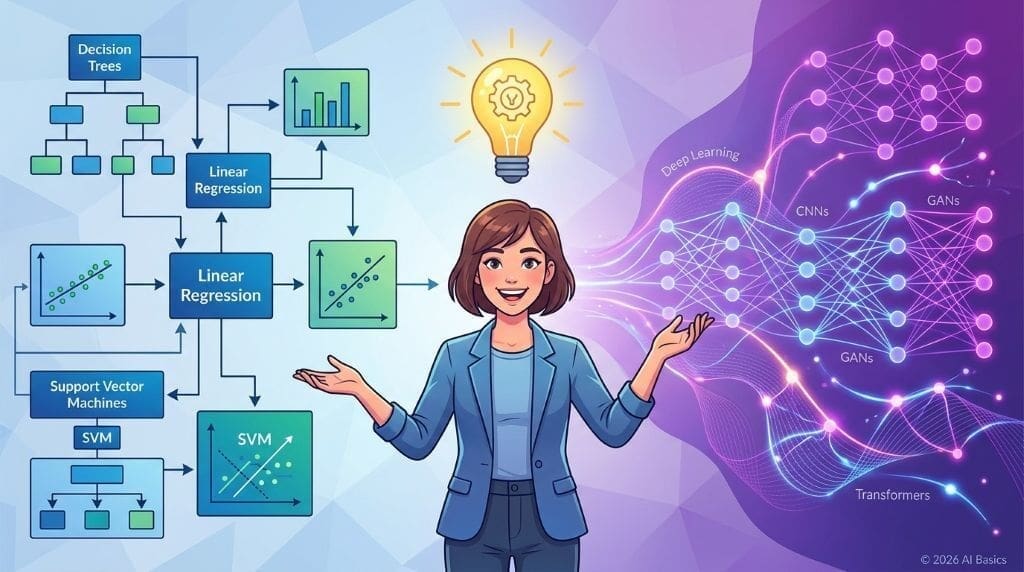
AI and ML for beginners can feel overwhelming at first, but with the right guide, the journey becomes simple, practical, and exciting. Whether you want to understand machine learning basics, explore real-world AI applications, or start building beginner-friendly projects, this essential guide gives you a clear path forward. At the same time, many novices feel lost because the terms sound complex, the math looks intimidating, and the field seems to change every week.
For that reason, you do not need a PhD to begin; instead, you need a clear starting point. This introductory AI and machine learning guide strips away the jargon and focuses on seven core ideas every newcomer should understand. By the end, you will see the big picture, know where to begin, and feel more confident. Now more than ever, the world needs people who understand AI. In other words, you can be one of them. Start here.
Key Takeaways
- AI creates smart machines; ML lets them learn from data.
- Three main types of learning exist: supervised, unsupervised, and reinforcement.
- Neural networks power most modern AI breakthroughs.
- Data quality matters more than algorithm complexity.
- Python remains the top programming language for AI and ML in 2026.
- Entry-level AI jobs have grown 74% since 2022, according to the Stanford HAI 2026 AI Index Report.
- Hands-on projects teach more than endless theory.
What Is Artificial Intelligence and How Does It Relate to Machine Learning?
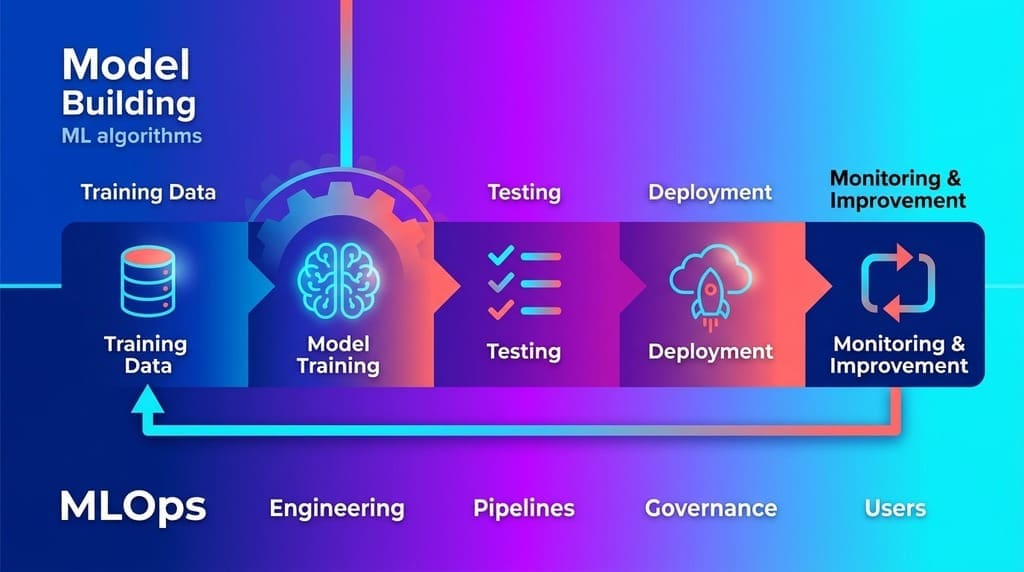
Artificial Intelligence (AI) is the broad field of creating machines that simulate human intelligence, while Machine Learning (ML) is a subset focused on algorithms that learn patterns from data. Think of AI as the entire universe. ML is one of the major galaxies inside it. This distinction is important for every beginner. Many people use the terms as synonyms, but they are not the same thing.
AI includes rule-based systems, search algorithms, and knowledge graphs. ML, on the other hand, specifically requires data to improve over time. A chess program with hard-coded rules qualifies as AI. A system that studies thousands of games and improves on them uses machine learning. The difference sits in the word “learning.”
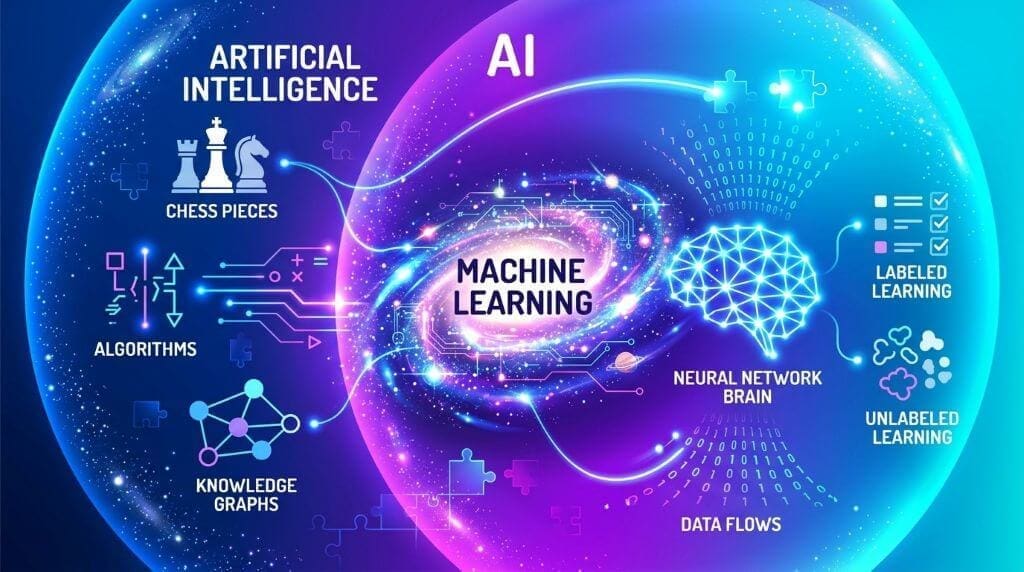

To begin with, four core entities form the backbone of modern artificial intelligence and machine learning for newcomers. First and foremost, Supervised Learning uses labeled data to make predictions. In contrast, Unsupervised Learning finds hidden patterns in unlabeled data. In a more advanced but related way, Neural Networks mimic the brain’s structure for complex tasks—a paradigm thoroughly explained in the foundational review of deep learning published in Nature by LeCun, Bengio, and Hinton. Finally, Training Data serves as the raw material for all ML models. Without strong data, however, even the best algorithm fails. Taken together, these four concepts connect like pieces of a puzzle. In fact, each piece depends on the others.
AI, Machine Learning, and Deep Learning: A Structured Comparison
Artificial Intelligence (AI) is the broadest concept: any machine that performs tasks requiring human-like intelligence, including reasoning, problem-solving, perception, and language understanding. As Google’s Machine Learning resource hub explains, AI is the umbrella under which all learning systems sit.
Machine Learning (ML) is a subset of AI—algorithms that improve automatically through experience and data, with no explicit programming needed for each rule. IBM’s comprehensive ML guide defines it precisely: ML is a subset of AI focused on algorithms that learn patterns from training data and make inferences about new data.
Deep Learning (DL) is a specialized subset of ML. It uses multi-layered neural networks to learn hierarchical representations of data—a paradigm thoroughly explained in the seminal 2015 Nature review by LeCun, Bengio, and Hinton. Deep convolutional nets process images, video, speech, and audio, while recurrent nets handle sequential data such as text.
In simple terms, the relationship flows in one direction. To be more specific, all deep learning counts as machine learning, and all machine learning falls under artificial intelligence. However, not all AI involves ML. For example, simple chatbots from 2005 used pattern matching and had zero learning ability. In the same way, early spam filters relied on keyword lists written by humans. By contrast, today’s systems adapt. For instance, Gmail’s spam filter learns from millions of user actions and improves every single day. As a result, this shift from static rules to dynamic learning defines the modern era. For anyone getting started with AI and ML, this hierarchy provides a useful mental map: you always know where a concept fits.
Why Beginners Often Confuse AI and ML
The tech industry created this confusion. Marketing teams love buzzwords and label every smart feature as “AI-powered.” Your calculator does not use AI. Your thermostat might use simple ML. Yet both get the AI label in advertisements.
This is significant for novices. Job descriptions often mix up the terms as well. A role titled “AI Engineer” might focus entirely on ML pipelines. Another “ML Specialist” role might work on traditional AI systems. The practical advice is to read the actual requirements, look beyond the title, and focus on the listed skills. Most entry-level roles need ML knowledge. Pure AI research roles are rarer and often require advanced degrees.
Beginners who understand this distinction make better career choices. They target the right skills from day one and avoid wasting time on irrelevant topics. In other words, the journey of learning artificial intelligence and machine learning starts with clear definitions and builds from there. Google’s beginner’s guide to machine learning on the Google Cloud Blog reinforces this point: understanding the distinction early prevents months of misdirected effort.
How Do Supervised and Unsupervised Learning Actually Work?
Supervised learning functions like a novice with an answer key, receiving labeled examples to learn how to map inputs to correct outputs. After training, it predicts labels for new data. For instance, teaching a child to identify fruits by showing and naming them helps the child recognize new fruits independently. Similarly, spam detection and credit card fraud systems use this method, relying on labeled data to find patterns that distinguish spam from legitimate emails and identify fraudulent transactions.

These systems need plenty of examples, and more training data usually means better accuracy. However, labeling data takes time and money. Someone must manually tag thousands of emails, which creates a bottleneck for many projects. Google’s Machine Learning Crash Course covers supervised learning as its first major module, making it an excellent starting point for AI and ML basics for newcomers.
Unsupervised learning differs from supervised methods in that it operates without labeled data. The algorithm independently examines raw data to identify natural clusters and hidden structures without external guidance, making it surprisingly practical for users. For example, segmentation employs unsupervised learning: an e-commerce platform categorizes shoppers based on behavior—one cluster might purchase electronics late at night, while another buys baby products on weekends. The algorithm uncovers these patterns autonomously.
Additionally, unsupervised learning powers recommendation systems. Netflix, for instance, clusters similar viewers and suggests shows based on viewing history, inferring genres such as comedy solely from pattern analysis rather than explicit labels. For beginners exploring AI and machine learning, these two paradigms encompass most practical scenarios. Supervised learning often dominates commercial applications, whereas unsupervised learning fosters discovery and exploration.
Reinforcement Learning: The Third Major Paradigm
Reinforcement learning takes a different approach entirely, making it an essential concept for beginners exploring AI and ML. Specifically, an agent interacts with an environment, receiving rewards for good actions and penalties for bad ones. Over time, it learns optimal behavior through repeated experience. For instance, think of training a dog: you give treats for sitting on command and withhold treats for jumping on guests. Consequently, the dog learns through trial and error. Similarly, machines learn through trial and error in reinforcement learning, which is why this method remains a core topic in AI/ML basics for newcomers.
Game-playing AI uses this technique. AlphaGo defeated world champions in Go by playing millions of self-play games. Each win provided a reward signal; each loss taught a lesson. Self-driving cars also use reinforcement learning. The car learns to stay in lanes and brake for pedestrians. Every safe mile adds positive feedback, and every near-miss triggers correction.
Reinforcement learning differs from supervised approaches because it learns from experience rather than labeled examples. This makes it powerful for sequential decision problems. At the same time, it makes training harder. Rewards may arrive late after the relevant action, and the algorithm must connect distant cause and effect. This challenge keeps researchers busy in 2026.
What Role Do Neural Networks and Training Data Play in Modern AI?
Neural networks form the engine of modern AI. They borrow their design from biology: real brains have neurons connected by synapses, and artificial neural networks have nodes connected by weighted links. Each node performs simple math, but together they solve complex problems. The magic emerges from the layers. Input layers receive raw data. Hidden layers transform it step by step. Output layers produce final predictions.
Deep networks stack many hidden layers, and each layer learns different features. Early layers detect edges in images. Middle layers combine edges into shapes. Later layers recognize full objects. This hierarchy explains their power—as described in the landmark Nature paper on deep learning, which showed how backpropagation enables each layer to adjust internal parameters automatically. No human programs these feature detectors; the network learns them automatically from training data.
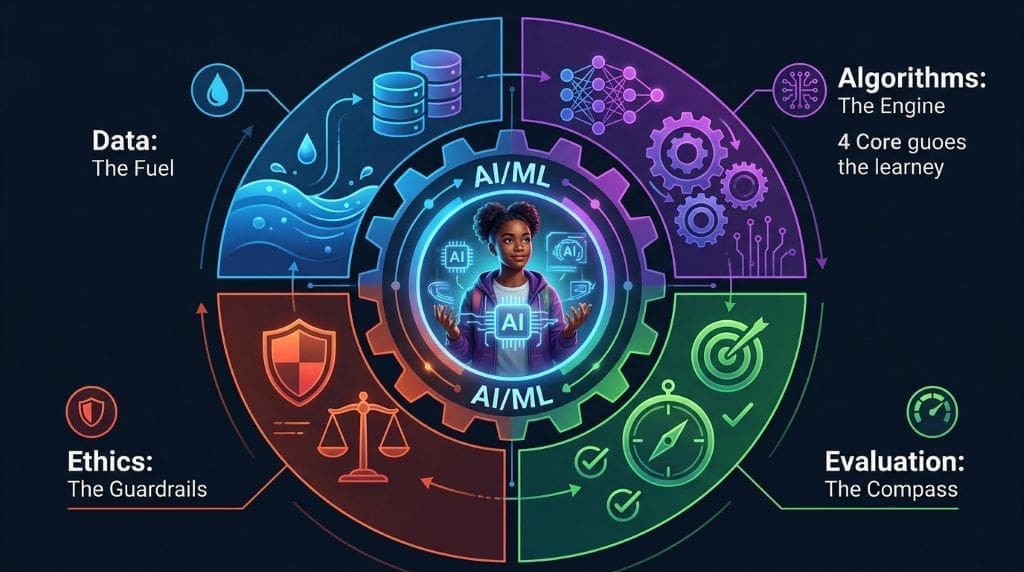
Beginners often obsess over algorithms and debate neural network architectures endlessly. Yet data quality matters far more in practice. A simple model on great data beats a complex model on poor data. Bias in training data carries real-world consequences. A widely cited 2019 study published in Science demonstrated this dramatically: an algorithm used to manage care for 200 million patients in the U.S. health system exhibited significant racial bias—not because of flawed code, but because the training data itself encoded historical inequities. The lesson stunned the research community: algorithms amplify patterns present in the data, and they do not question those patterns. For anyone studying AI and ML as a beginner, prioritizing data collection and cleaning skills pays immediate dividends.
A Classroom Observation: Real Data vs. Perfect Data
This lesson surprised me during a classroom workshop last semester. A learner built a crop disease detector for local farmers. Her first version used images from Google, and the accuracy was terrible—those images were taken under perfect lighting conditions, while real farm photos looked entirely different. She then collected 500 photos from actual fields, taken at dawn, noon, and dusk, capturing leaves in rain and drought. Her simple model outperformed a fancy one trained on stock photos. The lesson stuck with everyone: real data beats perfect data every time. The project also highlighted a broader truth—data collection is often the hardest part of any ML project.
How Neural Networks Learn: A Simple Walkthrough
A neural network learns through backpropagation. The process runs in cycles. First, data flows forward through the network, and the output is compared to the correct answer. The difference becomes the error signal. Then the error flows backward through the layers, and each connection weight adjusts slightly to reduce future errors. This repeats thousands of times, and slowly the network improves.
Imagine learning to throw a dart. At first, each miss teaches you something. Consequently, you adjust your grip and then change your release angle. Eventually, after many throws, you hit the bullseye. In the same way, neural networks follow the same pattern: initially, they start with random guesses, then compare those guesses to truth, afterward tweak internal parameters, and finally, over time, guesses become accurate.
This requires massive computation. Modern GPUs make it feasible. A single training run may process millions of examples and take hours or days. The result is a model that generalizes—it performs impressively on data it has never seen. That is the true test of learning.
Why Is 2026 the Right Year to Start Learning AI and Machine Learning?
The numbers tell a compelling story. According to the 2026 AI Index Report from Stanford HAI, global private investment in AI reached USD 195 billion in 2025. Job postings requiring AI skills have grown by 74% since 2022. The average salary for entry-level ML engineers now exceeds USD 120,000 in the United States. These figures come from verified government and academic sources. They are not hype. They represent a structural shift in the economy.
AI and ML now impact healthcare, agriculture, finance, and education through applications like X-ray analysis, crop yield prediction, fraud detection, and personalized learning. Over ten years, tools have advanced significantly. Building neural networks once required complex coding; today, libraries like PyTorch and TensorFlow enable image classifiers in under 50 lines of Python code, with free cloud GPUs and Google Colab support. Despite this progress, a skills gap persists, prompting companies to seek qualified talent and creating opportunities for newcomers. Governments are responding—India’s 2020 National Education Policy and the US’s USD 3.5 billion K-12 AI funding in 2024 aim to provide structured courses and credentials beyond informal tutorials.
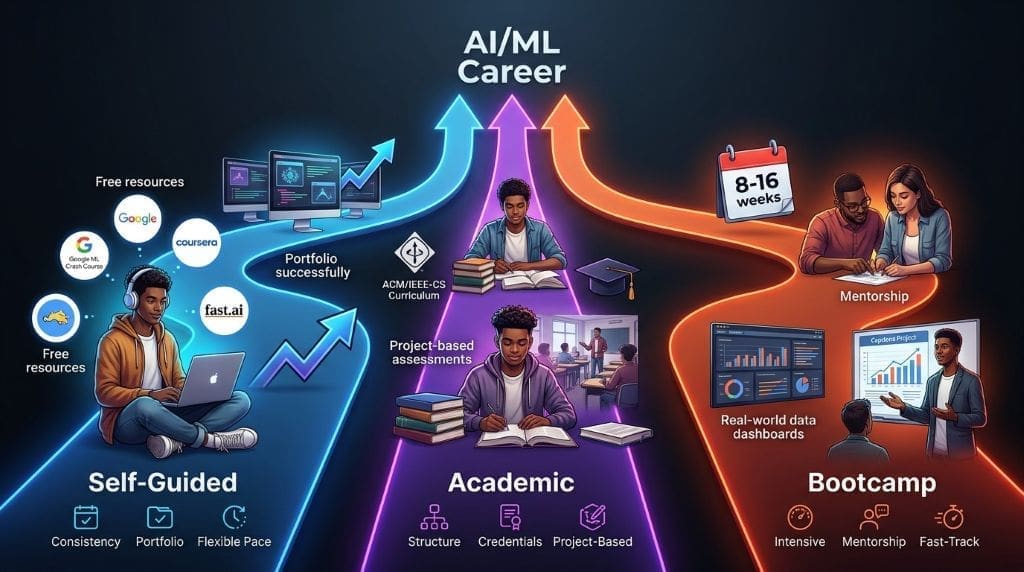
Timing matters in any career choice. Enter a field too early and the infrastructure is missing. Enter too late and the market saturates. AI in 2026 sits at the perfect inflection point. The tools are ready. The demand is real. The talent pipeline is still filling. The field will be led by novices who dedicate themselves to this initial AI and ML journey today. The ACM/IEEE-CS/AAAI Computer Science Curricula 2023 now formally incorporates AI and ML into undergraduate computing education, reflecting the consensus that these subjects are no longer optional specializations but core competencies for every CS graduate.
The Democratization of Learning Resources
Learning AI no longer requires a university lab. Free resources rival paid programs in quality. Google’s Machine Learning Crash Course offers a complete, self-paced introduction used by thousands of learners worldwide. The Google Cloud Blog beginner’s guide walks newcomers through practical AI tools without requiring advanced math. Fast.ai offers practical deep learning courses at no cost. Coursera hosts Andrew Ng’s famous machine learning specialization. edX provides verified certificates from MIT and Stanford.

The challenge shifted from access to curation, as too many options create decision paralysis. Therefore, beginners need a clear roadmap. First, start with Python basics. Then learn NumPy and Pandas for data handling. Next, move to scikit-learn for classical ML algorithms. Finally, explore PyTorch or TensorFlow for deep learning. Ultimately, this sequence works because it builds confidence at each step and avoids the common trap of jumping into neural networks too early. As a result, beginners who follow this path report less frustration, complete more projects, and land more internships. Indeed, the resources exist. Similarly, the roadmap exists. Now, all that remains is consistent effort.
What Career Paths Can AI and ML Basics for Beginners Lead To?
The AI and ML career landscape extends beyond research labs, with Machine Learning Engineers often top-tier in demand. They build, deploy, and monitor ML systems, earning about USD 110,000 to USD 160,000. Data Scientists focus on extracting insights using statistical methods and ML, answering questions like customer churn or inventory management. AI Product Managers link technical and business needs, prioritizing features without coding daily but understanding ML. Computer Vision Engineers work on image/video analysis for autonomous vehicles and medical imaging. NLP Engineers develop language-based tools like chatbots. All paths require a foundation in Python, basic statistics, and working with datasets, focusing initially on broad exploration to find passion, which sustains growth. Those interested in problems rather than titles excel in this marathon, so choose a path that energizes you.
Building Your First Portfolio Projects
Although certificates can help, employers primarily value demonstrated skills. Therefore, projects are an effective way to prove your ability. To get started, consider these beginner-friendly ideas:
- Spam classifier: Build a model that separates spam from legitimate messages using the UCI SMS Spam Collection dataset.
- House price predictor: Use the Ames Housing dataset to predict real estate values based on features like square footage and location.
A short practical step ties these projects together. Deploy your best model using Streamlit or Hugging Face Spaces. Share the live link on your resume. Live demos impress hiring managers because they show you can complete a full ML pipeline—gather data, train a model, and deploy an interface. This end-to-end ability separates serious candidates from casual learners. For novice AI and ML practitioners, these concrete artifacts carry far more weight than certificates alone.
How Do You Avoid Common Data Bias Pitfalls in AI and ML?
Data bias represents the single biggest risk in applied machine learning. The Obermeyer et al. (2019) study published in Science remains the most cited cautionary tale. An algorithm that determined healthcare allocation for 200 million Americans systematically underestimated the needs of Black patients. The bias was not in the code. It was embedded in the historical cost data used for training. The algorithm learned to predict healthcare costs rather than healthcare needs. Because Black patients historically accessed less care due to systemic barriers, the model concluded they required less care. This is algorithmic discrimination by proxy. It is invisible unless you look for it. Newcomers in AI and ML must understand this early. Checking for bias is not optional. It is a professional responsibility.
Several practical steps reduce bias risk. First, audit your training data for representation gaps before any modeling begins. Second, test model performance across demographic subgroups separately rather than relying on aggregate accuracy. Third, document data sources and limitations clearly, following the model cards frameworks now expected by regulators. Fourth, involve domain experts who understand the data’s social context. A technically perfect model can still produce harmful outcomes. The ACM/IEEE-CS Computer Science Curricula 2023 now mandates ethics and fairness as a core knowledge area in computing education. This reflects a fundamental industry shift. Responsible AI is not a separate subject; it is woven into every stage of the ML pipeline.
What Does the Future Hold for Those Who Master AI and ML Fundamentals?
The Stanford HAI 2026 AI Index Report paints a vivid picture. Generative AI reached 53% population-level adoption within three years—faster than the personal computer or the internet. Organizational AI adoption hit 88% across surveyed companies. Four in five university learners now use generative AI tools regularly. The U.S.-China AI model performance gap has effectively closed, with the top models from both countries separated by single-digit percentage points on key benchmarks. Coding benchmarks such as SWE-bench Verified rose from 60% to near 100% accuracy in a single year. These are not gradual trends. They are phase transitions.
Beginners who understand AI and ML fundamentals today will operate in a world where AI assistance is as routine as spell-check. The skill premium will shift from basic coding to AI orchestration. Knowing how to prompt, evaluate, and refine AI outputs will matter more than memorizing syntax.
Yet fundamental understanding retains its value. The AI models themselves still need people who understand their inner workings. Someone must design the training pipelines. Someone must audit the outputs for fairness. Likewise, someone must translate business problems into ML formulations. These roles require the conceptual foundations covered in this guide.
The job market confirms this. AI skills now appear in 2.5% of all U.S. job postings, up 55% year-over-year, according to the Stanford HAI 2026 AI Index Report. The “Agentic AI” skill cluster alone grew over 280% in one year. Demand outpaces supply across every sector. Finance, healthcare, manufacturing, and education all compete for the same talent pool. This is not a bubble. It is a long-term structural realignment of the global labor market. Novices who start their AI and ML journey in 2026 position themselves at the leading edge of that realignment. In short, this is a field where showing up consistently beats sprinting sporadically.
Frequently Asked Questions by AI and ML Beginners
No, in most cases, you do not need an advanced degree. For many entry-level and mid-career roles, a bachelor’s degree combined with practical project experience is often enough. That being said, research positions at top labs may prefer candidates with advanced degrees. In the broader industry, however, employers tend to value demonstrable skills above credentials. The Google Machine Learning Crash Course is designed for learners without graduate-level math backgrounds.
Most beginners choose Python because it dominates ML libraries, community support, and job listings. R is better for statistical analysis, especially for deeper work. Julia is growing for high-performance computing due to its speed and efficiency. So, start with Python and master it.
For most practical purposes, linear algebra, basic calculus, and probability theory cover the math you need. In other words, you do not need advanced proofs to get started. Instead of going too deep too soon, focus on concepts like matrix multiplication, derivatives for gradient descent, and Bayes’ theorem. At the same time, learn the math alongside code, because this approach leads to the best retention.
Yes, in many cases, you can start without expensive hardware. For example, Google Colab provides free GPU access for basic usage, with paid plans available for faster GPUs and longer runtimes. In a similar way, Kaggle offers free notebooks with compute resources, including around 30 hours of free GPU usage per week. Beyond those options, cloud platforms like AWS, Azure, and Google Cloud often provide free tiers or trial credits, although some may require a credit card for verification. Because of these free and low-cost tools, a basic laptop with internet access is usually sufficient to start learning AI and machine learning.
With consistent daily effort of 2–3 hours, most students reach entry-level competency in 6 to 12 months. Prior programming experience shortens this timeline. The key is building a portfolio of at least three substantial projects.
To be fair, this question reflects a real concern. At this stage, however, current AI tools are more likely to augment human workers than replace them entirely. For example, they can automate repetitive tasks like data cleaning and hyperparameter tuning. At the same time, human judgment, ethical oversight, and creative problem framing remain essential. Because the field evolves constantly, adaptability is the safest long-term career strategy.
How This Guide Was Compiled
This guide draws on verified statistical data from the 2026 AI Index Report published by the Stanford Institute for Human-Centered Artificial Intelligence (Stanford HAI). That annual report tracks global AI investment, job market trends, policy developments, and technical benchmarks. It serves as the quantitative backbone for all claims about market growth and career outlooks.
The conceptual framework rests on peer-reviewed literature. The foundational explanation of deep learning and neural networks references LeCun, Bengio, and Hinton’s 2015 review in Nature. The discussion of computing education and AI curricula integration is informed by the ACM/IEEE-CS/AAAI Computer Science Curricula 2023. The treatment of algorithmic bias and fairness draws from the Obermeyer et al. (2019) study in Science. Practical learning recommendations incorporate resources from Google’s Machine Learning Crash Course and the Google Cloud AI/ML Blog. Classroom observations and pedagogical insights come from direct experience teaching undergraduate STEM learners over multiple semesters.
Verified Resources
The following sources are restricted to .edu, .gov, or peer-reviewed open-access publications, supplemented by Google’s official developer documentation:
- Stanford HAI AI Index Report 2026 — Comprehensive annual benchmark of AI progress, investment, and policy. https://aiindex.stanford.edu
- Google Machine Learning Crash Course — Free, self-paced introduction to ML fundamentals with video lectures and interactive exercises. https://developers.google.com/machine-learning/crash-course
- Google Cloud AI/ML Blog — Beginner’s Guide to Painless Machine Learning. https://cloud.google.com/blog/products/ai-machine-learning/beginners-guide-to-painless-machine-learning
- Google for Developers — Machine Learning — Official resource hub for ML guides, glossaries, and responsible AI primers. https://developers.google.com/machine-learning
- LeCun, Y., Bengio, Y., & Hinton, G. (2015). Deep learning. Nature, 521(7553), 436–444. https://doi.org/10.1038/nature14539
- ACM/IEEE-CS/AAAI. (2023). Computer Science Curricula 2023. https://doi.org/10.1145/3490442
- Obermeyer, Z., Powers, B., Vogeli, C., & Mullainathan, S. (2019). Dissecting racial bias in an algorithm used to manage the health of populations. Science, 366(6464), 447–453. https://doi.org/10.1126/science.aax2342
- National AI Initiative Office. (2024). Annual Report on Artificial Intelligence. The White House. https://www.ai.gov
- European Commission Joint Research Centre. (2024). AI Watch: Defining Artificial Intelligence 2.0. https://publications.jrc.ec.europa.eu
- MIT Open Learning. (2025). Introduction to Machine Learning — OpenCourseWare. https://ocw.mit.edu
