

Artificial Intelligence (AI) encompasses the creation of machines that mimic human intelligence, while Machine Learning (ML) is a subset focused on algorithms that identify patterns in data. Neural Networks are a key method within ML, learning from Training Data, adjusting weights, and enhancing prediction accuracy. Students initially encounter Supervised Learning, which uses labeled data like “cat” or “dog.” Subsequently, they explore Unsupervised Learning, which identifies groups without predefined labels. Neural Networks connect these concepts through layered structures, where each layer transforms data into meaningful patterns. This process underpins speech recognition, image applications, search engines, and chatbots. LeCun, Bengio, and Hinton note that deep learning models employ many layers to derive representations from data. Overall, understanding neural networks enables students to grasp modern AI’s workings and assess its limitations thoughtfully.
Key Takeaways
- Neural Networks learn patterns from data.
- CNNs work well with images.
- RNNs handle sequences and time patterns.
- Transformers power many modern AI tools.
- Training Data strongly affects model behavior.
- Bias can enter through data and goals.
- Responsible AI skills support future careers.
What are neural networks in AI and Machine Learning?
Neural Networks are computing systems inspired by the interconnectedness of brain cells. They do not copy the brain exactly. Instead, they use simple math units called neurons. Each neuron receives inputs, applies weights, adds a bias, and sends an output. The network improves by changing these weights during training. This is central to deep learning.In Machine Learning, a model learns patterns from examples. Supervised Learning includes correct answers; Unsupervised finds hidden structure. Neural Networks can support both methods. The article on neuroscience and AI provides broader context on machine intelligence. However, students should treat the brain comparison carefully. Neural Networks are mathematical systems. They learn statistical relationships. They do not understand like humans. By comparison, human learning uses memory, emotion, culture, and intent. This difference matters when students ask how neural networks work.
AI
AI is the wider field of machines doing intelligent tasks.
Machine Learning
Machine Learning trains algorithms using data patterns.
Deep Learning
Deep Learning uses many-layered Neural Networks.
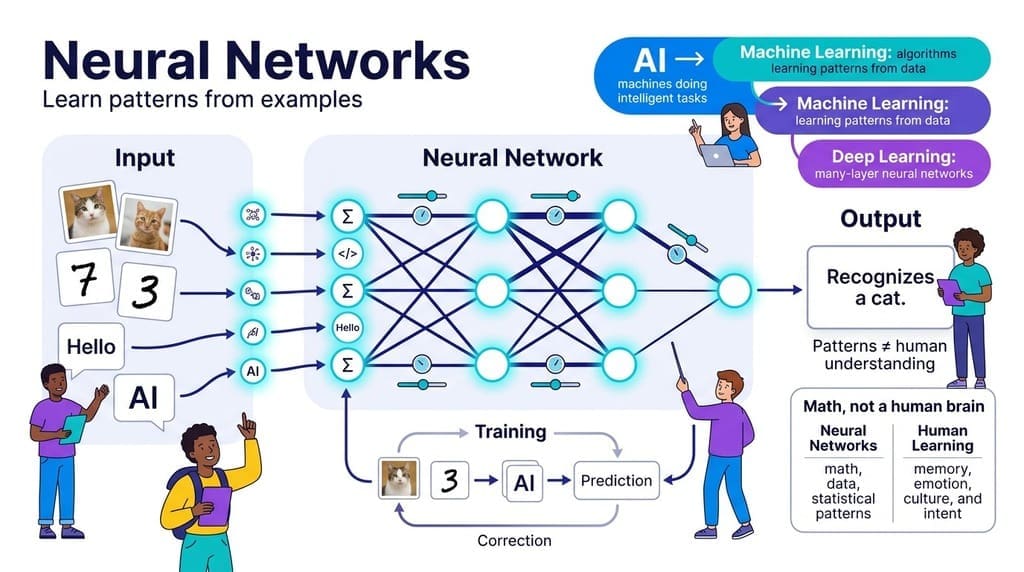
An easy explanation of how neural networks function.
A neural network starts with input data, which may be pixels, words, sounds, or numbers. Initially, each input becomes a list of values, and then the first layer receives those values. After that, hidden layers process them. Meanwhile, each connection has a weight, and as a result, a higher weight gives stronger influence. Subsequently, the model compares its output with the correct answer. Then it measures error through a loss function. Consequently, training reduces that error step by step.
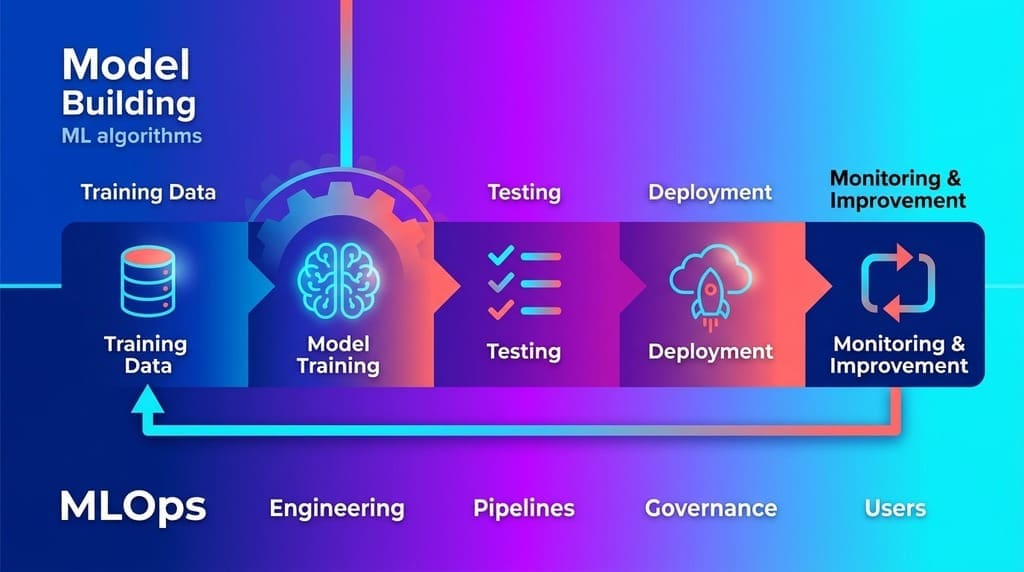
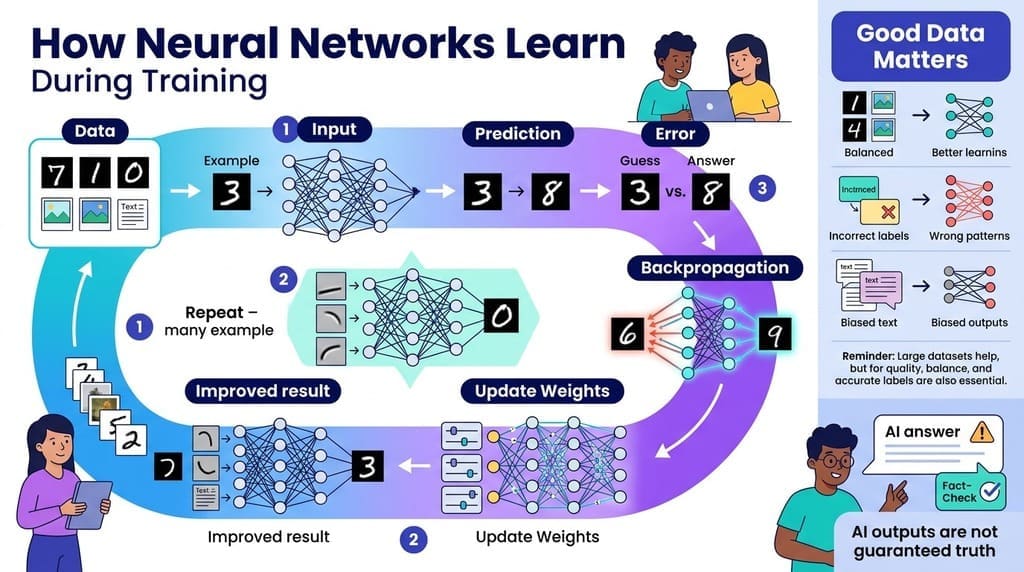
Furthermore, this process often uses backpropagation, which tells the model how to adjust its weights. In fact, LeCun, Bengio, and Hinton describe backpropagation as a key method for changing internal parameters across layers. In simple terms, the network learns by making mistakes, and then it improves through repeated correction. Finally, weights store learned patterns, while training data shapes those patterns. Therefore, better data often supports better models.
Why does Training Data matter so much?
Training data guides models in learning, with high-quality images aiding pattern detection and low-quality images hindering it. Lack of diversity leads to unfair results, as seen in healthcare where an algorithm using healthcare costs as a proxy for need caused harm by misrepresenting Black patients’ health. Data choices, including labels and group inclusion, impact fairness and accuracy. Students should consider data sources and missing groups to enhance model performance and fairness.
How do neural networks learn from data?
Neural networks learn through repeated prediction and correction. Specifically, the process begins with random weights. First, the model receives an example, and then it produces an answer. Next, training software compares that answer with the target, so the difference becomes the error. Afterward, the model sends that error backward, thereby updating weights across layers. Over time, after many examples, the model improves. For this reason, large datasets matter. However, data size alone is not enough. In addition, quality, balance, and labels also matter. For instance, in image recognition, wrong labels can teach wrong patterns. Similarly, in text systems, biased writing can shape biased outputs. At present, students see AI tools everywhere. Indeed, Stanford HAI’s 2026 AI Index reports broad student use of generative AI for school-related tasks. With this in mind, students need clear technical understanding. Above all, they should know that AI answers reflect learned patterns, not guaranteed truth.
Understanding neural network training processes
Training has several steps. First, data is collected and prepared. Next, the model receives inputs. Then it makes predictions. After that, the loss function measures mistakes. Backpropagation updates weights. Training repeats this cycle many times. To explain, imagine a network learning handwritten digits. At first, it guesses poorly. It may confuse 3 and 8. The error signal changes weights. Later, the model detects curves and edges better. Deep networks learn simple patterns first. Later layers combine them into complex features. LeCun, Bengio, and Hinton describe how convolutional networks improved image, speech, and audio processing. This example shows the power of layered learning. Training is not memorizing one answer. It is adjusting many small numbers. Those numbers help the model generalize. However, generalization still depends on good examples.
A 7-point learning path from basics to careers
Students should learn neural networks in a clear order. This order builds concepts before tools. It also connects classroom projects with careers. To enumerate, the path below moves from foundations to real impact.
- Learn definitions of AI, ML, and Deep Learning.
- Understand Training Data and labels.
- Study neurons, weights, and layers.
- Practice Supervised and Unsupervised Learning.
- Compare CNNs, RNNs, and Transformers.
- Test models for bias and errors.
- Build ethical projects for career portfolios.
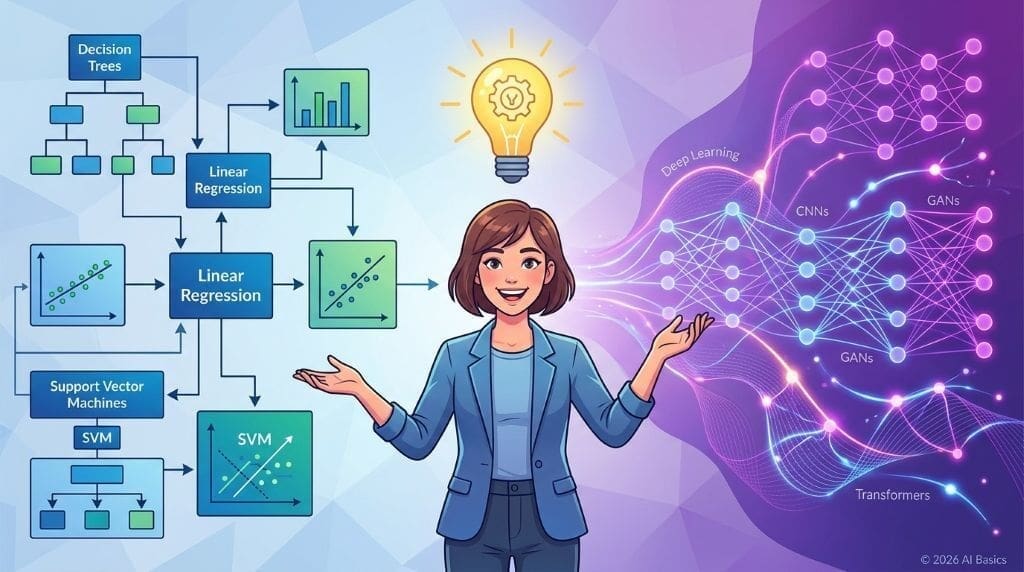
This sequence supports strong learning. First, students learn language. Then they learn mechanisms. After that, they compare architectures. Finally, they connect models to people. Seshia’s work on cyber-physical systems education supports systems thinking in computing education. Similarly, neural network education should connect theory, testing, and real-world use. A project should not end with accuracy alone. It should include limitations, data notes, and human review. This approach shows career readiness. It also shows responsible engineering judgment.
What is the difference between CNN, RNN, and Transformer networks?
CNNs, RNNs, and Transformers are neural network architectures. Each handles information differently. CNN means Convolutional Neural Network. It scans data using filters. This makes it strong for images. RNN means Recurrent Neural Network. It processes sequences step by step. This helps with time-series, speech, and older-text tasks. Transformers use attention. Attention lets the model compare parts of the input directly. This design supports modern language models. It also supports images, code, audio, and multimodal systems. The Stanford HAI 2026 AI Index notes rapid progress in AI capabilities and broad adoption. That growth makes architecture knowledge useful for students. In short, students should not treat every model as the same. Architecture shapes strengths, costs, and risks. For additional student-friendly context, this AI careers guide connects AI knowledge with future roles.

CNN vs RNN vs Transformer comparison
| Model type | Best for | How it works | Common uses | Main limitation |
| CNN | Images and grids | Uses filters across local regions | Image recognition, medical scans, robotics vision | Weak with long sequences |
| RNN | Ordered sequences | Reuses memory across steps | Speech, sensor data, older NLP systems | Hard to train on long context |
| Transformer | Language and mixed data | Uses attention across tokens | Chatbots, translation, coding, vision models | Needs large data and compute |
CNNs detect local patterns. For example, early layers may find edges. Later layers may find shapes. RNNs read order. They treat “dog bites man” differently from “man bites dog.” Transformers compare many positions at once. This helps them handle long text. By comparison, RNNs often struggle with long-range memory. Transformers also scale well with large datasets. However, they can confidently produce false answers. They can also reflect bias in Training Data. So, students should compare models by purpose. They should ask what the input looks like. They should also ask what mistake would cause harm. Model choice should follow the problem.
How neural networks work in computer vision
Computer vision often uses CNNs, which convert images into numbers, with each pixel contributing. Filters slide across images to detect features, starting with simple patterns like lines and edges, then combining these to recognize complex objects like eyes or tumors. This layered learning has transformed the field. LeCun, Bengio, and Hinton highlight CNNs as crucial for processing images, video, speech, and audio. For instance, in a classroom activity, students classified leaf photos. The model performed well with bright images but failed on blurry ones, initially blamed on the algorithm. Inspection revealed most training images had clean backgrounds, showing that context influences predictions. Thus, models need diverse examples and testing beyond ideal data.
How neural networks work in language models
Language models often use Transformers today. They break text into tokens. Tokens may be words or word parts. The model learns relationships among tokens. Attention helps it decide which parts matter. For example, a pronoun may refer to a word earlier. A Transformer can directly compare those positions. This helps with translation, summaries, code, and chat. Yet language models do not guarantee truth. They predict likely text based on patterns. This is why students must verify claims. A fluent sentence can still be wrong. A citation can also be fabricated. Therefore, AI-assisted writing needs source checking. Language models can support brainstorming. They can also support revision. However, students should not submit outputs without checking them. Responsible use means asking better questions. It also means checking evidence before trusting answers.
Why do neural networks make mistakes?
Neural Networks make mistakes because they learn patterns, not meaning. A model may use shortcuts. It might focus more on the background than the object, overfit training data, and struggle with new data. Inaccurate labels can cause errors. Missing groups can create unfair results. Obermeyer and colleagues showed how a healthcare algorithm produced racial bias through a flawed proxy target. This case matters beyond healthcare. It shows that technical accuracy can hide harm. Students should ask what a model optimizes. They should also ask who audits results. NIST’s AI RiskThe chance that harm occurs, given the hazard and the exposure. More Management Framework promotes the identification and management of AI risks for trustworthy systems. That idea fits student projects too. A project should include error testing. It should include bias checks. It should also include clear human oversight.

How neural networks work with bias and fairness
Bias can occur at various stages, including data collection, labeling, and goal setting. It can also enter during deployment. For example, a school tool may predict student risk. If it relies solely on attendance, it may punish students with transportation issues. If it relies solely on past grades, it may miss improvement. Therefore, fairness needs context. A model cannot know social causes on its own. Students should examine outputs across groups. They should test edge cases. They should ask whether errors affect people equally. NIST describes trustworthy AI work through explainability and interpretability, among other themes. These ideas help students ask practical questions. Can users understand the result? Can someone appeal it? Who fixes harm? Fairness is an ongoing process, not a one-time checkbox.
How can students test neural network outputs?
Neural networks work by predicting and correcting through repeated cycles. They start with random weights, make predictions, compare them to targets to find errors, and update weights to improve. Successful training depends on more than dataset size; data must be high quality with accurate labels, or else learning becomes faulty and biased. Today, students often use AI for school tasks, so understanding that AI answers are pattern-based and probabilistic, not guaranteed facts, is crucial.
How can learning how neural network wor help students build careers?
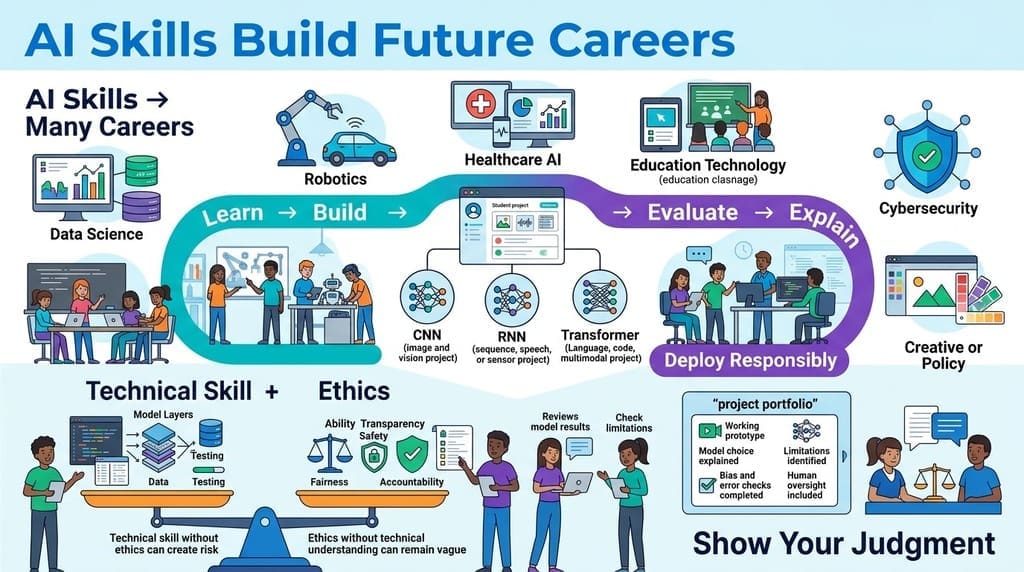
Learning how neural networks work helps students choose better projects. It also helps them speak clearly about AI. Career paths include data science, robotics, healthcare AI, education technology, cybersecurity, design, and policy. Some roles require coding. Others need communication and evaluation skills. Stanford HAI’s 2026 AI Index reports high AI use among students and expanding AI adoption across organizations. This means AI knowledge now supports many careers. Students who understand CNNs, RNNs, and Transformers can explain tool choices. They can also spot limits before deployment. Employers value that judgment. Technical skill without ethics can create risk. Ethics without technical literacy may stay vague. Together, they create responsible talent. Career growth depends on both ability and trust. Students should build projects that show both.
How This Guide Was Compiled
This guide was first compiled using open-access and peer-reviewed sources to explain how neural networks work and how AI affects education and society. The statistical foundation, for instance, comes from Stanford HAI’s 2026 AI Index Report, which tracks AI capability, adoption, education, and social impact. Meanwhile, the technical foundation comes from the article by LeCun, Bengio, and Hinton in Nature, which explains neural network learning and development.
Additionally, the education framing draws from Seshia’s article on cyber-physical systems education, while the fairness discussion uses Obermeyer and colleagues’ Science study on racial bias in a healthcare algorithm. Finally, NIST resources informed the responsible AI risk framing, while classroom observations from student AI activities provided practical insights.
Ultimately, the goal was practical: to provide students with clear definitions, simple explanations of how neural networks work, model comparisons, and ethical guidance. Therefore, this guide avoids hype and instead focuses on learning, testing, and career value.
Verified Resources
- Stanford HAI 2026 AI Index Report
- NIST AI Risk Management Framework
- NIST Trustworthy and Responsible AI
- Deep learning, Nature
- Explorations in cyber-physical systems education, CACM
- Dissecting racial bias in an algorithm, Science
References
LeCun, Y., Bengio, Y., & Hinton, G. (2015). Deep learning. Nature, 521(7553), 436–444. https://doi.org/10.1038/nature14539
National Institute of Standards and Technology. (2026). AI Risk Management Framework. https://www.nist.gov/itl/ai-risk-management-framework
National Institute of Standards and Technology. (2026). Trustworthy and responsible AI. https://www.nist.gov/trustworthy-and-responsible-ai
Obermeyer, Z., Powers, B., Vogeli, C., & Mullainathan, S. (2019). Dissecting racial bias in an algorithm used to manage the health of populations. Science, 366(6464), 447–453. https://doi.org/10.1126/science.aax2342
Seshia, S. A. (2022). Explorations in cyber-physical systems education. Communications of the ACM, 65(5). https://doi.org/10.1145/3490442
Stanford Institute for Human-Centered Artificial Intelligence. (2026). The 2026 AI Index Report. Stanford University. https://hai.stanford.edu/ai-index/2026-ai-index-report
List of terms
- Risk
