
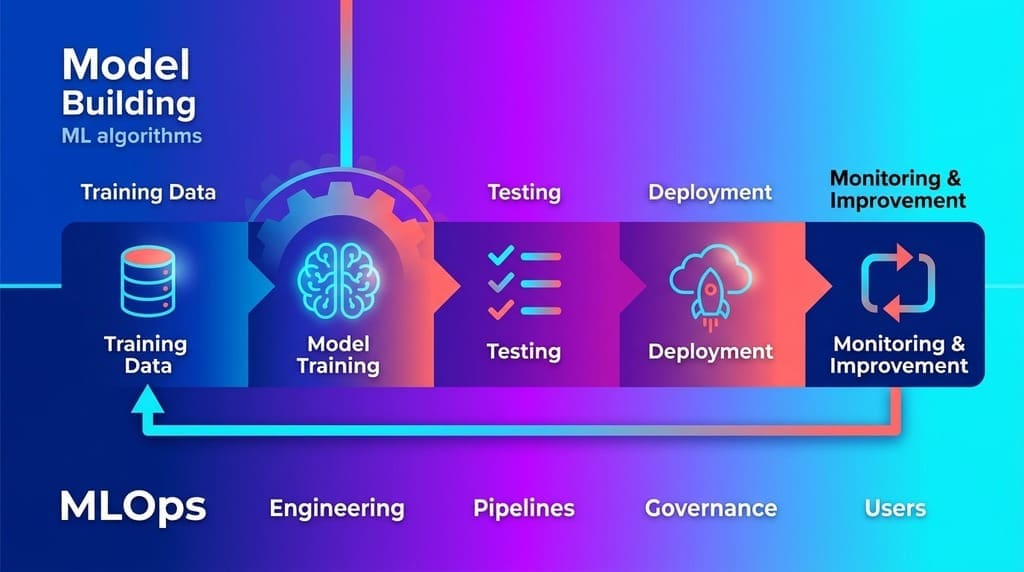
Artificial Intelligence (AI) is the broad field of creating machines that simulate human intelligence, while Machine Learning (ML) is a subset focused on algorithms that learn patterns from data. At present, many students can train a small model. However, fewer know how that model becomes a reliable AI application. Machine Learning starts with Training Data, then uses Supervised Learning, Unsupervised Learning, or Neural Networks to detect useful patterns. Yet a trained model is not enough. It must be tested, deployed, monitored, and improved. This is where MLOps matters. It connects model building with software engineering, data pipelines, governance, and real users. In short, MLOps is the bridge between algorithms and AI applications. It helps teams move beyond experiments and build practical systems that work safely.
What Is the Difference Between AI, ML, Deep Learning, and MLOps?
A beginner may think the algorithm is the final product. In reality, the algorithm is only the engine. The full system also needs data checks, deployment tools, user interfaces, security, logging, and human oversight. Google Cloud’s MLOps guidance states that the hard part is not only building a model, but building and continuously operating an integrated ML system in production. This idea also matches ENTECH Online’s article on engineering intelligent systems, which explains that modern AI needs more than models, including data pipelines, system design, deployment infrastructure, and continuous improvement. To put it differently, the journey from algorithm to AI application is an engineering process, not only a mathematics exercise.
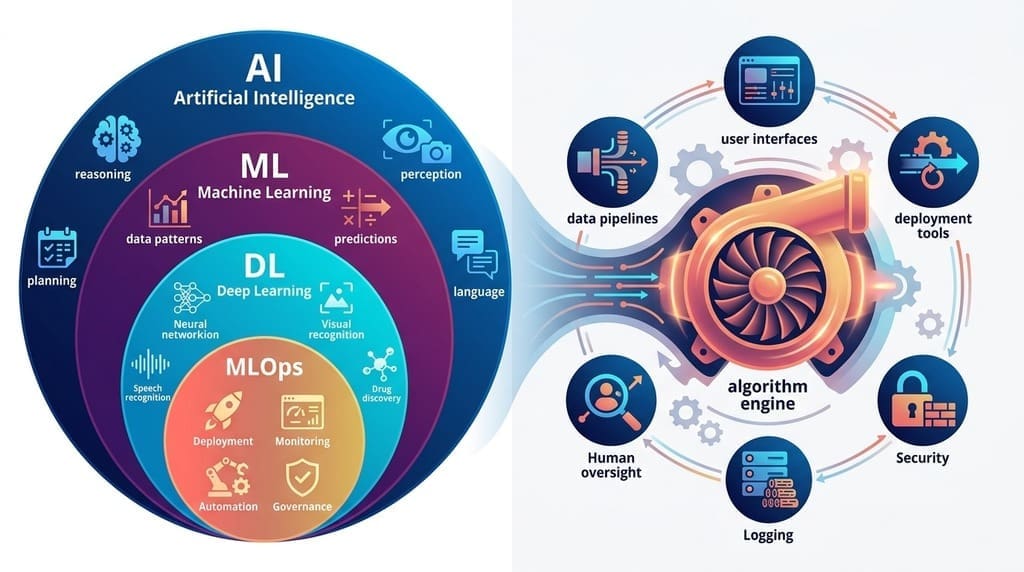
Image Credit: Infographic generated via Google Nano Banana 2.
| Aspect | Artificial Intelligence (AI) | Machine Learning (ML) | Deep Learning (DL) | MLOps |
|---|---|---|---|---|
| Definition | Broad field of building systems that simulate human intelligence | Subset of AI that trains algorithms on data to recognize patterns and make predictions | Subset of ML that uses layered neural networks to learn complex patterns from large datasets | Machine Learning Operations: practices that combine ML development with software engineering, automation, monitoring, and governance |
| Relationship | Parent field that includes ML, DL, and other approaches | Subset of AI; parent of DL | Subset of ML (and therefore of AI) | Operational framework that applies to ML and DL models (not a modeling technique itself) |
| Core Focus | Reasoning, planning, perception, language, and decision support | Pattern recognition and prediction from data | Learning hierarchical representations automatically from raw data | Reliable deployment, maintenance, and governance of models in real applications |
| Key Methods / Techniques | Rule-based systems, search, knowledge representation, and learning methods | Supervised, unsupervised, and reinforcement learning algorithms | Multi-layer neural networks (CNNs, RNNs, transformers, etc.) | CI/CD pipelines, versioning, monitoring, testing, and automated retraining |
| Data Requirements | Varies widely; can work with limited or structured knowledge | Requires training data; performance improves with more relevant data | Typically needs large volumes of data to train effectively | Focuses on data pipelines, quality, and continuous data flow for production models |
| Typical Applications | Chatbots, expert systems, planning tools, robotics | Recommendation systems, fraud detection, demand forecasting | Speech recognition, image/object detection, drug discovery, genomics | Production ML systems in healthcare, finance, manufacturing, and any domain where models must run continuously |
| Strengths | Can address a wide range of intelligent behaviors | Automatically improves with data; handles many prediction tasks | Excels at complex, high-dimensional patterns (vision, language, sequential data) | Ensures models remain accurate, reliable, and compliant after deployment |
| Limitations | Can be brittle or hard to scale when purely rule-based | May require feature engineering; performance depends on data quality | Computationally intensive; often less interpretable (“black box”) | Adds process overhead; does not improve the model’s underlying accuracy by itself |
| Role in the Workflow | Defines the overall intelligent goal or system | Builds the predictive or pattern-finding component | Provides high-capacity models for complex data | Moves models from development into stable, monitored production use |
How Does MLOps Move From Algorithm to AI Application?
MLOps starts before the first model is trained. At first, the team defines the real problem. For example, a hospital may want to predict the risk of readmission. A school may want to support personalized learning. A farmer may want to detect crop disease early. The team must ask one careful question: what decision will this model support? Without that clarity, even a strong algorithm may solve the wrong problem. In fact, Obermeyer and colleagues showed that a health algorithm became racially biased because it used healthcare cost as a proxy for health need. That lesson matters for every MLOps pipeline. Good deployment starts with correct problem framing, not code.
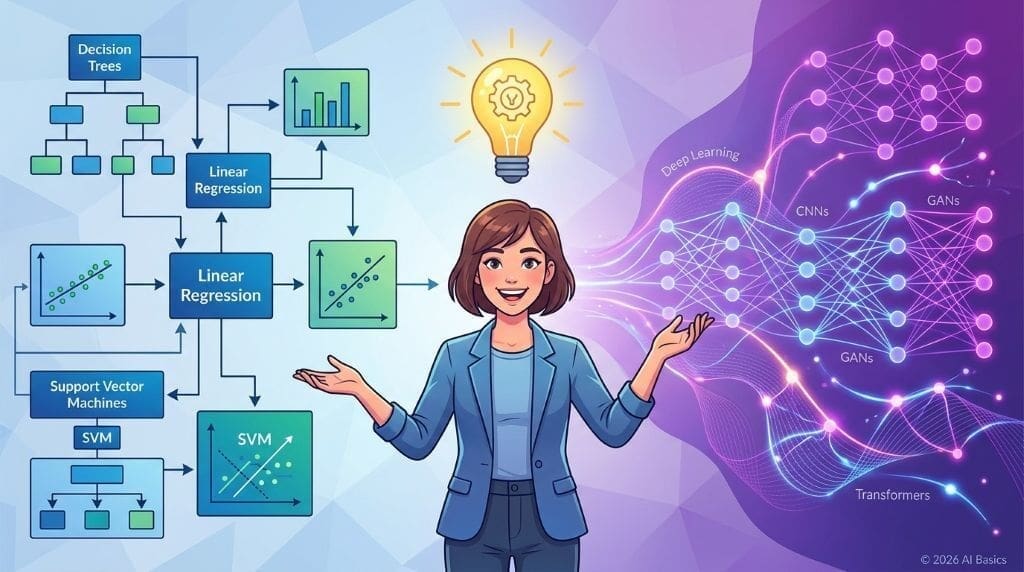
After that, teams collect Training Data and inspect its quality. They remove duplicates, check missing values, and study labels. They also document data sources. As a result, future engineers can understand model behavior. In supervised learning, labels guide predictions.On the contrary, in unsupervised learning, patterns emerge without labels. While in deep learning, neural networks learn layered representations from larger datasets. Yet every approach depends on data quality. If the data is incomplete, biased, or outdated, the final AI application may fail. This is why MLOps treats datasets as living assets. Models change when users change. Therefore, teams must monitor data drift after deployment.
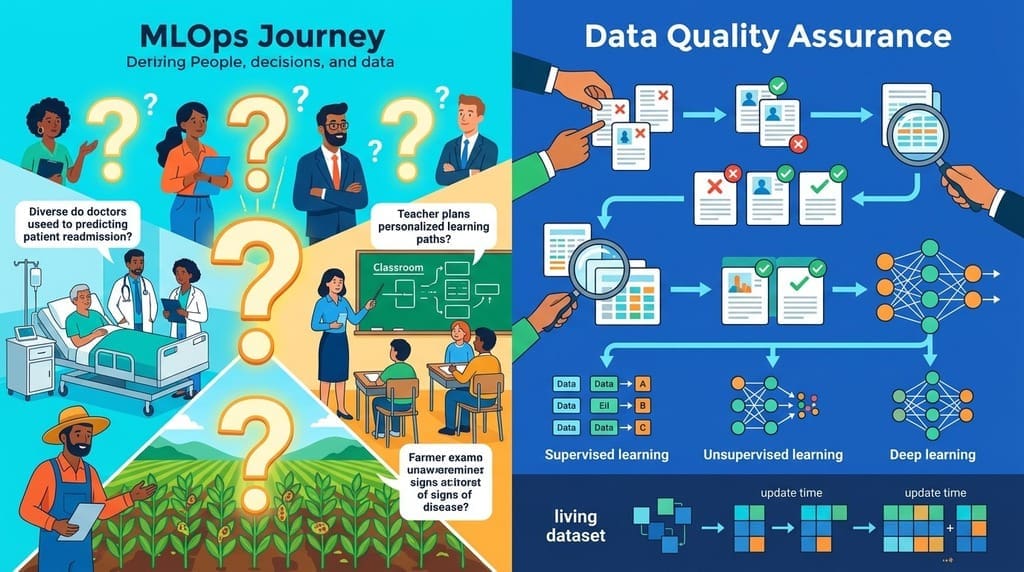
Image Credit: Infographic generated via Google Nano Banana 2.
From Algorithm to AI Application: The 7-Step MLOps Pipeline
The MLOps pipeline should feel like a learning path. It moves from basic concepts toward real careers. Each step builds on the previous one. With this in mind, students can treat MLOps as a practical roadmap rather than a difficult technical label.
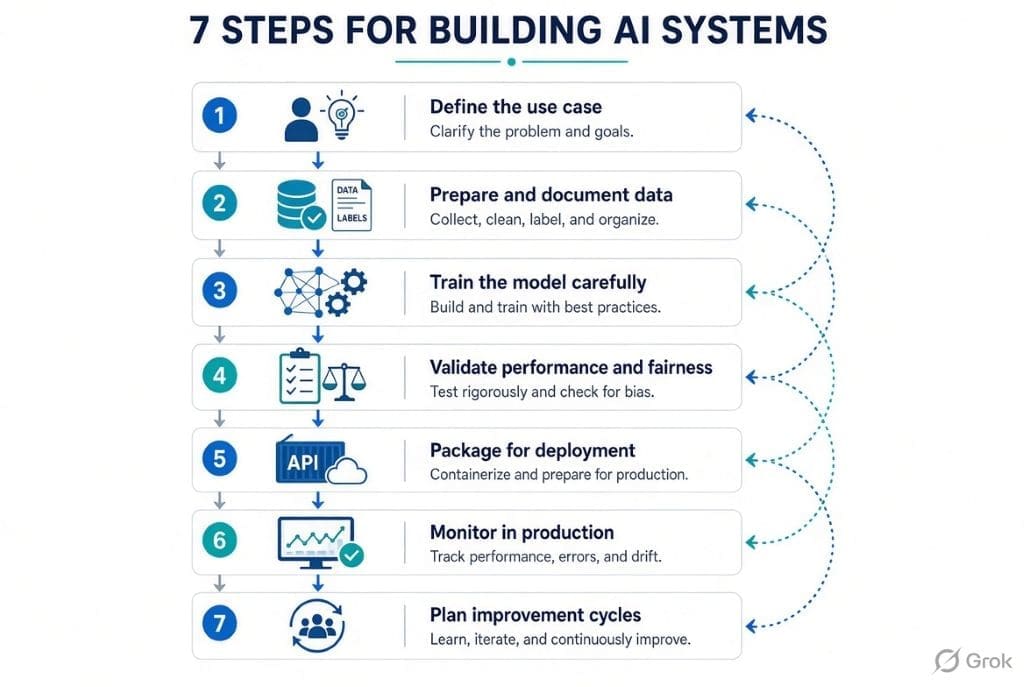
This seven-point flow shows why MLOps is a full discipline. It connects data science with software engineering. It also connects technical choices with human outcomes. In my classroom, students often celebrate when their first model reaches high accuracy. However, their excitement changes when I ask, “What happens if tomorrow’s data looks different?” That question usually creates silence. Then it creates learning. Students begin to see that deployment is not the finish line. It is the start of responsibility. Above all, this shift builds professional thinking.
Why Is MLOps Important for Practical AI Solutions?
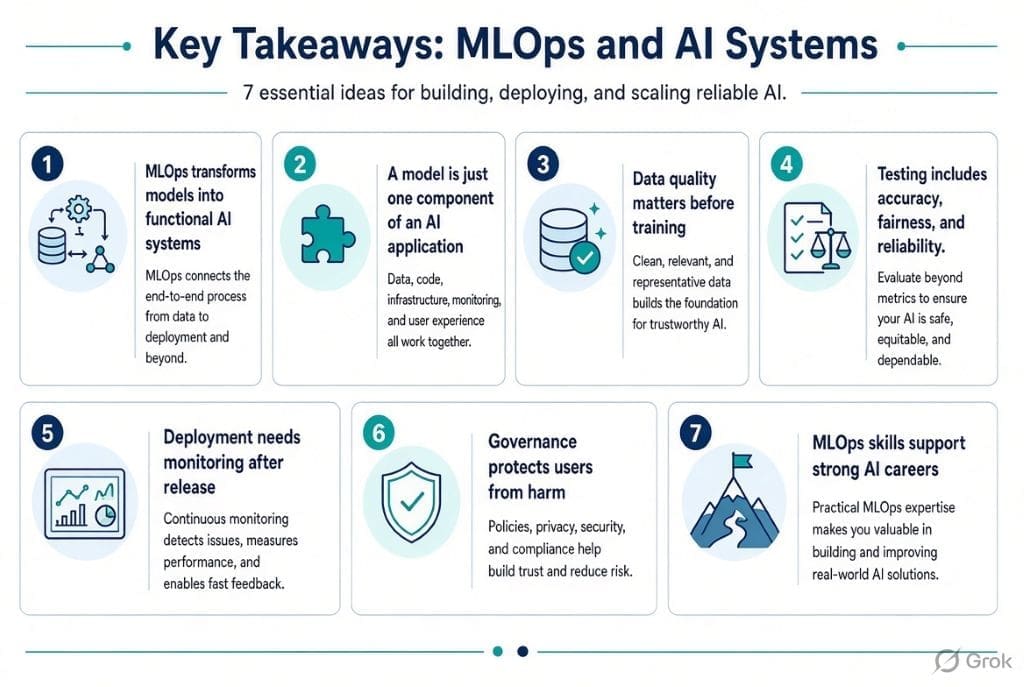
MLOps matters because real users create messy conditions. Data arrives late. Labels contain errors. APIs fail. Users behave differently than expected. A model that worked in a notebook may break in production. Therefore, a practical AI solution needs more than a saved model file. It needs automation, testing, logging, alerts, and rollback plans. Google Cloud describes MLOps as applying DevOps principles to ML systems, with automation and monitoring across integration, testing, release, deployment, and infrastructure management. That definition is useful for students because it translates a broad idea into everyday engineering work.

In my experience, students understand MLOps best through a simple attendance prediction project. The first version predicts the risk of absence from past attendance. It works well on old data. Then we add a school holiday week. Suddenly, the model behaves oddly. At that point, students learn data drift without memorizing a definition. They also learn why monitoring matters. By comparison, a static algorithm only answers yesterday’s problem. An MLOps pipeline keeps checking whether the solution still fits today’s conditions. This explains the transition from algorithms to AI applications.

Image Credit: Infographic generated via Google Nano Banana 2.
MLOps also supports ethical AI. A model can pass an accuracy test and still harm users. For example, the Science study on racial bias showed that a widely used health algorithm reduced the number of Black patients identified for extra care because it used cost as a proxy for need. In light of this, MLOps teams must check proxies, subgroup performance, and decision impact. The NIST AI Risk Management Framework provides organizations with a structured approach to managing trustworthy AI risks. For students, that means governance is not paperwork. It is part of responsible engineering.
How Can Students Learn the MLOps Pipeline for AI Applications?
Students should start with one small project. A simple image classifier, chatbot, or prediction model works well. The goal is not to build the most advanced model. The goal is to complete the full path from algorithm to AI application. Students can train a model, save it, create a small interface, test sample inputs, and record errors. After that, they can add simple monitoring. For instance, they may count failed predictions or log unusual inputs. This creates a real MLOps mindset early. It also prevents the common mistake of stopping after training.
Students also need a vocabulary map. They should know model training, validation, deployment, monitoring, drift, retraining, and governance. These terms appear in real job descriptions. ENTECH Online’s article on AI in education describes how students can learn workflow automation and team roles through practical classroom projects. That approach fits MLOps well because AI deployment is rarely solo work. Teams need data engineers, ML engineers, software developers, product managers, and ethics reviewers. Similarly, students should practice explaining their model to non-technical users. Clear communication is a career skill, not an optional extra.
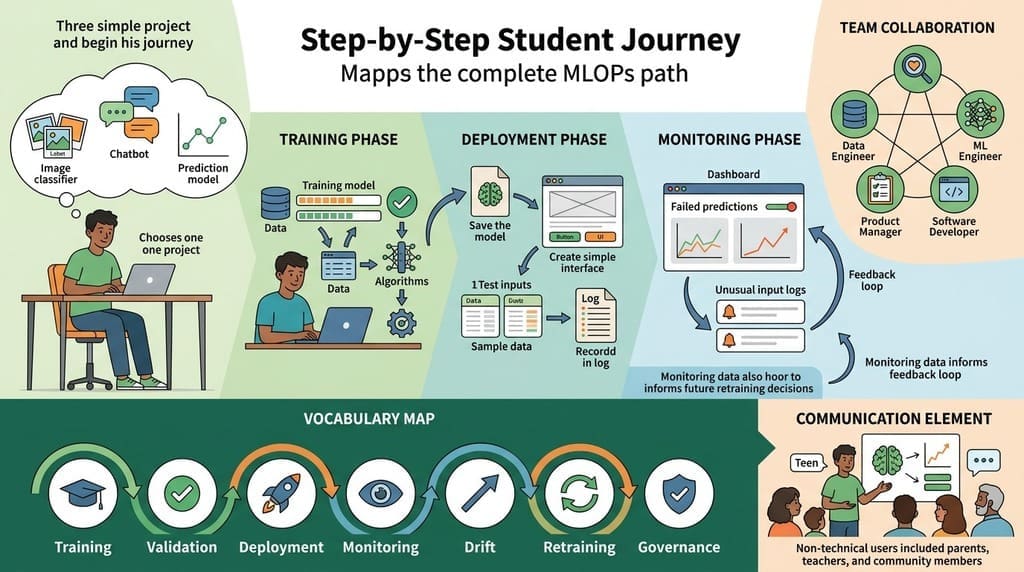
Image Credit: Infographic generated via Google Nano Banana 2.
How Does Algorithm to AI Application Fit Student Projects?
A student project should include a short “model card” or documentation note. It can explain the data source, intended use, known limits, and test results. This small habit builds trust. It also prepares students for professional work. To illustrate, a plant disease detector should state which crops were included. It should also state which lighting conditions were tested. Without that context, users may trust the model too much. In effect, documentation becomes part of safety.
Another key point is version control. Students should save versions of datasets, code, and models. This helps them compare results later. It also helps when something breaks. In production teams, version control supports audits and reproducibility. The ACM article connected to DOI 10.1145/3490442 focuses on cyber-physical systems education and shows how computing education increasingly connects software, systems, and real-world behavior. That connection matters here. AI applications often interact with physical, social, or institutional systems. Therefore, MLOps learning should include both code and context.
What Careers Use MLOps to Build Real AI Applications?
MLOps opens practical career paths for students who like both coding and problem-solving. Machine Learning Engineers build training and deployment workflows. Data Engineers prepare reliable data pipelines. AI Product Managers connect user needs with technical work. ML Platform Engineers manage tools, cloud systems, and automation. AI Governance Specialists check fairness, privacy, and compliance. These roles differ, but they share one theme. They all help move from algorithm to AI application.
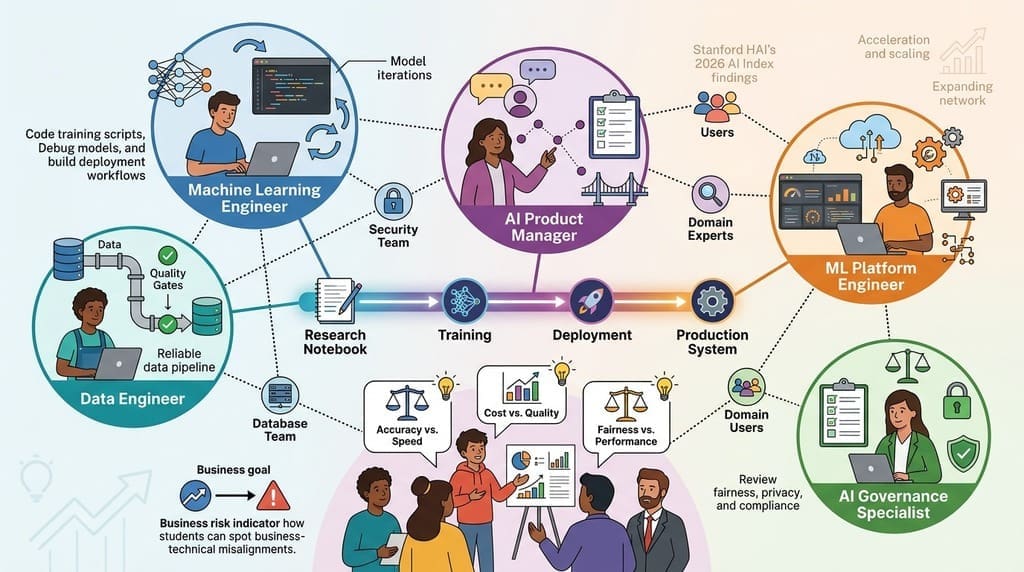
Image Credit: Infographic generated via Google Nano Banana 2.
Career growth also depends on collaboration. A model may start in a research notebook. Yet deployment needs security teams, database teams, domain experts, and users. By and large, students who communicate well progress faster. They can explain trade-offs between accuracy, speed, cost, and fairness. They can also spot when a business goal creates technical risk. The 2026 AI Index Report from Stanford HAI states that AI capability is accelerating and reaching more people than ever. As a result, organizations need people who can build useful systems responsibly.
From Algorithm to AI Application: Career Skills Checklist
These skills move students beyond tool usage. They build professional judgment. In short, MLOps teaches students to think like builders. It also teaches them to think like caretakers. Once an AI system affects people, maintenance becomes a duty. That duty includes updates, audits, and user feedback. All things considered, the best AI careers will reward people who combine technical depth with responsibility.

How This Guide Was Compiled
This guide was compiled using three layers of evidence. First, it uses the previous NYCSTEM beginner AI article as context, so this blog avoids repeating broad AI-vs-ML content and instead focuses on the MLOps pipeline. Second, it reviews the requested peer-reviewed and open-access sources, including LeCun, Bengio, and Hinton’s Nature article on deep learning; the ACM article linked to DOI 10.1145/3490442; and Obermeyer and colleagues’ Science article on racial bias in a health algorithm. Third, it uses the 2026 Stanford HAI AI Index Report as the statistical foundation for AI adoption and capability trends. The classroom observation reflects direct teaching experience with beginner AI projects, especially in the transition from model accuracy to deployment thinking.
Verified Resources
- Stanford HAI 2026 AI Index Report — https://hai.stanford.edu/ai-index/2026-ai-index-report
- NIST AI RiskThe chance that harm occurs, given the hazard and the exposure. More Management Framework — https://www.nist.gov/itl/ai-risk-management-framework
- Nature: Deep learning — https://doi.org/10.1038/nature14539
- ACM: Explorations in cyber-physical systems education — https://doi.org/10.1145/3490442
- Science: Dissecting racial bias in an algorithm used to manage the health of populations — https://doi.org/10.1126/science.aax2342
Frequently Asked Questions
References
Google Cloud. (2024). MLOps: Continuous delivery and automation pipelines in machine learning. https://docs.cloud.google.com/architecture/mlops-continuous-delivery-and-automation-pipelines-in-machine-learning
LeCun, Y., Bengio, Y., & Hinton, G. (2015). Deep learning. Nature, 521(7553), 436–444. https://doi.org/10.1038/nature14539
National Institute of Standards and Technology. (2026). AI Risk Management Framework. https://www.nist.gov/itl/ai-risk-management-framework
Obermeyer, Z., Powers, B., Vogeli, C., & Mullainathan, S. (2019). Dissecting racial bias in an algorithm used to manage the health of populations. Science, 366(6464), 447–453. https://doi.org/10.1126/science.aax2342
Seshia, S. A. (2022). Explorations in cyber-physical systems education. Communications of the ACM, 65(5). https://doi.org/10.1145/3490442
Stanford Institute for Human-Centered Artificial Intelligence. (2026). The 2026 AI Index Report. Stanford University. https://hai.stanford.edu/ai-index/2026-ai-index-report
List of terms
- Risk
