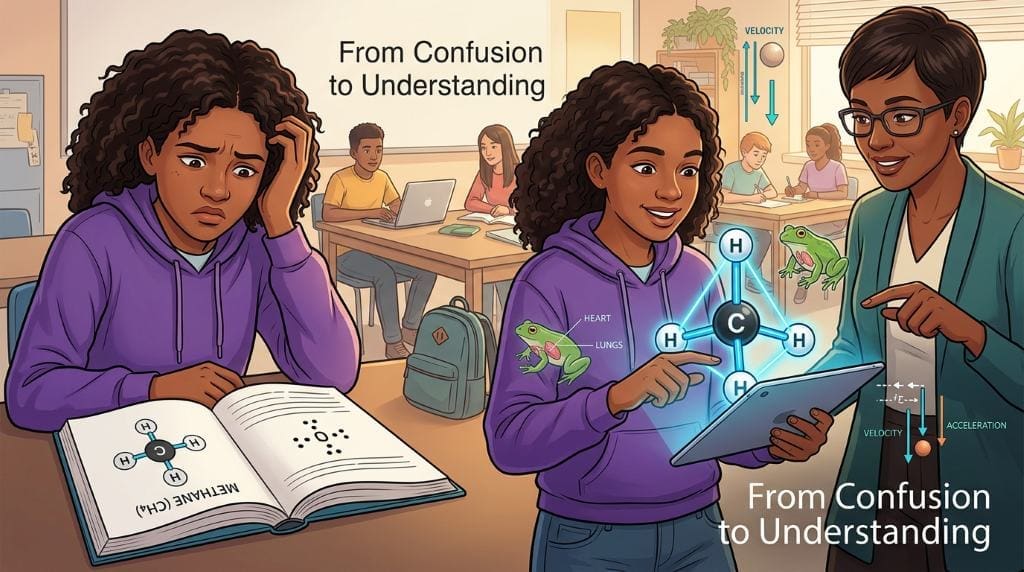
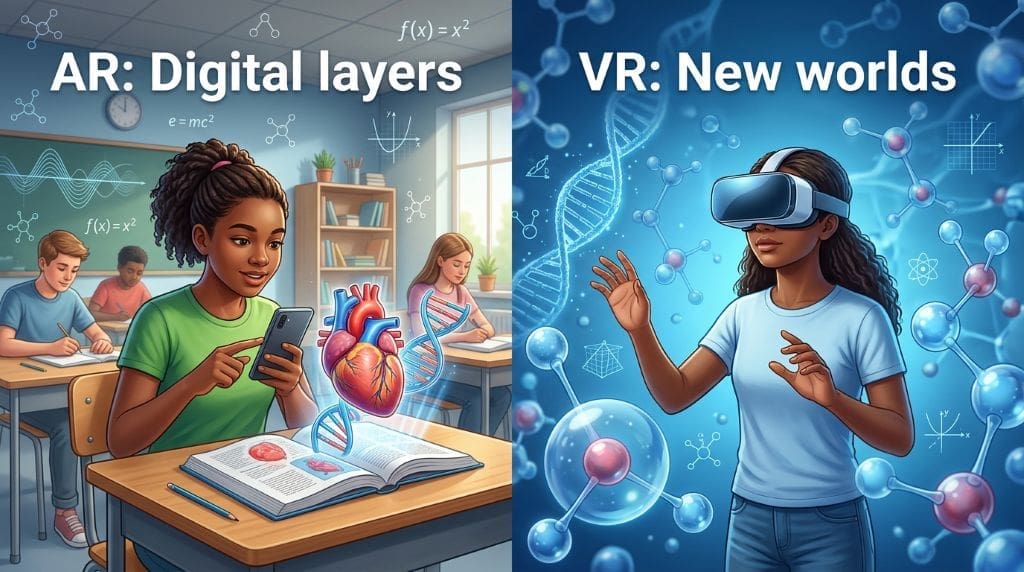
A flat page can’t show a molecule twisting in space, but your phone camera can. Just point it at a printed page, and you might see a beating heart rise up. Another student puts on a headset and steps inside a giant water molecule. These scenes are now common in real classrooms. At first, these technologies might seem like something out of a movie, but they are becoming everyday tools. AR and VR in STEM education are beginning to transform the way students learn and interact with complex concepts.
Augmented reality adds digital content to our surroundings, while virtual reality creates a completely digital world. Both can help students understand complex ideas through AR and VR in STEM education, which is especially important in STEM subjects where topics like physics, chemistry, biology, and math can sometimes feel distant or uninteresting. Some students lose interest early for this reason. In this guide, we’ll look at how AR and VR in STEM education can help support STEM education.
Key Takeaways
- Augmented reality overlays digital content onto real objects, while virtual reality creates complete simulations.
- Both of the tools increase engagement and spatial reasoning in STEM learning.
- They reduce the mental strain involved in the study of hard physics and chemistry topics.
- Phone and tablet apps work well and cost very little money.
- Strong lesson design beats fancy hardware every single time.
- Immersion and personal control drive the biggest learning gains.
- These skills map directly to modern technical careers.
How AR and VR Applications Build Stronger STEM Foundations
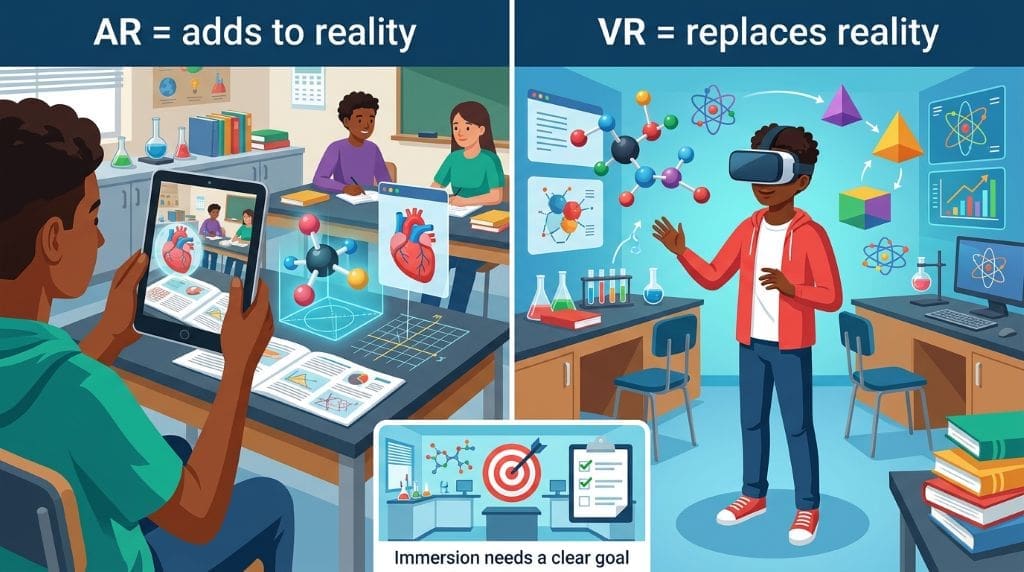
Teachers sometimes mix up these two tools. Augmented reality adds digital content to a real scene, so students still see the room and their desk. Phones, tablets, or smart glasses can do this. Virtual reality replaces the real scene with a digital one. Students wear a headset that blocks out the real world. In short, AR keeps reality while VR replaces it. Both are types of immersive technology used in AR and VR in STEM education. Their main goal is to let students explore concepts from the inside. Recent reviews back this up. A meta-review of many STEM studies found that these tools boost engagement in science and math. But the studies also warn that weak lesson design can limit their impact.
Just because immersive technology is used doesn’t mean that students’ test scores will improve. Even the most advanced virtual lab requires a well-defined lesson objective. Good teaching enables students to understand what they experience. Technology should serve to support the teacher, not take the teacher’s place. If the lesson is not carefully planned, the equipment will have no effect.
The Power of Embodied Learning
Students can also learn by using their whole bodies. For example, they can reach out and grab a diagram, tilting, turning, and pulling it apart with their hands. This kind of physical action helps them remember better. Scientists call this embodied learning, and it’s a key principle driving AR and VR in STEM education. Someone who moves a virtual lever in an immersive environment is more likely to remember it than someone who just reads about it. Many education studies mention this effect of embodied cognition in AR and VR in STEM education. It’s one reason immersive tools work so well. Our minds learn best when movement and sight work together.

A flat page can’t do that, but a headset or phone screen can—technologies that are central to AR and VR in STEM education. That’s why STEM teachers value these tools. They want students to experience ideas, not just name them. Direct experience stays in the brain much longer and becomes a real memory, not just a fact to memorize. This approach especially helps students who struggle, and AR and VR in STEM education makes abstract concepts tangible and accessible for diverse learners.
Why STEM Abstractions Are Hard to Learn
Why do beginners often find STEM so difficult? These subjects talk about things we can’t see or touch, like electrons, fields, enzymes, and probability. Because of this, traditional teaching relies on diagrams and equations, which can hide the real structure. An equation stands for a moving system, and a flat diagram stands for a 3D shape. Students have to imagine that missing shape in their minds, and that’s hard for many. Immersive tools help by showing those hidden structures. A recent review of 117 K-12 STEM studies found that these tools help with spatial concepts and support hands-on skills. They also make complex topics feel less boring and less abstract. However, the review also warns about distractions and device costs. Careful lesson planning is still the most important thing. A good tool supports a lesson, but it can’t replace it.
Digital Layers Sit on Real Lessons
Augmented reality is particularly effective in classroom settings since it allows the actual object to be seen, enabling students to still be able to touch the beaker or the model—a key advantage of AR and VR in STEM education. The digital hints appear directly on top of the object. For instance, a small marker placed alongside a chemistry kit can be read by the camera in seconds and display the bond angles on the screen. At the same time, the students are able to see both the real flask and the virtual labels. This combination keeps their attention and connects abstract ideas to real objects, making them easier to remember.
In physics, a phone app can draw force arrows over a moving cart, with the arrows changing as the cart speeds up—a practical application of AR and VR in STEM education that makes invisible concepts visible while keeping the real world in sight. This method is low-cost and doesn’t need special headsets, so most schools can use it quickly. Teachers can add AR and VR in STEM education to their current lessons without needing a new unit or big changes—the app fits right into the existing plan.
Getting Started Without Breaking the Budget
Hardware concerns stop some schools from trying these tools. Staff often worry about cost and maintenance. But most phones and tablets can already handle AR apps, and many schools already have these devices. Basic AR science apps are cheap or even free, and you don’t need special goggles to get started. This keeps the entry cost low and makes it easier for schools to try. A teacher can test an app in just one class period, and the same device can be shared by the whole class. Simple apps need almost no maintenance. Schools can start small and expand later, buying headsets only after seeing good results. This gradual approach protects budgets and helps teachers avoid feeling overwhelmed.
Full Simulations Stay Safe and Repeatable
Virtual reality is especially useful when a real task is risky or expensive. Students can repeat experiments as many times as they need, and they can visit places that a classroom can’t reach. For example, a student can stand inside a cell or tour a nuclear reactor. After the initial setup, these virtual trips cost nothing. Real lab trips, on the other hand, take time, money, and require close supervision. Virtual reality also removes real dangers. Students can mix virtual chemicals without any risk, since a virtual spill is fixed in seconds. This lets them try more ideas without fear, which encourages curiosity. Teachers should always set clear goals for each VR session. Simulations work best when they have a learning target. Without a goal, students may just wander and not learn much.

A further benefit of using virtual tools is that they allow for repeated practice. Instead of needing additional materials, students can carry out the same experiment ten times. With each attempt, they can correct small errors, and this kind of repetition results in true mastery. In a physical laboratory, students usually have only one opportunity since both equipment and time are limited. Virtual labs never exhaust their supplies, so students can carry out the practice until they feel confident, which in turn helps them perform better in actual labs later on. Schools also cut costs, as a single virtual kit can be used by all the students for many years. Chemistry sets that used to break now last indefinitely, and specimens that once went bad remain fresh. The money saved adds up rapidly throughout a school district.
AR and VR in STEM Education: Applications in Physics and Chemistry
How AR and VR in STEM Education Make Physics Labs Clearer
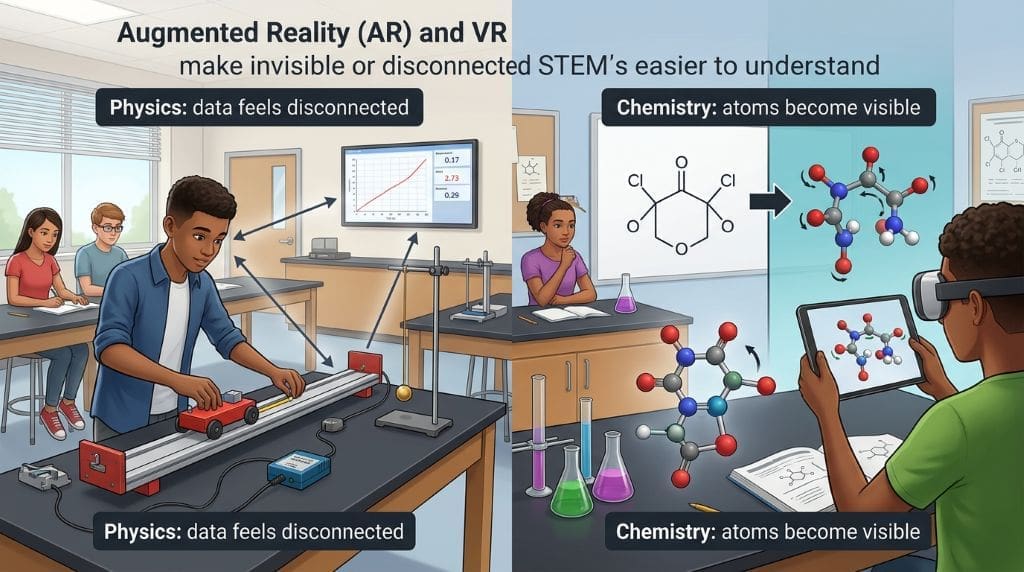
Physics labs create a classic problem for students. They see a measurement on one screen and touch real equipment elsewhere. Their eyes jump back and forth between the two places, splitting their attention and adding extra mental strain. A physics lab study measured this effect directly. University students tested heat flow through metal rods. One group used traditional lab tools. A second group wore see-through smartglasses that placed live temperature data right on the rods. The AR group reported far less cognitive load. Both groups scored the same on concept tests, however. This result matters for teachers: better tools do not always boost conceptual recall on their own, but they reduce wasted mental effort that can then feed deeper thinking.
Many physics topics work well with immersive tools powered by AR and VR in STEM education. Forces, waves, fields, and circuits all involve motion, but their real causes are often hidden. Augmented reality can show force vectors on a moving object, while virtual reality can slow down a collision so students watch energy transfer step by step. A student can stretch a virtual spring and feel the force right away—something a textbook can’t offer.
Immersive tools also help with 3D problems, like electric and magnetic fields, which exist in space, not just on paper. A virtual field lets students move a probe through it, building intuition that flat drawings can’t provide. This is why AR and VR in STEM education proves especially valuable for spatial reasoning. Teachers should still connect each demonstration to a written equation, so AR and VR in STEM education tools and the formula work together to create a complete learning experience.
How AR and VR in STEM Education Make Chemistry Tangible
Students are asked by chemistry to place their trust in a world that is invisible. Atoms, bonds, and reaction stages are far too small to see, yet textbooks represent them with circles and lines, concealing their actual shapes and movements. Immersive tools restore those shapes. For example, a student can hold and spin a virtual methane molecule, seeing the tetrahedral angles for herself through AR and VR in STEM education. Biomedical and pharmacy developers create tools like this for advanced students, letting them explore molecules in 3D.
Chemistry labs can involve reactions that produce heat, gas, or dangerous fumes. Virtual laboratories allow students to practice these experiments safely, making mistakes without risking injury or creating difficult cleanup. They can mix incorrect amounts, observe the results, and learn from the outcome. Virtual labs can also reduce long-term costs because one headset or tablet can support repeated experiments, while the same software can be used by many students.
However, virtual laboratories cannot completely replace real wet labs. Handling glassware and equipment develops important practical skills, so the most effective classrooms combine both approaches. Immersive tools are particularly useful for helping beginners understand molecular geometry, which can be difficult to visualize in two-dimensional drawings. Students can rotate virtual models, zoom in, and measure bond angles, making tetrahedral and trigonal planar structures easier to remember.
Once students understand molecular shapes, they can focus more on chemical reactions instead of struggling to visualize geometry. If they ask fewer questions about molecular structure and more about how chemicals behave, it suggests deeper understanding. This is the main advantage of immersive chemistry through AR and VR in STEM education: it removes one learning barrier while helping students develop other essential scientific skills.
How AR and VR in STEM Education Reinforce Biology and Mathematics
How AR and VR in STEM Education Make Biology Visible
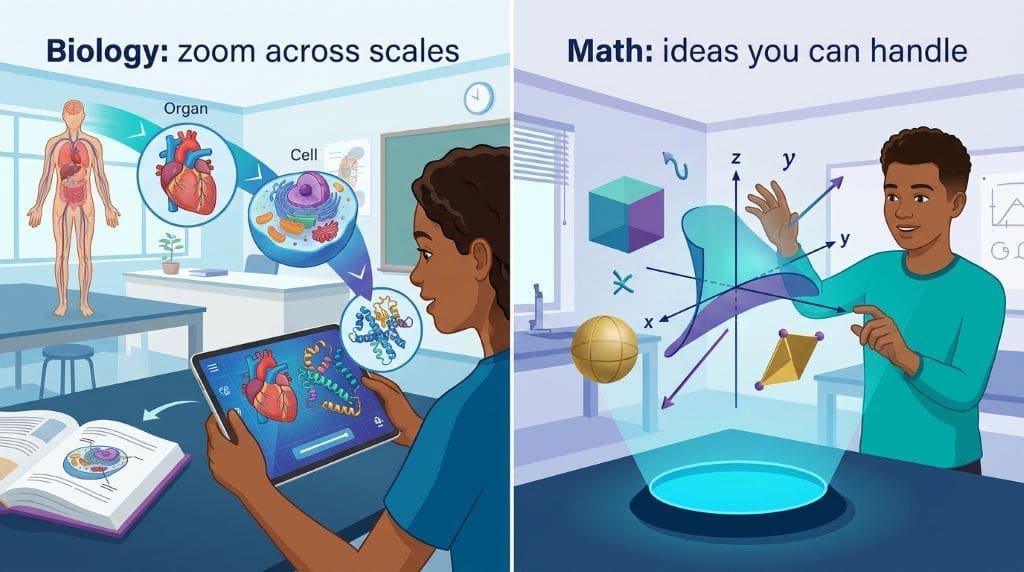
Biology covers a huge range of scales. In one lesson, students might go from studying a whole organism to looking at a single protein. Textbooks use simple diagrams to bridge this gap, but those drawings are often static and hard to interpret. Immersive tools let students move through these scales at their own pace, which is why AR and VR in STEM education transforms how biology is taught. For example, a student can start with the human body, zoom into an organ, and then go inside a cell to watch a protein fold. This kind of journey is hard to describe with words but easy to show in a virtual space.
Biomedical modules let students explore molecular machines, helping them build stronger mental images of cells and systems through AR and VR in STEM education. Words like organelle become linked to real pictures, so students remember them better as they tackle harder topics.
Virtual Dissection and Microscopy
Real specimens for anatomy cost money and raise ethical concerns. Many schools also struggle to store and prepare them. Virtual dissection removes those barriers completely, making AR and VR in STEM education invaluable for schools with limited resources. A student peels back layers of a virtual frog or heart and sees each structure labeled in place. A printed diagram flattens those layers into one image. The virtual model allows unlimited redos.
A student who cuts the wrong place can start over. Teachers should pair the virtual version with discussion so the tool shows structure while the teacher explains function. Together they build complete biological understanding. Real microscopes are expensive and can break easily, and students often have trouble focusing the image at first. A virtual microscope removes these problems. Students can drag a virtual slide under the lens and zoom in or out with a finger, and the image is always clear. Teachers can label cell parts directly on the screen, and students can match each label to the real structure. Practicing this way builds confidence, so students use real microscopes without fear later on.
How AR and VR in STEM Education Make Math Spatial
Mathematics is the most abstract STEM subject. Its objects exist only as ideas in the mind. That nature makes math hard for many students. Immersive tools turn those ideas into things people can handle. A graph becomes a surface students can walk around. A function becomes a shape they can stretch and bend. For instance, a learner pulls a point on a quadratic curve. The equation updates on the screen at the same time. That direct link between shape and formula is powerful indeed. It is nearly impossible to show on a static whiteboard. A review of recent AR and VR development found strong growth here. Researchers report gains in spatial reasoning and engagement. Wearable and mobile devices now deliver these visuals cheaply. So more classrooms can try them this year.
Geometry, trigonometry, probability, and calculus can become more understandable through immersive tools. Students can rotate 3D solids to explore volume, slice a cylinder to see an ellipse form, scatter virtual data points, and fit lines to understand slope and intercept. Motion also helps students visualize calculus concepts, such as limits, the area under a curve, and solids of revolution. These experiences allow students to grasp the ideas before learning the formulas and symbols. However, immersive tools should support—not replace—traditional practice. Students still need to work with abstract symbols on paper, but visual and interactive activities can build the spatial understanding and confidence needed to make those symbols easier to understand.
The Pedagogy Behind Immersive STEM Lessons
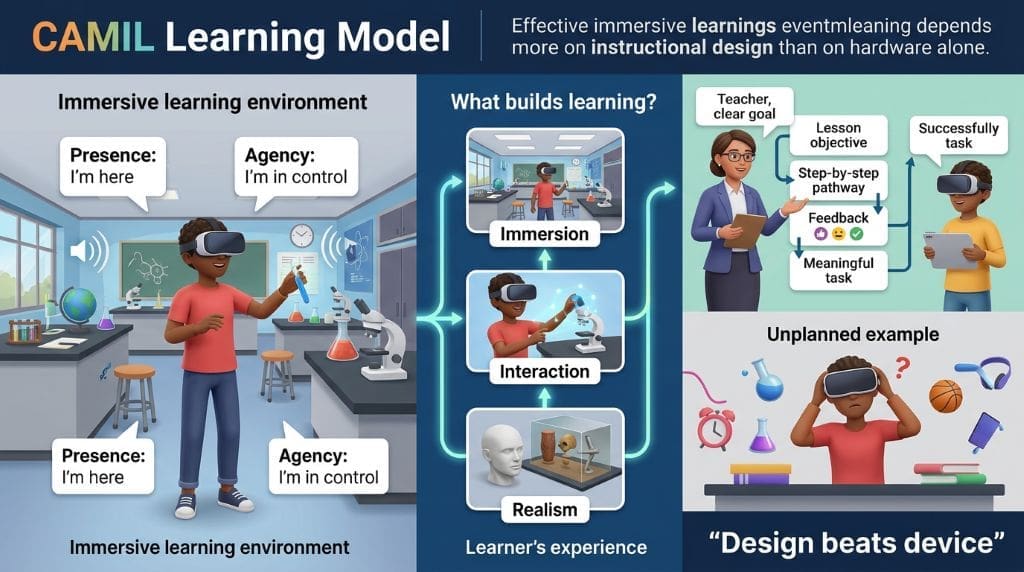
Even the best tools need a solid learning theory behind them. The Cognitive Affective Model of Immersive Learning, or CAMIL, explains why these tools are effective. Two main factors matter most: presence, which is the feeling of being inside a space, and agency, which is the feeling of control. Immersion, interaction, and realistic details help build both. When students feel present and in control, they learn better. But the model also warns that media alone doesn’t teach—good teaching methods do. A great virtual lesson still needs strong instruction. If teachers skip this step, the hardware goes to waste. Putting a student in a headset without a plan won’t lead to deep learning. Good design, not just the device, makes the difference.
Six Factors Shape Immersive Learning
CAMIL highlights six factors that support learning in virtual spaces. Teachers can use this list to review any lesson, whether it’s in physics, chemistry, biology, or math, and for students of any age. Each factor is easy to check during a quick classroom review. Strong lessons usually meet most of these points, while weak ones miss several. This checklist helps teachers improve quickly, turning vague impressions into clear action steps. A teacher can score a lesson in just five minutes, and the checklist works before, during, or after class. It becomes a regular part of planning.
- People become more interested when the content feels new and matters to them.
- Students’ motivation increases when they feel that they can complete the task.
- People’s self-efficacy increases following a series of small victories.
- Embodiment becomes greater when learners use their own bodies.
- Cognitive load stays low when design avoids clutter.
- Self-regulation strengthens when students set the pace.
Each factor also gives teachers a clear design goal. For example, a good physics lab keeps things simple to protect students’ working memory. The study mentioned earlier showed this: a clean augmented-reality view reduced extra mental effort. Designers should use only a few labels on the screen at once and let students control the pace. In general, students need to stay active during the lesson. Immersive lessons don’t work if students just watch—a passive tour wastes the opportunity. Active tasks make the most of these tools. Teachers can quickly check each lesson against the six factors, and a low score shows what to fix. Making this a habit can quickly improve classroom results.
A Classroom Observation
Last semester, I taught a mixed ninth-grade physics class. Some students had trouble picturing electric current, so I gave half of them a phone AR app that showed moving charges in a simple circuit. The other half used a textbook diagram. The difference was clear right away. AR and VR in STEM education proved its value instantly. The AR group discussed the direction of flow and used terms like upstream and junction on their own. The students in the textbook group asked me to give the definition again.
Students in the AR group created their own mental picture rather than simply copying my explanation. One quieter student drew the circuit from memory and corrected her own mistake using the AR app. The group who used the textbook merely copied the diagram without inquiring as to why. This contrast showed me how AR and VR in STEM education shifts students from passive reception to active discovery.
As a result of that lesson, I altered the way I teach. Nowadays I begin with a demonstration using AR or VR, then ask a series of guided questions, and finish off with a brief reading. This sequence enables the students to develop a mental model before they learn the labels. The approach keeps learning active and deepens retention far better than starting with vocabulary.
From the Classroom to STEM Careers: AR and VR in STEM Education
Immersive lessons do more than improve test scores—they teach skills that matter in real jobs. Today’s engineers, surgeons, and lab scientists use simulations every day. Students who learn with simulations are better prepared for these fields. Reports on future skills highlight abilities like spatial reasoning, digital teamwork, and flexible thinking. Immersive STEM activities help students develop these skills. Rotating virtual models sharpens spatial sense, and working together in a virtual lab builds teamwork. These tasks also encourage trying new ideas and learning from results, just like in real science and engineering. In this way, the classroom starts to look more like the workplace.
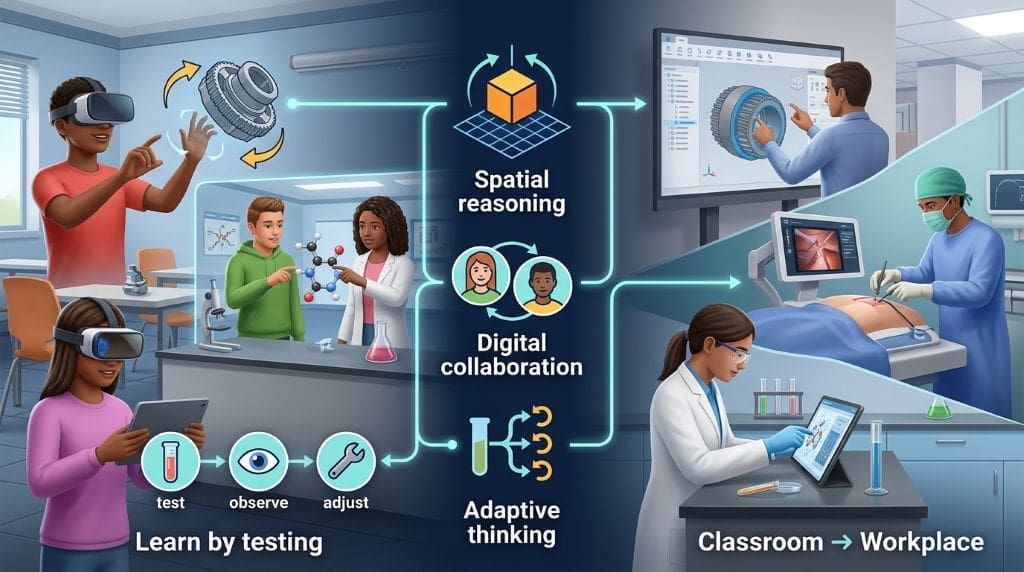
This connection to careers also boosts motivation because students can see why STEM subjects matter. A future surgeon, for example, can practice anatomy in 3D, while a future chemist can conduct safe reactions in a virtual laboratory. Similar simulation training is already used by pilots, doctors, and plant operators, so bringing these methods into schools gives students early exposure to real professional experiences. This exposure may also influence their future choices. A child who enjoys exploring the human body might become interested in medicine, while another who enjoys a virtual construction activity might consider engineering. By offering hands-on experiences that words alone cannot provide, immersive lessons can help students develop confidence, discover technical interests, and work harder toward long-term academic and career goals.
How This Guide Was Compiled
This guide is based on a clear research process. I started with the six open-access papers listed in the references, each of which is peer-reviewed and free to read. Their findings on AR and VR in STEM education, combined with my own classroom teaching and lesson design experience, shaped this guide. I checked every claim against its source before writing.
When a source described a specific study, I mentioned it in the text. Citations are linked to the right words in each section, so every fact is traceable, and readers can check each point themselves.
No claims in this guide are made up or based on memory. I read the abstracts, methods, and results of every cited source. The material moves from basic concepts to career connections, following the way a teacher might introduce a new topic. I used plain language and short sentences for clarity. Only open-access sources are included, and each was checked before use. Readers can follow every link and check the findings themselves. This openness helps build trust in the content.
FAQs About Immersive Science Lessons
Many studies show they improve engagement and spatial reasoning. Gains on fact recall appear less consistent.
Physics and math gain the most from three-dimensional tools. Chemistry and biology gain from safe simulations.
Not at first. Phone and tablet apps work well. They cost very little money.
Short and closely supervised sessions are usually safe, but teachers should be on the lookout for motion discomfort.
On the contrary, they support actual laboratories; virtual work cannot take the place of practical skills.
Start with one free app in one lesson. Then add a short VR activity.
Verified Resources
- National Science Foundation — Education offers STEM education programs and research.
- ERIC — Education Resources Information Center hosts peer-reviewed education literature.
- NASA STEM Engagement provides hands-on STEM activities.
References
Jiang, H., Zhu, D., Chugh, R., Turnbull, D., & Jin, W. (2025). Virtual reality and augmented reality-supported K-12 STEM learning: Trends, advantages and challenges. Education and Information Technologies, 30(9), 12827–12863. https://doi.org/10.1007/s10639-024-13210-z
A. M. Al-Ansi, M. Jaboob, A. Garad, and A. Al-Ansi (2023) ‘Analyzing recent developments in augmented reality (AR) and virtual reality (VR) in education’, Social Sciences & Humanities Open, 8(1), 100532. https://doi.org/10.1016/j.ssaho.2023.100532
Thees, M., Kapp, S., Strzys, M. P., Beil, F., Lukowicz, P., & Kuhn, J. (2020). Effects of augmented reality on learning and cognitive load in university physics laboratory courses. Computers in Human Behavior, 108, 106316. https://doi.org/10.1016/j.chb.2020.106316
Hemme, C. L., Carley, R., Norton, A., Ghumman, M., Nguyen, H., Ivone, R., Menon, J. U., Shen, J., Bertin, M., King, R., Leibovitz, E., Bergstrom, R. and Cho, B. (2023) Developing virtual and augmented reality applications for science, technology, engineering, and math education. BioTechniques, 75(1), pp. 11–20. https://doi.org/10.2144/btn-2023-0029
Zhang Y, Feijoo-Garcia MA, Gu Y, Popescu V, Benes B and Magana AJ (2024) Virtual and augmented reality in science, technology, engineering and mathematics (STEM) education: An umbrella review. Information, 15(9): 515. https://doi.org/10.3390/info15090515
Makransky, G., & Petersen, G. B. (2021). The cognitive affective model of immersive learning (CAMIL): A theoretical research-based model of learning in immersive virtual reality. Educational Psychology Review, 33(3), 937–958. https://doi.org/10.1007/s10648-020-09586-2