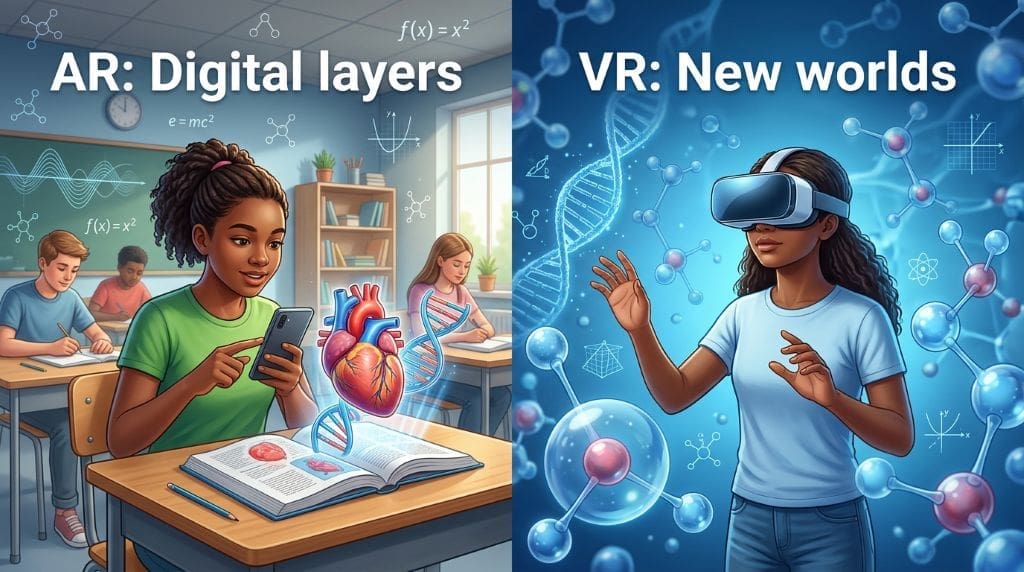
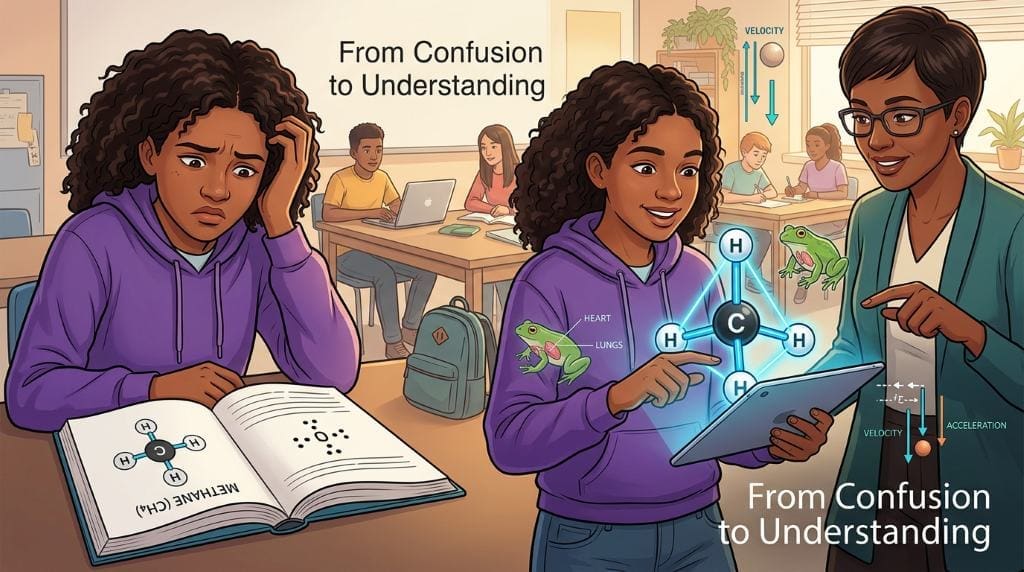
Envision a student having difficulty with molecular geometry. Since textbooks only display one side of a molecule, it is difficult for her to form a mental image, and she is frequently left feeling frustrated. However, with a tablet, she can view a three-dimensional model of methane, rotate it ,and zoom in on the bonds. This change causes her confusion to turn into understanding. Nowadays, teachers make use of immersive STEM technology by incorporating digital content into the real world. These solutions are often called AR STEM Classroom Applications, which let students carry out virtual frog dissections or run physics simulations even without special equipment. These augmented reality tools support conventional teaching since they help teachers to explain abstract concepts and allow students to interact with complicated systems, thus making the theory more practical.
Key Takeaways.
- Students can understand abstract STEM concepts more quickly with interactive 3D models than with traditional methods.
- Low-cost mobile AR apps make the technology accessible to most school districts.
- Guided inquiry approaches result in much better learning outcomes than unstructured exploration.
- Case studies from real-life situations show considerable improvements in spatial reasoning and long-term knowledge retention.
- Appropriate teacher training helps avoid cognitive overload and technical frustration during lessons.
- AR platforms align directly with the Next Generation Science Standards, enabling seamless integration into the curriculum.
- Early experience with these tools helps develop the basic skills needed for later careers in technical areas.
How AR STEM Classroom Applications Transform Abstract STEM Concepts into Tangible Learning
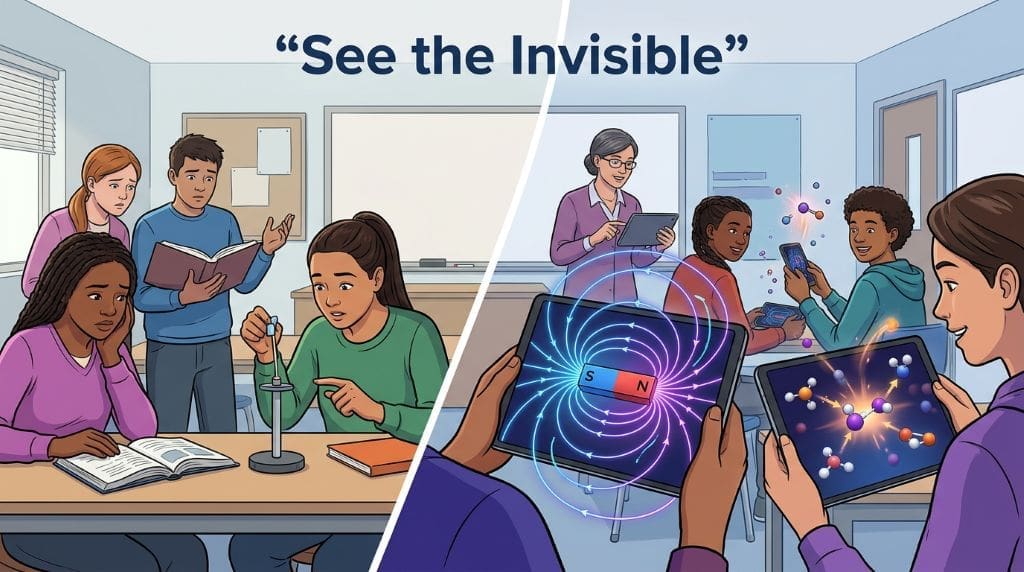
Traditional STEM teaching methods often fall short because magnetic fields and chemical reactions are invisible and hard for students to understand. Interactive 3D STEM simulations turn phones and tablets into windows into these invisible phenomena, helping students visualize previously abstract concepts.
Visualizing the Unseen in Chemistry and Physics with AR STEM Classroom Applications
Chemistry is difficult since students have to visualize electron transfers, bond angles, and molecular shapes, and this kind of complexity usually makes the subject hard to understand. AR STEM Classroom Applications can assist in this regard because augmented reality allows students to watch these processes take place. For instance, when looking at sodium chloride, they are able to see a virtual chlorine atom take an electron from sodium, with the particles appearing above their desk. By moving the tablet, they can observe the ionic bond being formed, which makes electronegativity something that can be seen rather than something that has to be memorized.
Physics classrooms benefit in similar ways. With AR, students can see electromagnetic fields as streams of light and gravitational wells as grids they can move and change. One middle school teacher saw quiz scores improve after using an AR app for circuit building. Students built virtual circuits, watched the current flow, and safely experienced short circuits. This safe environment helps students feel more confident when testing their ideas. Some students struggle with trigonometry because they can’t picture objects in their minds. AR-based math lessons help by letting students view virtual shapes from every angle and slice through cones to see conic sections. This technology builds a natural sense of space that paper exercises can’t provide. Students can interact with a spinning 3D model, see its internal structure, and view measurement notes. This hands-on experience leads to deeper mathematical understanding.
Supporting Multi-Sensory Learners with Immersive Tech
Students in every classroom have different learning styles. Some learn best by listening and looking at diagrams, while others need hands-on activities. Augmented reality helps by letting students interact with virtual objects, like exploring a virtual cell and moving its parts. This hands-on experience boosts memory and helps the brain treat virtual activities as real, making learning more effective.
Textbooks and lectures frequently fail to cater to students who learn most effectively by moving around or taking part in practical activities. Using augmented reality, students have access to a variety of methods for engaging with difficult subjects. For example, students with dyslexia can make use of 3D diagrams that are labeled, and English language learners can associate new vocabulary words with virtual objects. Because of this inclusive approach, STEM education becomes more equitable.
Evidence-Based AR STEM Classroom Applications: Classroom Outcomes and Case Studies
Stories have the ability to inspire teachers, but administrators require reliable data if they are to make decisions. Research indicates that well-designed AR lessons usually perform better than traditional methods in controlled studies. The following sections provide actual examples from the classroom.
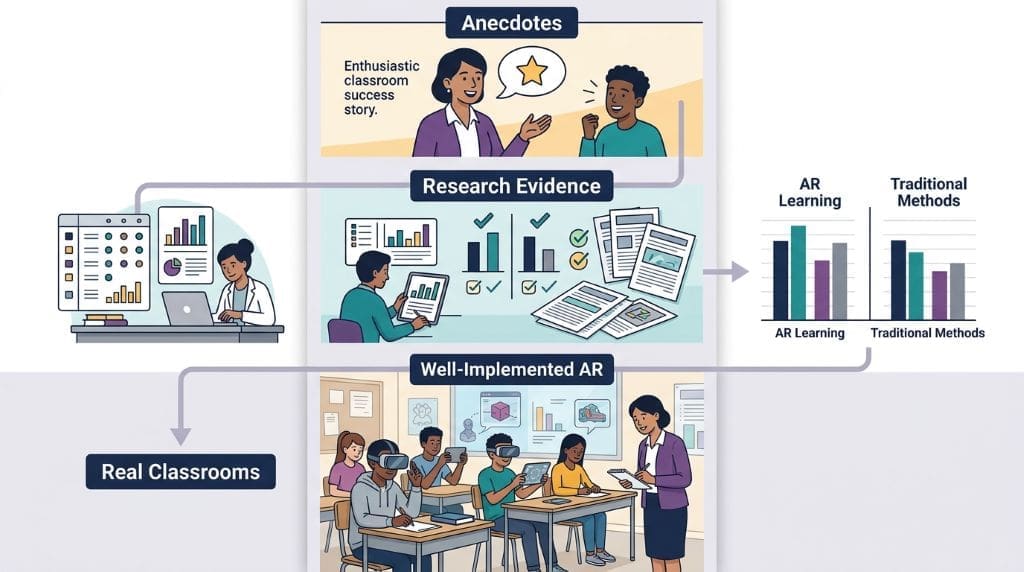
K-12 Case Study: The Singapore Primary Science Project
The education system in Singapore is frequently listed as one of the best in the world. Researchers carried out a thorough investigation into AR STEM Classroom Applications in primary science. The students were divided into a control group and an experimental group. Both groups were taught about plant systems. The control group used textbooks and two-dimensional diagrams, while the experimental group used an augmented reality application that scanned markers on seed packets. A three-dimensional flowering plant then appeared on their desks, allowing the students to peel back the virtual petals and zoom in on the stamen.
The findings were significant; although the two groups had similar scores before the test, the post-test analysis revealed a large effect size (Cohen’s d = 0.98) for the AR group. These students were able to remember detailed vocabulary items such as “phloem” and “xylem” for weeks longer than their classmates. Moreover, members of the AR group expressed higher levels of intrinsic motivation, referring to science class as “exciting” rather than “required”. The use of the technology changed the nature of learning from one based on memorization to one based on discovery.
Higher Education Application: Medical Anatomy Training
The gross anatomy labs involve a number of logistical difficulties, such as the limited availability of cadavers, high costs, and health hazards caused by the preservation of chemicals. Because of these issues, medical schools have resorted to using immersive STEM learning technology and have achieved positive results.

A randomized controlled trial carried out at a university in Europe examined the effectiveness of Microsoft HoloLens instructions compared with traditional cadaver dissection. Both groups studied the musculoskeletal system for three weeks. During this period, participants in the augmented reality group used headsets to view the bones and muscles of volunteer peers and were able to reveal the tissue layers using voice commands. In contrast, those in the cadaver group carried out dissections under supervision. Consequently, the final exam results revealed no significant difference between the two groups. Therefore, AR STEM Classroom Applications can achieve the same level of competency while avoiding the logistical difficulties associated with cadaver dissection.
Students using HoloLens could also repeat virtual dissections at home, which isn’t possible with real cadavers. The study found AR to be a scalable, ethical, and affordable way to support anatomy education everywhere.
Secondary School Impact of AR STEM Classroom Applications: Spatial Reasoning and Retention
A large-scale study in European secondary schools examined long-term learning outcomes through AR STEM Classroom Applications. Researchers used the Purdue Spatial Visualization Test to measure spatial reasoning. Experimental classes used interactive 3D STEM simulations, while control classes used traditional methods. After six weeks, students using AR improved their spatial visualization scores by 12%, while the control group showed minimal gains. This is significant for STEM equity, as strong spatial reasoning predicts future success in technical fields. AR can help develop this skill rather than relying solely on innate ability.
The results regarding long-term retention were also favorable. One week after the intervention, the AR students remembered 35 percent more of the core vocabulary than the group that followed the traditional method, which, as usual, suffered from learning loss. The researchers attribute this to the dual coding theory, according to which the brain stores both visual and verbal information and thus forms stronger memory traces. Instead of merely memorizing for exams, the students develop enduring mental frameworks.
Table: Summary of Key AR Learning Outcome Studies
| Study Focus | Educational Level | Main Finding | Measured Outcome |
| Plant System Biology | Primary School | Large effect size (d=0.98) | Conceptual understanding and motivation |
| Musculoskeletal Anatomy | Medical School | Equivalent to cadaver lab | Practical exam dissection scores |
| Spatial Reasoning & Chemistry | Secondary School | 12% gain in spatial scores | Purdue Spatial Visualization Test |
| Physics Circuits & Electricity | Middle School | 35% increase in retention | Delayed post-test factual recall |
These results show that augmented reality tools help students understand concepts better, not just keep them interested. Students learn more and remember information longer when lessons use virtual objects.
Practical AR STEM Classroom Applications: Tools and Implementation Strategies for Educators
Knowing AR works is only the beginning. Picking the right tools and adding them to lessons takes careful planning. With so many choices, teachers should review each technology to make sure it fits their learning goals.
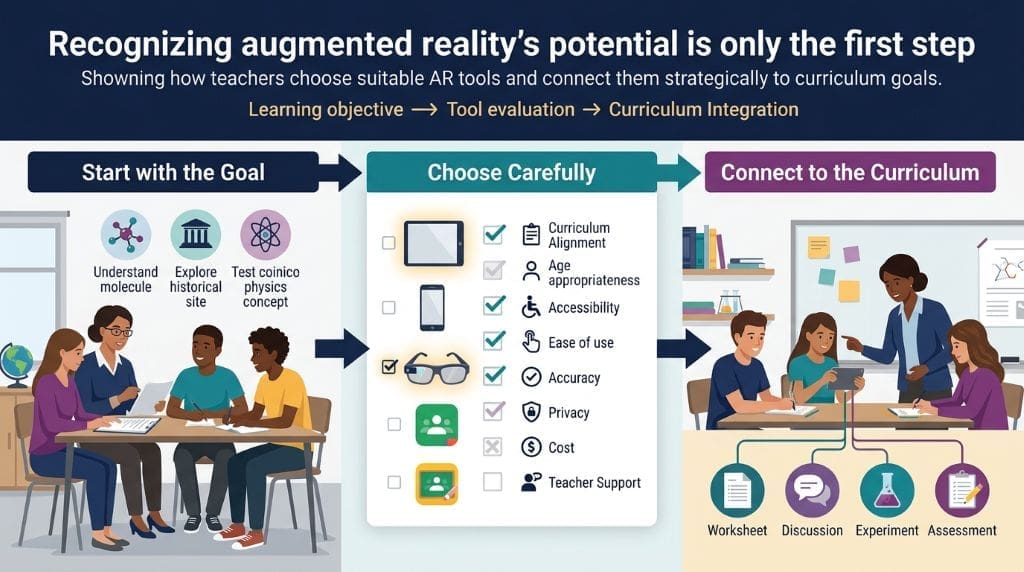
Software Platforms for AR STEM Classroom Applications That Align with Standards
Curriculum alignment is essential for effective AR STEM Classroom Applications. Apps that do not connect to state standards are often ineffective. Several platforms offer lesson libraries mapped to the Next Generation Science Standards and Common Core. Merge EDU, for example, is notable for K–8 classrooms. Students use a physical cube that transforms into interactive models, such as a beating heart or a water cycle. The tactile feedback enhances the experience, and teachers can access ready-made quizzes and activity plans through the platform.
Froggipedia has won the award for Apple’s iPad App of the Year for use in high school chemistry and biology courses. It enables students to carry out virtual frog dissections and to examine the different anatomical layers using an Apple Pencil. The app also has a life cycle section featuring labeled structures to help with academic vocabulary. This AR anatomy tool is cheaper than buying preserved specimens
Physics and engineering classes benefit from platforms like CoSpaces Edu, which enable students to create interactive 3D simulations using a block-based coding interface. For example, students can build Rube Goldberg machines to demonstrate energy transfer and momentum conservation, and classmates can view these creations on smartphones. This project-based approach develops higher-order thinking skills.
Hardware Considerations and Digital Equity
The digital divide makes it difficult for all schools to use AR STEM Classroom Applications equally. Some districts can afford expensive headsets, but most cannot. Fortunately, mobile AR has made implementation easier, since most smartphones and tablets released within the last five years can run marker-based AR apps effectively.
Teachers should check which devices are available before planning AR lessons and determine how many students can use AR apps at the same time. Most platforms work well when three students share one device and take turns using AR while completing other activities. This approach makes effective use of available resources and keeps the class running smoothly. Slow Wi-Fi can cause delays, so teachers should download all necessary materials in advance whenever possible. Preloading devices in the morning can also save valuable class time. These simple steps help ensure that AR STEM Classroom Applications are used effectively rather than left
Pedagogical Frameworks for Guided Inquiry
Technology alone doesn’t guarantee learning. Without guidance, students can get overwhelmed when they explore AR environments. Too much multimedia can overload their memory. Beginners need clear instructions to help them focus on what matters most.
The Predict-Observe-Explain framework provides an effective structure. To carry out the activity, teachers ask students to make predictions about what will happen before carrying out an AR simulation, for example, by asking them, “What will take place when I add zinc to hydrochloric acid in this simulation?” The students record their predictions, watch the virtual reaction, and then explain the differences between their predictions and what they observe. This approach promotes active engagement and critical thinking.
Collaborative learning can likewise improve AR experiences. At each AR station, two students should be assigned specific roles: the ‘Driver’ is responsible for operating the device and the ‘Navigator’ for reading the prompts and recording the observations. The roles should be swapped halfway through so that all students take part equally. This approach not only advances STEM learning but also helps to develop the use of academic language and communication skills.
Overcoming AR STEM Classroom Application Barriers: Training, Distraction, and Assessment
Effective tools require strong support systems. Without intentional change management, AR investments risk being underutilized, as seen with interactive whiteboards. Building teacher confidence, minimizing distractions, and designing valid assessments are essential for sustainable implementation.
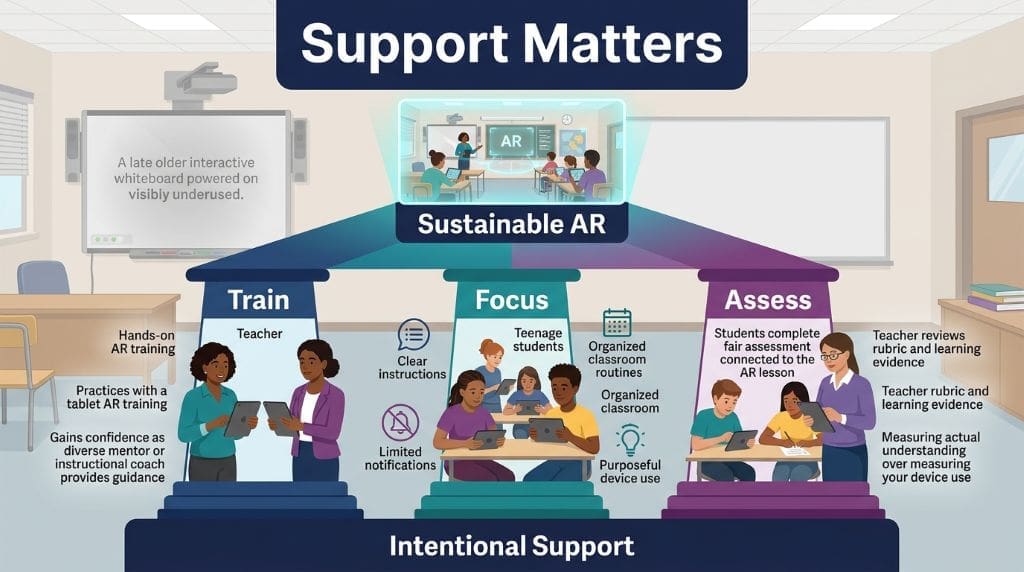
Teacher Training and Technical Confidence
Many teachers are new to augmented reality. In a 2023 survey, 64% of K-12 teachers said they were ‘novice’ or ‘complete beginner’ with AR. Administrators should offer hands-on training and give teachers time to try the technology before using it in class. Training should focus on practice, with experts ready to help with technical problems. This helps teachers build confidence and see the benefits for themselves.
The skills gained through initial training are maintained by peer coaching systems. Schools need to spot and pay teachers who are confident in using technology to act as mentors for their peers. When new users have a reliable source to turn to for simple questions, this reduces their frustration and helps to encourage continued use of the technology. This is known as the Novelty Effect.
The excitement of using something new can wear off quickly, which can affect research results. Teachers should focus on making AR lessons that keep students thinking and learning, not just interested in the new technology.
Limit extra animations. Pick apps with simple visuals and sounds to avoid distractions. Apps should have clean, professional interfaces like scientific tools, so students focus on learning, not rewards. For AR activities, ten to fifteen minutes of focused use usually leads to better learning than thirty minutes of open play. Use a timer in class. When time is up, have students put their devices face down. This routine helps students return to discussion and reflection. AR should be just one part of a varied lesson, not the whole lesson.
Authentic Assessment Design
Traditional multiple-choice tests do not effectively measure the spatial understanding developed through AR. Students may excel at manipulating 3D models but struggle with two-dimensional diagrams. Assessments should align with instructional methods to reflect learning gains accurately.
Performance-based assessments do provide a valid alternative; for instance, following an AR session, students can construct physical models in order to show their understanding of space or make narrated recordings of their AR interactions. Such methods show any reasoning involved and any misconceptions that written tests might fail to detect.
Digital portfolios let students collect evidence of their learning during the semester. They can save annotated screenshots of AR models to show how their thinking and science skills grow. Portfolios track progress over time and help students take charge of their learning. Learning is more than test scores. Immersive experiences can help students see themselves as scientists. For example, a middle school student who feels like a scientist is more likely to take advanced science classes later. AR can help inspire this by giving students access to real, professional-quality visualization tools.
Building Technical Fluency and Digital Literacy
Modern STEM careers depend on 3D visualization and simulation software. Early exposure to interactive 3D STEM simulations helps students develop fluency with these tools. Students comfortable with AR in elementary school are better prepared for professional-grade visualization technologies later.
Technical fluency gained through AR helps in other subjects too. For example, students who use AR to study topography learn about contour lines, which helps them in advanced classes. Teachers should highlight these career connections by sharing real examples and explaining how classroom tools relate to jobs.
Cultivating Spatial Reasoning for In-Demand Fields
Spatial reasoning is a key predictor of success in fields such as engineering, architecture, medical imaging, and data visualization. Research shows that targeted practice can develop spatial skills. AR applications offer effective training by allowing students to manipulate virtual objects, strengthening cognitive pathways for future technical creativity.
Guidance counselors and STEM teachers ought to work together on career exploration activities. Once students have used interactive 3D STEM simulations, the professionals should be invited in to show some real-world AR applications, thereby helping the students make the link between what they learn in the classroom and future careers. The fact that the content is relevant encourages them to persist when dealing with difficult material.
Lifelong Learning and the Evolving EdTech Landscape
Future augmented reality tools will offer more features, such as lightweight glasses, tactile feedback, and AI-generated 3D models. Teachers and students should stay flexible and focus on understanding spatial data, not just learning specific platforms.
Students who graduate comfortable with AR-based mathematics instruction and virtual laboratories will adapt quickly to whatever technology emerges next. They have internalized a learning process: observe a model, form a hypothesis, manipulate variables, and analyze outcomes. This scientific cycle operates regardless of the hardware delivering the pixels. By integrating augmented reality thoughtfully today, schools prepare students for a visually rich, data-dense professional future tomorrow.
How This Guide Was Compiled
This article was written by an Augmented Reality/Virtual Reality expert holding a degree in Computer Science Engineering with direct classroom teaching experience. The methodology prioritized empirical evidence from peer-reviewed, open-access publications over vendor marketing claims. Research began with systematic searches across Springer Open, PLOS ONE, ScienceDirect, and the International Journal of Information and Education Technology databases. Studies were evaluated for methodological rigor, including use of control groups, validated assessment instruments, and appropriate statistical analyses. Priority was given to studies that reported effect sizes and included longitudinal follow-up data. The author drew practical implementation strategies from firsthand experience training K-12 teachers on AR integration, observing student interactions, and troubleshooting technical deployments in underserved school districts. All recommendations align with Universal Design for Learning principles and the Next Generation Science Standards three-dimensional learning framework. The article avoids promotional language and acknowledges both the potential and the limitations of current AR technology.
Frequently Asked Questions
Most marker-based AR apps operate on existing student smartphones or a small set of tablets. Many foundational apps, such as those from Merge or Google Expeditions, offer free starter content. Meaningful integration can begin with a budget under $200 for a teacher tablet and printed markers.
Modern AR apps for K-12 education feature intuitive touch interfaces and visual cues. Even young students can navigate 3D models and basic interactions after a brief demonstration.
AR should supplement, not replace, hands-on labs. Physical labs teach essential skills and safety protocols, while AR is best for visualizing invisible processes or providing safe pre-lab training.
Effective assessment goes beyond multiple-choice tests. Teachers can use screen recordings with voiceover explanations, assign physical model-building tasks, or review annotated screenshots in digital portfolios.
Short, focused 10-15 minute sessions minimize these effects. Handheld tablet AR, which uses the real classroom as a background, causes fewer issues than fully immersive headsets. Teachers should encourage students to take breaks if they feel discomfort.
Verified Resources
Alkhabra, Y. A., Ibrahem, U. M., & Alkhabra, S. A. (2023). Augmented reality technology in enhancing learning retention and critical thinking according to the STEAM program. Humanities and Social Sciences Communications, 10(1), Article 174.https://doi.org/10.1186/s43031-025-00123-1
Cai, S., Wang, X., & Chiang, F. K. (2014). A case study of Augmented Reality simulation system application in a chemistry course. Computers in Human Behavior, 37, 31–40.https://doi.org/10.1016/j.chb.2014.04.002
Chang, H. Y., Wu, H. K., & Hsu, Y. S. (2013). Integrating a mobile augmented reality activity to contextualize student learning of a socioscientific issue. British Journal of Educational Technology, 44(3), E95–E99.https://doi.org/10.1111/j.1467-8535.2012.01379.x
Chen, P., Liu, X., Cheng, W., & Huang, R. (2017). A review of using Augmented Reality in education from 2011 to 2016. In M. Chang et al. (Eds.), Innovations in Smart Learning (pp. 13–18). Springer.https://doi.org/10.1007/978-981-10-2419-1_2
Garzón, J., Pavón, J., & Baldiris, S. (2019). Systematic review and meta-analysis of augmented reality in educational settings. Virtual Reality, 23(4), 447–459.https://doi.org/10.1007/s10055-019-00379-9
Ibanez, M. B., Portillo, A. U., Cabada, R. Z., & Barron, M. L. (2020). Impact of augmented reality technology on academic achievement and motivation of students from public and private Mexican schools. Computers & Education, 145, Article 103734.https://doi.org/10.1016/j.compedu.2019.103734
Ozdemir, M., Sahin, C., Arcagok, S., & Demir, M. K. (2018). The effect of augmented reality applications in the learning process: A meta-analysis study. Eurasian Journal of Educational Research, 18(74), 165–186.https://doi.org/10.14689/ejer.2018.74.9
Pellas, N., Fotaris, P., Kazanidis, I., & Wells, D. (2019). Augmenting the learning experience in primary and secondary school education: A systematic review of recent trends in augmented reality game-based learning. Virtual Reality, 23(4), 329–346.https://doi.org/10.1007/s10055-018-0347-2
Yilmaz, R. M., & Goktas, Y. (2017). Using augmented reality technology in storytelling activities: Examining elementary students’ narrative skill and creativity. Virtual Reality, 21(2), 75–89.https://doi.org/10.1007/s10055-016-0300-1