
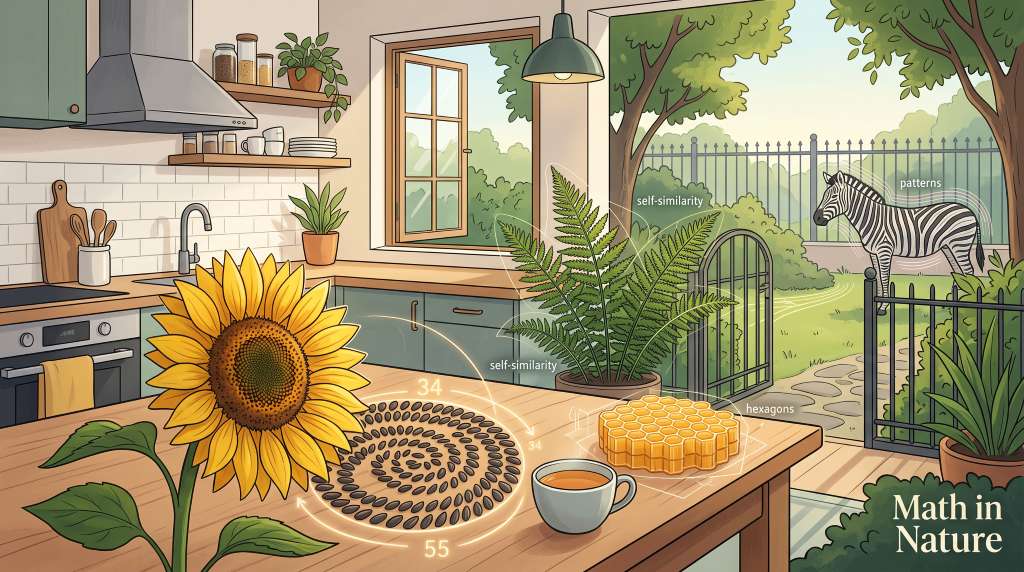
Imagine a sunflower placed on your kitchen table; you’ll find 34 seeds curving in one direction and 55 seeds curving in the other. These two numbers are adjacent in the Fibonacci sequence. Now consider the honeycomb in your tea each of the cells is a perfect hexagon. Take the fern next to your garden gate; each frond contains a smaller replica of itself. Zebra stripes can emerge from just two simple chemical rules. In fact, mathematics in nature is something you encounter every day. Numbers, shapes and rules all show up in everyday life. This comprehensive guide will explain the mathematics responsible for these observations. It includes practical examples and classroom activities. There is also a full section on career opportunities in this area.
What Mathematics in Nature Really Means
The subject rests on one key idea: we can describe living systems using rules. A seashell, for example, forms its spiral as it grows steadily. The spots on leopards come about due to two chemicals spreading out. In reality, reaction-diffusion models account for many animal coats. In both instances there is no need for a blueprint or designer. Rather it is the result of local interactions leading to a general order. This process is what scientists refer to as self-organisation. Consequently, this one idea had a major impact on modern biology.
In 1952 Alan Turing published his theory of the chemical basis of morphogenesis. He demonstrated that two chemicals can arrange themselves into patterns. Because of this, his mathematical work continues to influence research. The field therefore poses a practical question: what simple rules give rise to what kinds of shapes? Moreover, pattern formation takes place everywhere in living tissue. Hence the cells communicate with their neighbors and alter their behavior. In practice, these rules are found again in many different species.

This area is governed by three main families of rules. One of these consists of reactions and diffusion, two chemicals react in a local manner and spread at different speeds, as a result, this interaction leads to the formation of spots and stripes. Another family deals with growth and geometry, the plants continuously add new cells at specific angles, and it is these angles that determine the arrangement of the leaves. On the other hand, the third family is concerned with scaling and self-similarity, large structures repeat the same shape at smaller scales; rivers and lungs are examples of this behavior. Moreover, researchers use machine learning to select models through this data-driven method, which automatically matches patterns to equations.
The field thus combines traditional mathematics with up-to-date techniques. In fact, it is now possible to quickly test old theories using data. In practice, scientists compare the predictions with actual images of tissue and then adjust the numbers until the agreement becomes better.

Nature has another set of rules based on geometry. For instance, bees construct hexagonal cells in their hives. Hexagons, in fact, fit together with no gaps between them. This shape saves wax and creates more space for honey. Crystals also obey similar spacing rules as they grow. Moreover, salt takes the form of cubes and snowflakes take on star shapes. In practice, cell sheets use packing arrangements that are efficient. Recently, researchers have described curved soft cells that fill space perfectly. These shapes can be found in tissues and in shells. Generally, nature favours arrangements that waste very little.
Geometry and energy costs both explain this pattern. Mathematicians study these tilings using careful proofs and then examine which shapes are able to cope with real-world limitations. For example, soap films always minimise their surface area. This one rule leads to beautiful structures. Students can carry out the experiment using wire and soap.
Mathematics in Nature for Students: Building Intuition First
People usually first come across mathematics in nature by making simple observations. Begin by going for a walk and taking a small notebook with you. Measure the angle between two leaves on a single stem and also count the petals on ten flowers nearby. Next, draw the pattern of a branch on a tree that has no leaves.
These small activities quickly build genuine intuition. This in turn links school mathematics to the real world and causes students to see algebra and geometry as useful tools. Teachers can go on by using inexpensive and safe activities. For example, pour some ink into still water and observe what happens.
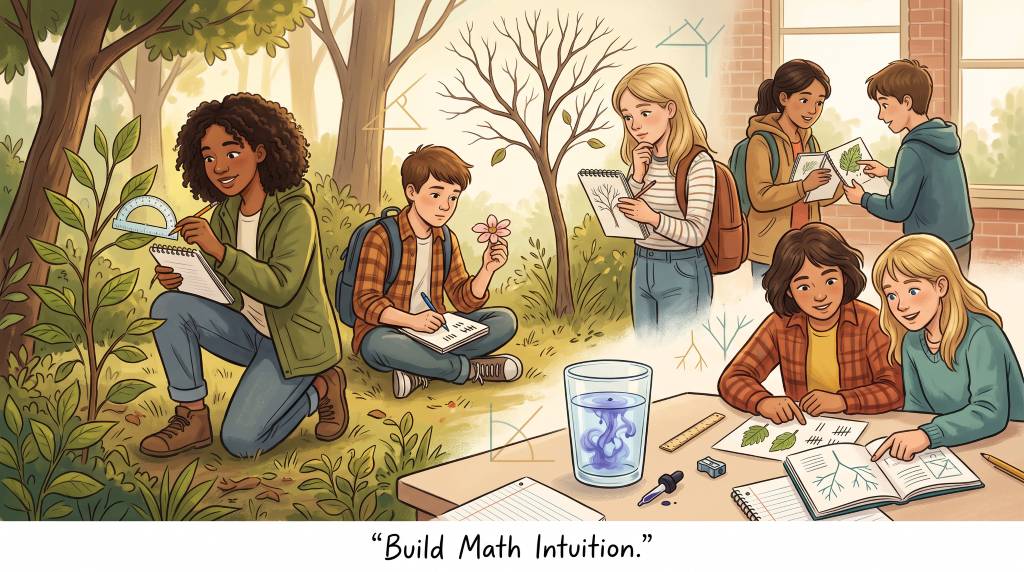
This simple experiment demonstrates diffusion in action. Gradually, the learners progress from counting to modelling and in the end abstract equations begin to seem friendly. Group work also helps less able students to take part in the activity. Each team provides one measurement to the class.
Mathematics in Nature: Fibonacci, Spirals and the Golden Ratio
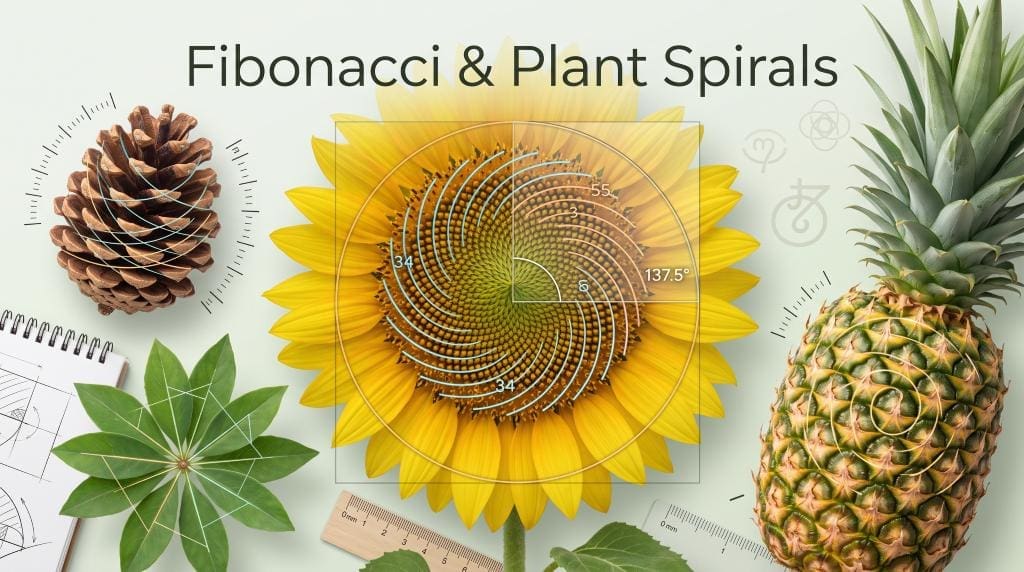
The famous number sequence was described by Leonardo of Pisa in 1202. To get each new number, you add the two that come before it, and the sequence starts with 1, 1, 2, 3, 5 and 8. If you divide one number by its neighbour, you approach phi, which is approximately 1.618 and is known as the golden ratio. Plants actually make use of these numbers quite frequently. For example, sunflowers arrange their seeds in 34 and 55 spirals. Pinecones generally have 8 and 13 spirals. Moreover, pineapples show 8 and 13 rows of bumps. These pairs of numbers are directly taken from the Fibonacci sequence.
The explanation is actually one of efficiency rather than magic. The seeds are packed closely and each one receives sufficient light; because of this, the spacing minimises wasted space. This arrangement is called phyllotaxis by botanists. Mathematical models are now able to produce a great many phyllotactic patterns. Some studies forecast that rare whorled arrangements occur in orixate plants.
The arrangement of the leaves is based on an angle known as the golden angle, its value being about 137.5 degrees. Each new leaf rotates around the stem by this angle. This means that the upper leaves shade the lower ones to a lesser extent. Consequently, each leaf is able to capture more sunlight for the process of photosynthesis. This simple method provides a real solution to an engineering problem. The spirals found in the seed heads function in the same way; they fill space evenly and prevent gaps from appearing.
On the other hand, some plants use other angles. Species in the Orixate genus exhibit a rare whorled arrangement. Moreover, the models include both the common and the unusual cases. Thus, a single framework is able to account for a variety of plant forms. At the same time, researchers keep testing these predictions. As a result, the original equations are often improved by new data. Over time the models become both simpler and more accurate. This progress aids students in understanding the underlying logic.
The golden ratio is the subject of a great many popular assertions. Certain writers connect it with paintings and pyramids. However, careful research has only validated a small number of these suggestions. On the other hand, the evidence concerning plants remains strong and consistent. In fact, the spirals found in plants do indeed correspond to angles related to the Fibonacci sequence. This has been confirmed for a magnetic cactus in the laboratory. Physicists have even created tiny magnets which arrange themselves in spirals.
Consequently, the same geometric rules reappear. The straightforward and balanced conclusion therefore is to place trust in measured data rather than in colourful anecdotes. In reality, good science is capable of embracing both wonder and scepticism. Some books frequently exaggerate the facts about this number. For this reason, scholars examine each of these claims in turn. A great many of them do not withstand close examination. For this reason, teachers should emphasize evidence rather than hype. Students will then be in a position to judge the claims for themselves.
Reading Patterns in Nature Mathematics in a Sunflower
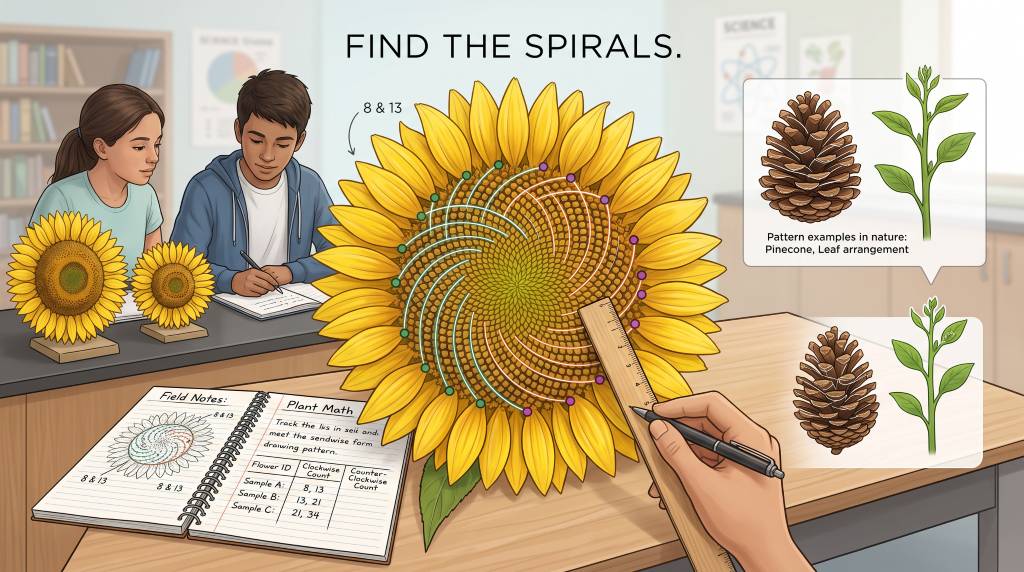
Choose a large sunflower head and a ruler. Begin by counting the spirals that twist in a clockwise direction and then write that number on paper. After that, count the spirals that twist in the opposite direction. You will usually discover two adjacent Fibonacci numbers, for example the pair 8 and 13 comes up frequently. This simple exercise makes the mathematical patterns in nature clearly apparent. Consequently, the sequence becomes a concrete thing for students to see. Eventually, the same test can be carried out on pinecones.
Some studies have even gone on to model the way these spirals develop. Their equations monitor auxin, a plant hormone. The movement of the hormone determines where each new leaf begins. Thus, geometry and chemistry interact in this case. This connection is something that surprises most people who are just starting out. In practice, carry out the exercise with three different flowers and then compare your counts with published data on plants. Accuracy is increased if you mark each starting point.
Mathematical Patterns in Nature: Stripes, Spots and Fractals
Simple rules lead to remarkable patterns in living organisms. Zebras’ stripes and leopards’ spots are based on the same chemical formula. An activator that spreads slowly comes into contact with an inhibitor that spreads quickly. The resulting struggle then settles down into stable forms. In fact, Turing foresaw this kind of behavior as early as 1952. Later on, scientists verified it in actual embryos. For instance, a study on zebrafish examined whether VEGFC produces Turing patterns. The chemistry in this case closely matched the theory. Moreover, laboratory experiments have produced similar spots in a gel. These experiments used the chlorite-iodide-malonic acid reaction.
The outcomes resembled the markings found in animals. For this reason, biologists currently have confidence in reaction-diffusion models. The mathematics allows predictions as to where a pattern will occur. In fact, it is able to predict the distance between the stripes. This predictive ability is what makes the theory so useful. Because of this, the mathematics is used to guide current experiments. As a result, the spacing that was predicted often agrees with the results from the laboratory.
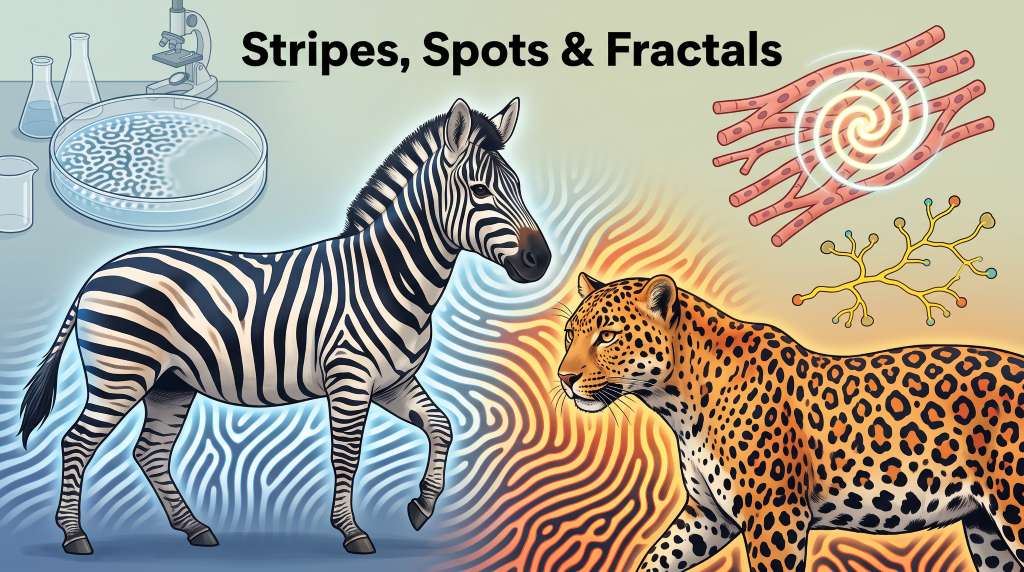
Patterns also occur in time as well as in space. The heart muscle produces waves of electrical activity, and these waves move through the tissue in a organised spiral fashion. Moreover, chemical systems display rotating waves in shallow dishes. A single spiral can continue to rotate for hours without disappearing. Once the wave breaks down, irregular rhythms may then occur. At the same time, medical researchers examine these dynamics in detail. Meanwhile, slime moulds create networks that resemble road maps. For instance, they link food sources with efficient routes. Generally, engineers take those designs and use them for transport networks.
Therefore, patterns found in nature influence practical technology every day. In fact, nature dealt with these problems a long time ago. The reason is that copying these solutions saves both time and materials. Consequently, biomimicry now involves thousands of scientists. Furthermore, these patterns lead to the development of new medical treatments. At the same time, careful modelling ensures that patients are kept safe during diagnosis.
Why Simple Rules Build Complex Shapes
Actually, mathematics in nature shows that complicated shapes do not need complicated instructions; a small number of local rules can produce endless variety. For instance, when a shell deposits material at its opening, each new ring becomes only slightly larger than the one before it and, after a period of months, a logarithmic spiral results. In this case, there is no central planner directing the growth; instead, it is chemistry and physics that control each step. The same principle applies to nerve cells and blood vessels as well; it is local signals that tell them where to grow. Furthermore, a minor modification of one rule leads to a different final shape. This sensitivity is the reason why species show such differences.
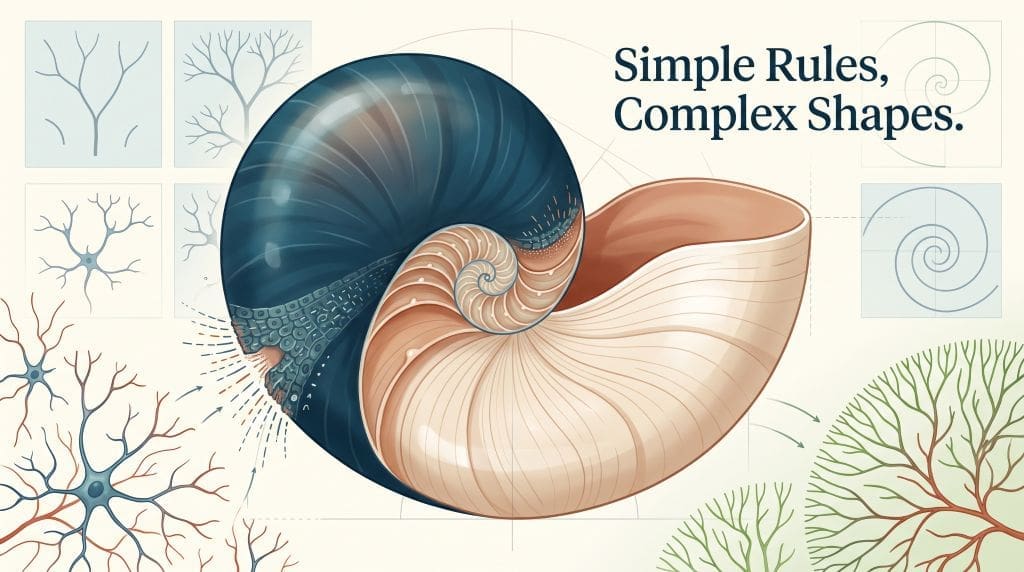
To sum up, nature continuously makes use of simple recipes. The behavior in question is called emergence by mathematicians. The final pattern is not programmed directly. For example, a small change in the speed of diffusion makes all the difference. As a result, researchers are able to quickly simulate a great many possible outcomes. Comparing the simulations with real organisms ensures that the simulations remain accurate.
Fractals in Rivers, Lungs and Lightning
Fractals show similar patterns at different scales, a key feature of mathematics in nature. For example, river deltas split into smaller channels, lungs branch into millions of tiny air sacs, and lightning forks repeatedly across the sky. Mathematicians use fractal dimension to measure how a shape fills space.
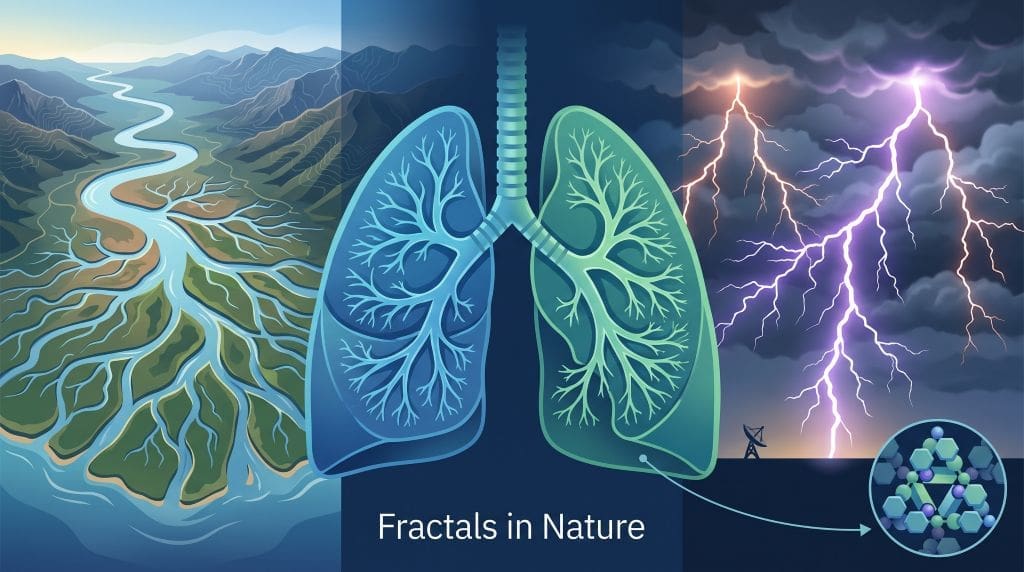
In reality, coastlines and mountain ridges have a high fractal dimension. Fractal geometry is also good at describing actual terrain, and in fact engineers apply it when designing antennas. Moreover, a recent discovery has taken fractals down to the molecular level. Scientists have found a bacterial enzyme which self-assembles into triangular shapes. This finding demonstrated that nature can construct fractals using proteins and it also showed that evolution can lead to geometric accidents. The enzyme is made up of a simple hexagonal block. Furthermore, ancestral reconstruction has been used to trace how this ability evolved. However, no physiological purpose has yet been confirmed.
Mathematics in Nature Examples for Students and Classrooms
Examples of mathematics in nature turn abstract concepts into memorable classroom lessons. Begin with materials from your local area and use simple tools. All you need is some string, a ruler, a notebook, and patience. Measure the height and width of twenty fallen leaves. Then plot the results and look for a ratio. After that, compare your figures with the Fibonacci sequence; you may discover a surprising connection.
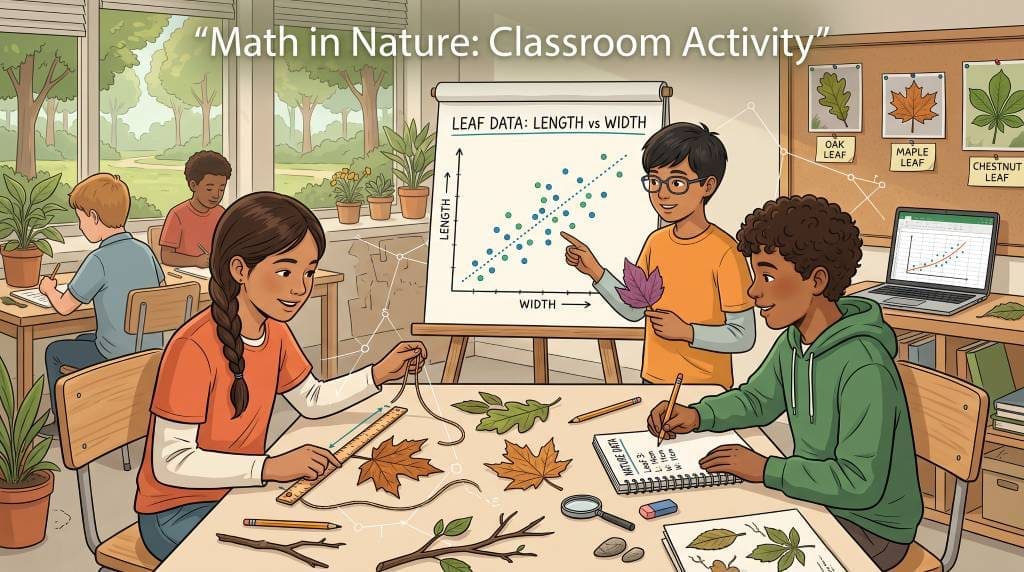
It is also a good idea to take photographs of the leaves for use in a class display. Digital tools are even capable of fitting equations to your data. Modern software can identify a model from an image by itself. Such tools introduce research methods into the classroom. As a result, students get the chance to carry out real scientific reasoning. As a result, they collect, compare and question the evidence themselves. Generally speaking, all this remains cheap and easy to repeat. This ease is important for schools with limited funding. Teachers can modify this activity to suit each age group.
Mathematics in Nature Examples You Can Test at Home
You can explore mathematics in nature through simple experiments at home. Add food coloring to a shallow tray of milk, then touch the surface with a soapy cotton bud. Watch the colors spread into branching patterns. Next, place a drop of water on a leaf to observe how its waxy surface affects the drop’s shape. You can also grow cress seeds on wet paper and record the angles of new shoots over several days. Finally, compare your measurements with the golden angle.

The cost of setting up each of these experiments is almost nothing. Because of this, carrying out the experiments at home supplements what is taught in school. Also, parents often learn together with their children. The common interest they share helps to foster a lasting enthusiasm for science. Attempt one experiment every week in order to make steady progress.
A Classroom Observation on Measuring Leaves
I used to teach a physics class to ninth-year students next to a park and distributed rulers for a straightforward measurement activity. Each group was asked to measure the leaf angles on the same shrub. A quiet student discovered that her readings were close to 137.5 degrees and then asked me why the plant had chosen that particular angle. In the following lesson we looked into golden-angle rotations. That question originated from a student who was using a plastic ruler.
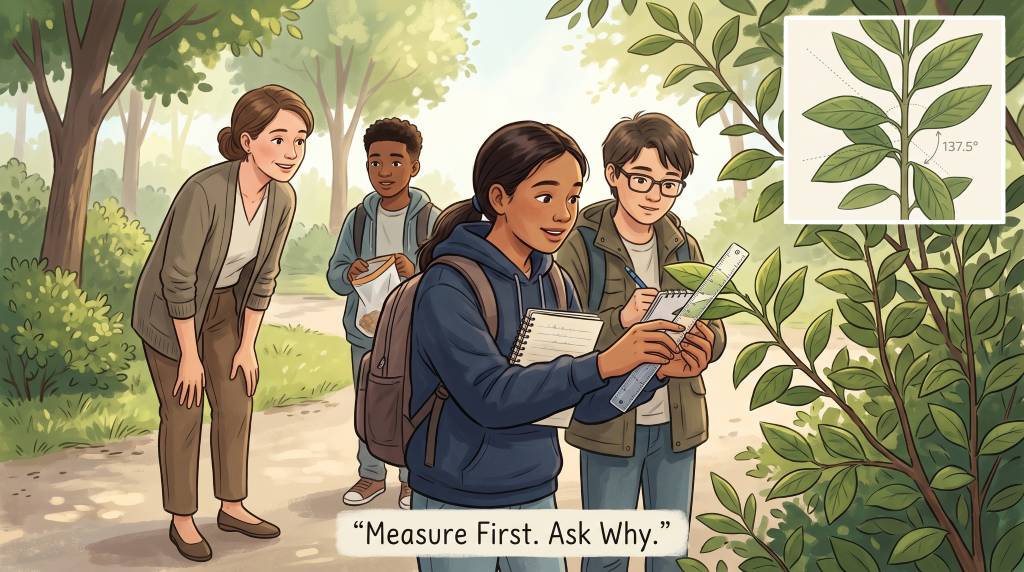
In truth, it taught me more than any chapter in a textbook. Ever since then I have always begun this subject by going outdoors. In practice, genuine curiosity always outperforms well-prepared slides. Actually, the real leaves make the mathematics seem more genuine. It is for that reason that students come to trust the figures that they collect themselves. When you hold the evidence in your hand, it makes all the difference. For that reason every lesson is built around measurement. We finally deal with the theory afterwards, not before.
Day Trips, Data and Honest Comparisons
Field trips make mathematics in nature easier to understand. Take students to a park, garden, or riverbank and ask them to record five branching structures. Back in class, they can sketch each shape, measure branch angles and channel widths, and compare their results with peer-reviewed research. This activity connects classroom ideas to real observations while building teamwork and careful recording skills. Students also learn to question their findings rather than simply memorise formulas.
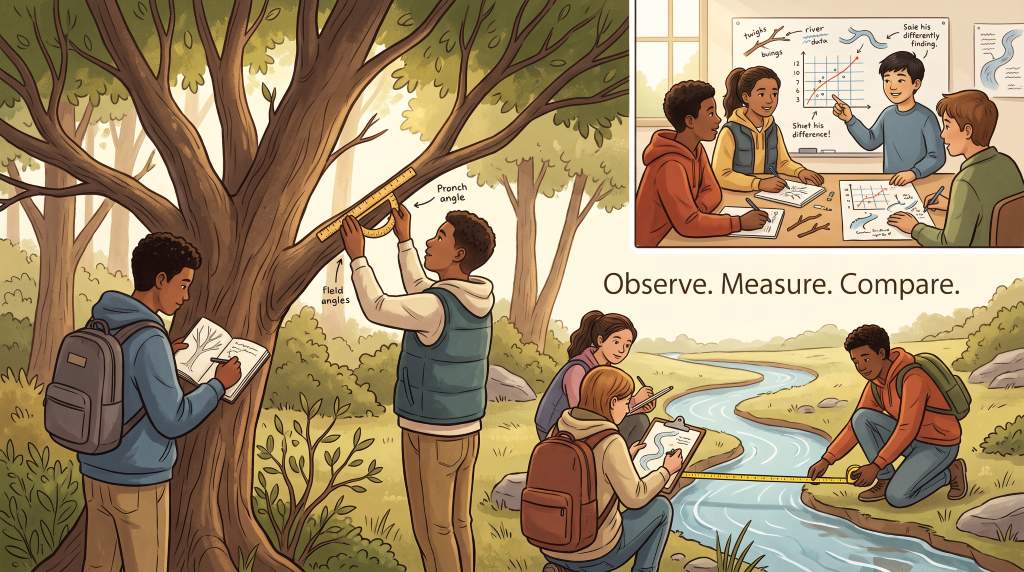
Mistakes can lead to useful discussions. Scientists check their work and share results openly, even when the findings differ from their expectations. By debating the data, students learn to think critically. Fieldwork also helps quieter students build confidence and take part in group learning.
Seven Steps from Foundational Patterns to Science Careers
A clear learning path helps students build their skills step by step, from simple observations to professional techniques. It also connects mathematics in nature to wider applied mathematics. Teachers can use this path as a syllabus or checklist and adapt each stage to different age groups.
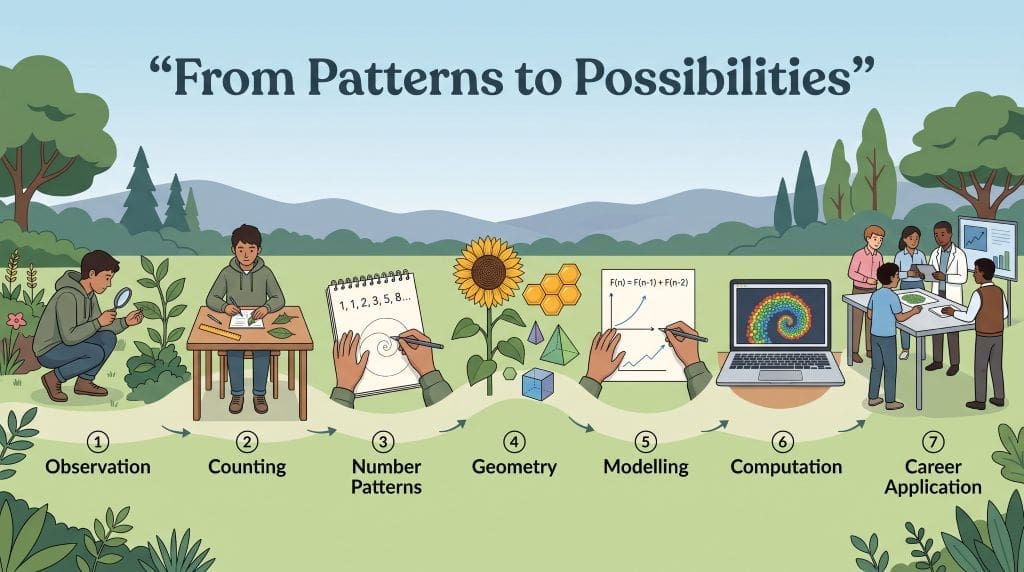
Students learn more when they follow the stages in order rather than rush ahead. Steady progress builds understanding and confidence. At each stage, students should produce something concrete, such as a record of their measurements. These portfolios often show learning better than memory tests. Parents can also support learning through simple kitchen experiments, keeping curiosity alive beyond school. By the end of a term, students should feel more confident explaining how patterns form.
Careers That Use Mathematics in Nature Every Day
These skills open doors to many careers. Biologists model how tissues and organs develop, while physicists study self-organising materials and magnetic systems. Mathematicians develop pattern equations, and data scientists train models using microscope images. Engineers use fractal maths to design antennas, while medical researchers study branching in the lungs and blood vessels. Climate scientists examine river networks and coastlines. Mathematics in nature connects these fields, and employers value people who can measure, model, and explain patterns.
To build these skills, combine mathematics with a life science. Start by learning a programming language and taking a statistics course. Then use both to investigate a biological question. Small research projects give you practical experience and help you stand out in interviews. Showing what you can do can be just as important as your grades.
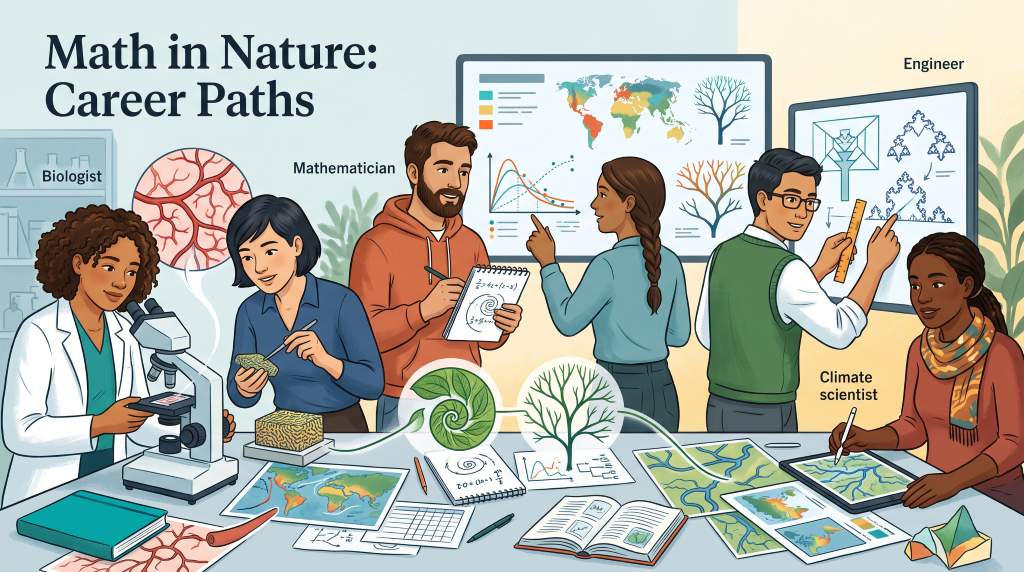
Here, education and skills are more important than raw talent. In practice, you should establish a solid foundation in calculus and algebra and also study statistics since real data always has noise. At the same time, learn one programming language thoroughly. Generally, you should get into the habit of explaining your results clearly because communication skills distinguish good scientists from great ones. Publishing your work open access also helps it to be read by a wider audience. Moreover, working together with people from other fields quickly increases your impact; for example, biologists and physicists have now published joint papers and this kind of teamwork enables them to solve problems which neither group could deal with on its own. Select a specialist area where your skills actually overlap and then strengthen that overlap through patient and consistent practice.
Furthermore, attending conferences provides new opportunities. Over time, small and regular efforts build up over many years and this continuous method is better than short bursts of enthusiasm. In practice, true skill is developed through patient and consistent practice.
How This Guide Was Compiled
I prepared this guide using peer-reviewed, open-access research. For each citation I verified its entry in the DOI database. Moreover, my classroom teaching experience was also taken into account. The examples included here were influenced by my secondary physics lessons. I selected sources which readers can access free of charge. In cases where popular claims were not well supported by evidence, I made that clear. This article does not include any unpublished or speculative results. All the figures and examples given here are taken from the referenced papers. Further corrections and updates will be made when new published evidence becomes available. This approach ensures that the guide remains reliable over time.
In practice, I tried to avoid using journals that require payment. Each source can be checked by the reader via the reference list. I believe that transparency is more important than making impressive claims. Any errors that are left unresolved are my own responsibility.
Verified Resources
These free resources come from universities, government archives or peer-reviewed societies. Each one supports classroom teaching or independent study.
- Fibonacci Spirals in Plants – University of Illinois Chicago teaching notes written for high-school mathematics teachers.
- Fractal Patterns: Science Activity – Exploratorium classroom activity on self-similar shapes in nature.
- Fractal Geometry and Its Applications – University of Utah lecture notes on self-similarity and scaling.
- Mathematical Interpretation of Fractal Dimension – Cornell University explanation of scaling exponents.
- Fractal Geometry course material – Yale University reference on fractal sets and measures.
- Phyllotaxis and Fibonacci in Plant Biology – American Society of Plant Biologists teaching resource.
- PubMed Central open-access archive – United States National Library of Medicine database of free full-text papers.
Frequently Asked Questions
A sunflower is a simple example of math in nature. Its seed spirals often follow Fibonacci numbers, such as 34 and 55.
Sunflowers often follow Fibonacci numbers because each new seed grows at an angle of about 137.5°, known as the golden angle. This arrangement creates interlocking spirals that help seeds fit efficiently into the flower head.
Yes, fractals appear in everyday life, from tree branches and river networks to lungs and lightning.
Students can explore mathematical patterns at home or school by measuring leaf angles, counting petals, and observing branching structures. They can also try simple diffusion experiments using milk and food coloring.
No, the golden ratio (approximately 1.618) does not appear everywhere in nature. It occurs in some plant growth patterns, including certain leaf and seed arrangements.
References
- Hishinuma, H., Takigawa-Imamura, H., & Miura, T. (2025). Data-driven discovery and parameter estimation of mathematical models in biological pattern formation. PLOS Computational Biology, 21(1), e1012689. https://doi.org/10.1371/journal.pcbi.1012689
- Maini, P. K. (2004). Using mathematical models to help understand biological pattern formation. Comptes Rendus Biologies, 327(3), 225-234. https://doi.org/10.1016/j.crvi.2003.05.006
- Nisoli C., Gabor N., Lammert Paul E., Maynard J. D., & Crespi V. H. (2009). Static and dynamical phyllotaxis in a magnetic cactus. Physical Review Letters, 102(18), 186103. https://doi.org/10.48550/arXiv.cond-mat/0702335
- Sendker, F. L., Lo, Y. K., Heimerl, T., Bohn, S., Persson, L. J., Mais, C.-N., Sadowska, W., Paczia, N., Nussbaum, E., Sanchez Olmos, M. del C., Forchhammer, K., Schindler, D., Erb, T. J., Benesch, J. L. P., Marklund, E. G., Bange, G., Schuller, J. M., & Hochberg, G. K. A. (2024). Emergence of fractal geometries in the evolution of a metabolic enzyme. Nature, 628(8009), 894-900. https://doi.org/10.1038/s41586-024-07287-2
- Smith, R. S. (2008). The role of auxin transport in plant patterning mechanisms. PLoS Biology, 6(12), e323. https://doi.org/10.1371/journal.pbio.0060323
- Turing, A. M. (1952). The chemical basis of morphogenesis. Philosophical Transactions of the Royal Society of London. Series B, Biological Sciences, 237(641), 37-72. https://doi.org/10.1098/rstb.1952.0012
- Tyson, J. J. (2026). Revisiting Turing’s chemical basis of morphogenesis. Bulletin of Mathematical Biology, 88(5). https://doi.org/10.1007/s11538-026-01629-z
- Wertheim, K. Y., & Roose, T. (2019). Can VEGFC form Turing patterns in the zebrafish embryo? Bulletin of Mathematical Biology, 81(4), 1201-1237. https://doi.org/10.1007/s11538-018-00560-2
- Yonekura, T., Iwamoto, A., Fujita, H., & Sugiyama, M. (2019). Mathematical model studies of the comprehensive generation of major and minor phyllotactic patterns in plants with a predominant focus on orixate phyllotaxis. PLOS Computational Biology, 15(6), e1007044. https://doi.org/10.1371/journal.pcbi.1007044