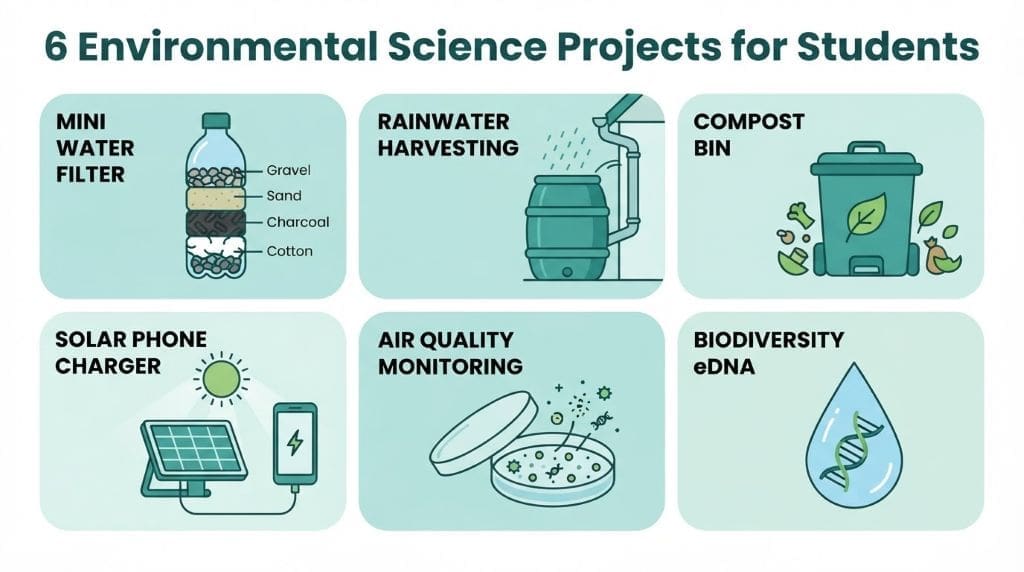
Environmental science is one of the coolest fields you can explore as a student. After all, it connects directly to the world around you. You don’t need a fancy lab or expensive equipment to get started. In fact, some of the best environmental science projects can be built right in your backyard or classroom. So, let’s talk about five (one extra) environmental science projects ideas that are easy to build, super impactful, and genuinely fun to work on.
Why Environmental Science Projects Matter?
Student climate awareness is already high. Hands-on participation, in contrast, lags behind. Zeeshan et al. (2021) surveyed 717 secondary and higher-secondary students in Rajouri, India. Roughly one in four students showed high awareness of climate change. At the same time, 60% scored high on environmental advocacy. In addition, 88% said they were willing to take environmental action.
Yet the study found a gap. Students who learned about climate change through formal education were not joining adaptation or mitigation actions. Because of that gap, the authors call for more hands-on exposure in school curricula. In other words, students learn about problems but rarely test solutions themselves. These environmental science projects fill that gap.
For a wider view of the field, ENTECH Magazine’s toxicology and environmental health features are free to read.
Climate change conference sessions and student meetups can help you share what you find.
5 Environmental Science Project Ideas for Students
Project 1: Mini Water Filter
It is the standard first project for students doing environmental science experiments. You construct a filter using a plastic bottle and then check how effective it is at cleaning muddy water. It shows students the principles of filtration, water quality, and experimental design in one afternoon.

How to build it:
- Remove the bottom from a clean 2-liter plastic bottle.
- Turn the bottle upside down, so the neck is at the bottom.
- Put it in a jar or another cup.
- Put a coffee filter or a piece of cloth into the neck.
- Start by adding the fine sand, then the activated charcoal, and finally the gravel.
- First, rinse the entire filter with some clean water and collect the dirty water that comes out.
- Slowly pass the muddy water through and collect the filtered water below.
- Check the clarity, colour, and odour before and after.

Caution: do not drink the filtered water; it is still not safe to drink
The bigger impact
The water data students collect is genuine. For example, Sefchick et al. (2021) studied high school students who tested 80 homes in Pelham, New York. The students found that lead exceeded the EPA limit of 400 ppm in about one in five soil samples. They also demonstrated that flushing a tap for two minutes clearly reduced lead levels in all cases. This simple habit change was based directly on the students’ measurements. Nevertheless, the team still identified lead-based paint as the greatest risk.
If you want to check water quality rather than filter it, Younkin and Romano (2018) outline a three-hour laboratory experiment involving bioluminescent bacteria. The students used Photobacterium phosphoreum or Aliivibrio fischeri to detect common pollutants. All fertiliser, household cleaners, and motor oil caused the glow to fade. As a result, environmental science projects for students can help identify contamination without carrying out expensive chemical tests.
If you want to try an advanced version, then use a nature-based filter. Almeida and others (2024) conducted a classroom exercise in which students built a small constructed wetland. The system uses gravel, plants, and time to purify contaminated water. Beyond filtering, it also replicates how actual wetlands protect rivers and oceans.
Related post: Environmental Toxicology Conferences: Young Minds for Future
Project 2: Rainwater Harvesting System
An environmental science project that can turn storm into a data set using a rain barrel. You calculate how much rain your roof catches, then keep records throughout the season. In this process, you also learn about water scarcity and runoff. The UN-Water states that over 2 billion people live in countries experiencing water stress. Rain harvesting by itself won’t solve the problem. Nevertheless, it does demonstrate how small systems can collectively make a difference.
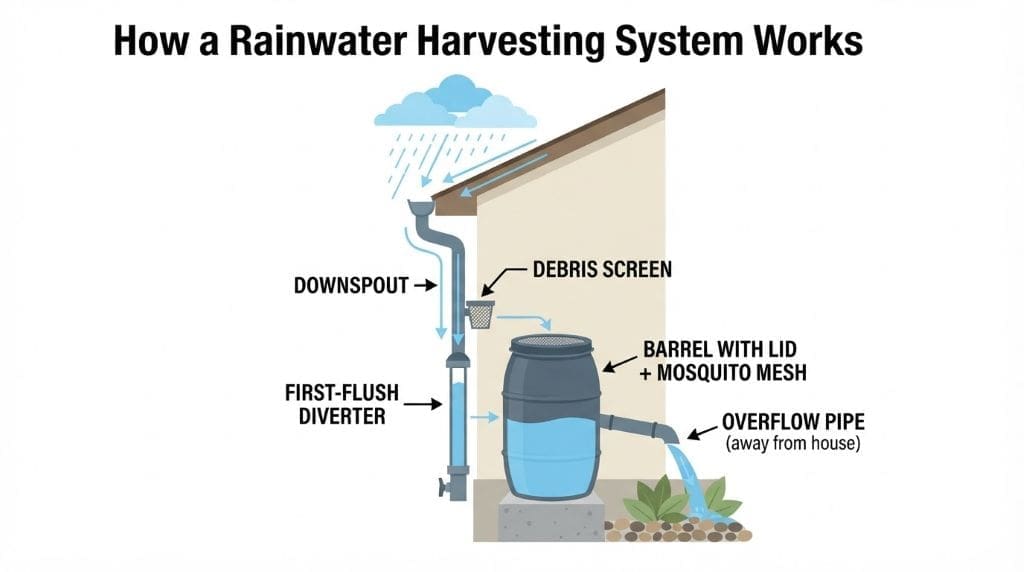
How to build it:
- Choose a downspout that is near your garden or a group of plants.
- Place a clean barrel on a firm, level base.
- Include a first-flush diverter or, at least, a debris screen.
- Attach the downspout to the barrel inlet.
- Attach an overflow pipe that extends away from the house.
- Put a tight lid and mosquito mesh on the barrel.
- After each storm, measure the volume collected and record the rainfall amount.
Safety note: Do not drink the collected water; use it only for watering plants or washing.
Project 3: Compost Bin to Reduce Food Waste
In a landfill, food waste decomposes without oxygen and releases methane, a strong greenhouse gas. Composting, on the other hand, returns nutrients to the soil. Most importantly, you can do the project with just a bin, a scale, and a desire to learn.
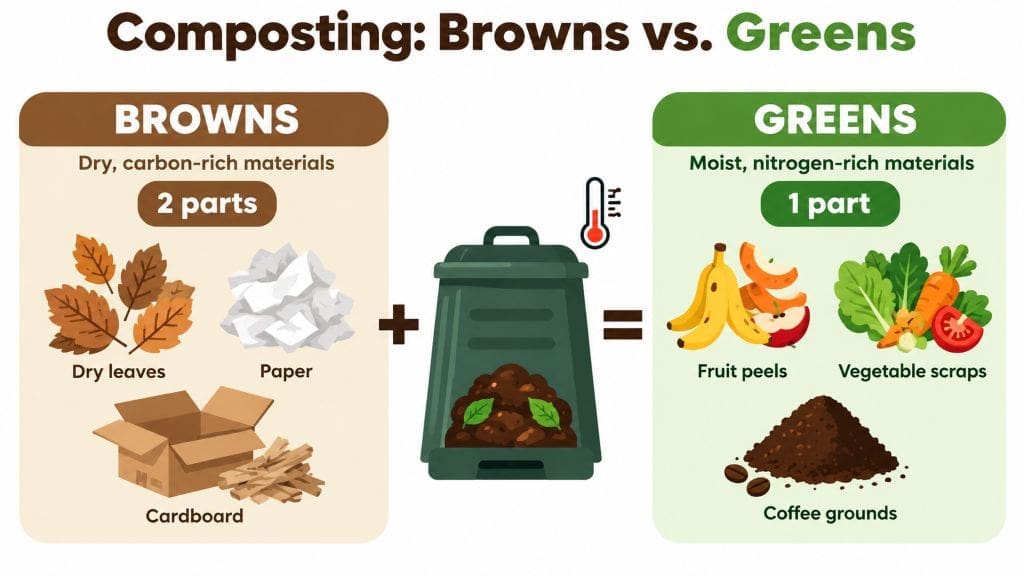
How to build it
- Make a series of air holes around the lid of a plastic bin.
- Begin with a thick layer consisting of “browns”, such as dry leaves, paper, or cardboard.
- Add “greens”: fruit peels, vegetable scraps, and coffee grounds.
- Maintain a ratio of about two parts browns to one part greens.
- Use a small fork to turn the pile once a week.
- Keep it as moist as a squeezed sponge.
- Use a compost thermometer to monitor compost temperature.
- Each week, calculate how much food waste you divert and draw a graph.
The bigger impact
The practical aspects of waste management can influence students’ behaviour. In their 2019 study, Liao and Li interviewed 562 high-school students in China. They found that environmental education was a major factor in both the students’ knowledge and predicted attitudes towards waste separation. Moreover, knowledge was the best indicator of students’ intention to separate waste on campus. In contrast, pressure from others did not significantly affect that intention. Overall, a composting project helps build knowledge, which in turn leads to habitual behaviour. Therefore, combine the waste bins with a simple campus rule: each lunch tray must be sorted before it is taken away from the table.
Project 4: Solar-Powered Phone Charger
Solar chargers connect clean energy to everyday life and generate data you can plot on graphs. For more examples of this type of build, see our renewable energy section.

How to build it
- Get a small solar panel (5 or 6 volts) and a USB charge controller.
- Attach the panel to the controller input.
- Connect a USB cable or port to the controller output.
- Fix the panel to the cardboard at a 30 to 45-degree angle, facing the sun.
- Check the charging current using a USB meter once every hour.
- Choose a sunny day and compare it with a cloudy one.
- Plot the graph of volts, amps, and charge time together.
The bigger impact
This kind of practical, hands-on experience is exactly what the research states is lacking. Zeeshan et al. (2021) found that simply raising awareness didn’t lead students to take climate-friendly action; instead, constructing and testing a solar charger did. To have a greater impact, link your measurements to the school. Over a month, keep a record of your footprint, then estimate how much a solar charger system installed throughout the school could offset.
Project 5: Air Quality Monitoring Study
Previously, air monitoring relied on costly equipment, but now students can measure airborne particles using simple deposition samplers. To show this, Bergami et al. (2025) ran a program involving Italian high-school students who monitored airborne microplastics indoors and outdoors at their school. Twenty of the students carried out the practical work, including the sampling surveys. They then shared what they learned by giving their classmates short seminars. Furthermore, surveys of 163 students revealed measurable increases in ecological awareness and self-reported pro-environmental behavior. To sum up, the project succeeded in changing people’s minds since the students had carried it out themselves.

How to build it
- Make simple deposition samplers by cleaning Petri dishes with sticky tape or using cards that have a thin film on them.
- Put samplers at three locations: in the classroom, in the hallway, and outside near a road or garden.
- Attach them at a height of 1 to 2 meters, in a position sheltered from the rain.
- Leave the items for a set period, for example, seven days, and note the start and end times.
- Take each sampler and count the particles using a magnifier or microscope.
- Sort what you find into categories such as fibers, fragments, or films.
- Carry out the sampling at three different times of the year.
- Next to each result, record the log weather and traffic conditions.
- Prepare a simple chart showing the average per site, with error bars.
Student data can affect local policy. In 2023, Catarino and colleagues studied students aged 15 to 18 in ten high schools across seven countries. The groups collected information on macro-, meso-, and microplastics from beaches by following the same protocol. Most importantly, they added their findings to a citizen science database connected to UN Sustainable Development Goal 14. So you can apply the same approach at your school: use consistent methods, share the data, and reach more people.
If you’re not done yet, check out the next biodiversity project!
Bonus Project 6: Biodiversity Detective with eDNA
You can detect the presence of fish without catching them using environmental DNA, or eDNA. Kitani and others (2026) tried out this method in three high schools in Japan. The students took simple water samples from a local river. The samples were then examined in a laboratory, which produced a list of the species present. Moreover, the questionnaires indicated that the students’ knowledge of, and interest in, biodiversity and ecosystem services increased as a result of the program, and they also said they now had a greater desire to protect local species. Overall, the approach suited teenagers regardless of their previous experience in nature.

How to run it
- Ask a partner university lab or supplier about a mail-in eDNA kit.
- Choose a river, pond, or canal in the local area to collect samples.
- Put one or two liters of water in a container and wear gloves.
- Follow the kit instructions exactly: either filter the samples or keep them unchanged.
- Send the samples to the lab for DNA analysis.
- Review the species list and check it against local records or a field guide.
- To repeat the sampling over different seasons and observe the changes.
- Take your findings to your class, your community, or a student conference.
Conclusion
You don’t need an elaborate laboratory to carry out real science; in fact, each of the projects mentioned begins with simple tools and a well-formulated question. Select one this month, take measurements before and after the event, keep your notes accurate, and graph your results. Eventually, your data will reveal a story worth sharing.
Once you have results, be sure to present them. For example, the student-oriented meetings described in our guide, “Young Minds for a Cleaner Tomorrow,” give young researchers a chance to share their findings, meet mentors, and receive feedback. Overall, that is how a weekend project develops into a science journey.
Key Takeaways
- Start small with a bottle filter, a rain barrel, or a compost bin, since these teach fundamental science.
- Students’ actual data matters; high-school testers detected lead in about 1 in 5 samples above the EPA soil limit (Sefchick et al., 2021).
- This practical work closes the awareness-to-action gap that Zeeshan et al. (2021) identified.
- Knowledge is the key to developing a habit; in fact, it was the best predictor of students’ intention to separate their waste (Liao & Li, 2019).
- Peer sharing increases this effect, as Bergami et al. (2025) show
- Students can share collected data with policymakers through citizen-science programs (Catarino et al., 2023).
- Conclude by showing your results at a session at a student conference.
Frequently Asked Questions
These projects suit middle and high school students, with the eDNA project best for upper high school students; younger students can complete the build steps with a mentor.
The first three projects are rather cheap. Bottles, jars, sand, and charcoal are usually available for free at home, while solar parts and eDNA kits are more expensive, so it’s a good idea to share them with the class.
It takes one afternoon to build, while data collection lasts from one week to one season, depending on the project. The longer the duration, the stronger the results and the better the charts.
It takes one afternoon to build, while data collection lasts from one week to one season, depending on the project. The longer the duration, the stronger the results and the better the charts.
Certainly. Bergami and others (2025) found increased awareness as a result of the student-operated monitoring program. Liao and Li (2019) showed that knowledge affects the intention to separate waste. Moreover, Sefchick and colleagues (2021) found contamination findings that were useful to local families.
References
- Almeida, C. M. R., Azevedo, T., & Guimarães, L. (2024). Constructed wetlands as nature based solutions – hands-on activities to highlight their potential to minimize ocean pollution. Journal of Coastal Conservation, 28, 42. https://doi.org/10.1007/s11852-024-01044-3
- Bergami, E., Ferrari, V., Scaramelli, M., Righi, S., & Prevedelli, D. (2025). Having fun and raising awareness: Italian students monitor airborne microplastic in school environments. Current Research in Environmental Sustainability, 10, 100309. https://doi.org/10.1016/j.crsust.2025.100309
- Catarino, A. I., Mahu, E., Severin, M. I., Akpetou, L. K., Annasawmy, P., Asuquo, F. E., Seeyave, S. (2023). Addressing data gaps in marine litter distribution: Citizen science observation of plastics in coastal ecosystems by high-school students. Frontiers in Marine Science, 10, 1126895. https://doi.org/10.3389/fmars.2023.1126895
- Kitani, R. P., Saga, T., Kasada, M., Kiyono, M., Sato, M., Ushimaru, A., & Minamoto, T. (2026). Feasibility of an eDNA-based educational programme for high school students. Biodiversity and Conservation, 35, 85. https://doi.org/10.1007/s10531-026-03280-5
- Liao, C., & Li, H. (2019). Environmental education, knowledge, and high school students’ intention toward separation of solid waste on campus. International Journal of Environmental Research and Public Health, 16(9), 1659. https://doi.org/10.3390/ijerph16091659
- Sefchick, E. M., Dusevic, D., Dougherty, J. R., Terraciano, A., Ellis, T., & van Geen, A. (2021). Testing homes for potential sources of lead exposure as a high-school science project. GeoHealth, 5, e2021GH000498. https://doi.org/10.1029/2021GH000498
- Younkin, K., & Romano, C. (2018). Student-centered microbioassay laboratory activity utilizing bioluminescent bacteria. Journal of Microbiology & Biology Education, 19(2). https://doi.org/10.1128/jmbe.v19i2.1373
- Zeeshan, M., Sha, L., Tomlinson, K. W., & Azeez, P. A. (2021). Factors shaping students’ perception of climate change in the western Himalayas, Jammu & Kashmir, India. Current Research in Environmental Sustainability, 3, 100035. https://doi.org/10.1016/j.crsust.2021.100035