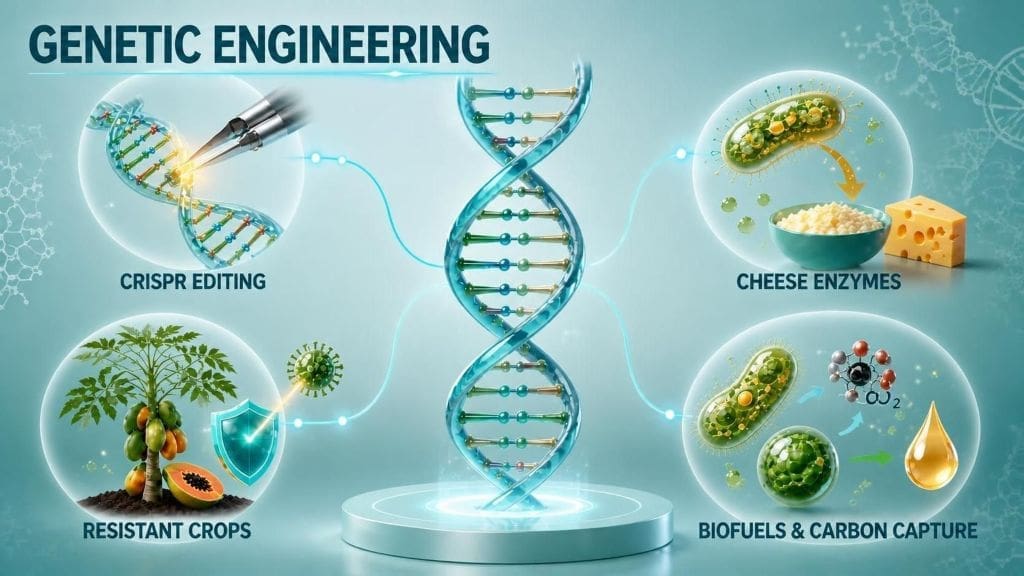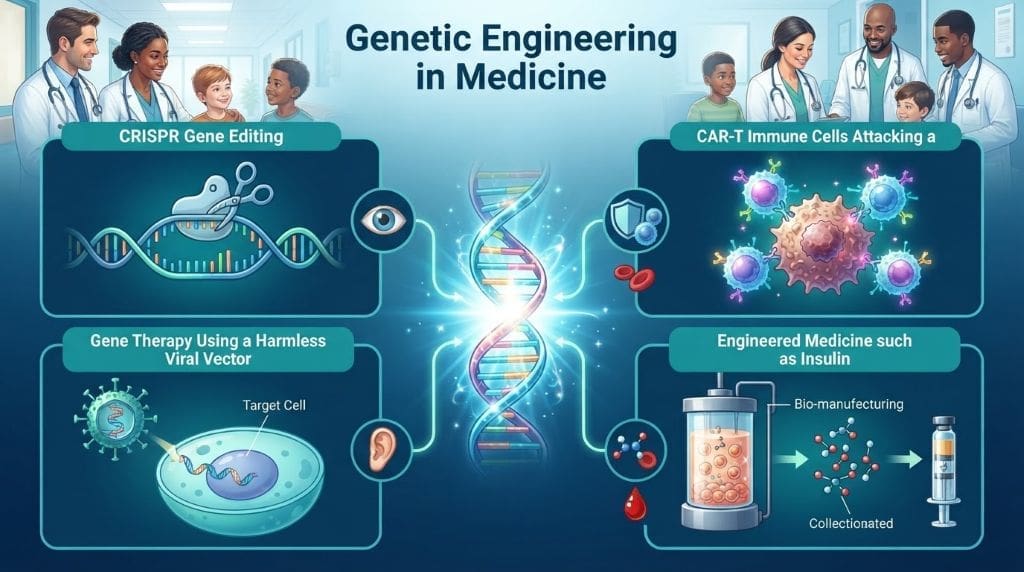

Scientists now deliberately change an organism’s DNA. They add new genes, remove unwanted ones, or rewrite specific sequences. As a result, they can study how genes actually work, create life-saving medicines, design better crops, and invent entirely new biological tools. The field began with early recombinant DNA experiments in the 1970s. However, it has since advanced dramatically. Today, Genetic Engineering tools like CRISPR-Cas9The term CRISPR stands for "clustered regularly interspaced short palindromic repeats" and Cas9 refers to the enzyme that cuts DNA. More let researchers edit DNA with remarkable precision. Still, the methods and outcomes depend on the organism and the goal.
This guide walks you through how genetic engineering works. It traces the key tools that shaped the field. Then it shows real applications in medicine and agriculture. Along the way, it examines the ethical questions the technology raises. Finally, it highlights study paths and career opportunities for students who want to enter this fast-moving area. Ready to see how we edit the code of life?

In this guide:
What it is · History · How it works · Tools · Medicine · Agriculture · Ethics · Careers · The future · FAQs · Learning pathway
What Is Genetic Engineering? A Simple Explanation
Genetic engineering is the direct alteration of an organism’s genetic material. Scientists make these changes in a laboratory instead of waiting for slow natural breeding. The goal is a new trait, a repaired gene, or a useful product. To see how this works, it helps to understand what DNA actually is. Inside almost every cell in your body sits a molecule called DNA, short for deoxyribonucleic acid. New to the topic? Start with this beginner-friendly introduction to genetic engineering to understand the basic terms and concepts.
DNA forms a twisted ladder called a double helix, with rungs made from four chemical bases: adenine, thymine, guanine, and cytosine, commonly abbreviated as A, T, G, and C. These four letters are the entire alphabet of life. The arrangement and repetition of those four letters across billions of positions create the differences between humans, jellyfish, and rose bushes. Please refer to the Fig. 1 for visual representation.

The Blueprint: Understanding Genes, Genomes, and Chromosomes.
A gene is simply a stretch of DNA that spells out the instructions for building one particular protein, and proteins are the molecules that actually do the work inside a cell. Some proteins act as tiny machines that speed up chemical reactions. Others form the structural material of hair, muscle, and skin. Still others carry oxygen through the blood or fight off invading bacteria. When a gene switches on, the cell reads its base sequence and uses the information to assemble the corresponding protein. This is why a single change in a gene can ripple outward into a visible trait, such as eye color, blood type, or resistance to a particular disease.

Scientists call the full set of DNA in an organism—every gene and every stretch of sequence in between—its genome. Actually, in humans and most complex organisms, this genome does not simply float loose. Instead, the cell packages the DNA into tightly coiled chromosomes that bundle the material so it fits inside the nucleus without tangling. Humans carry 46 chromosomes arranged in 23 pairs, one set inherited from each parent.
A trait is any observable feature, such as flower color, height, or resistance to a pest. Genetic engineering enables scientists to deliberately modify DNA, and this alteration changes how cells function. These modifications can influence the proteins that a cell produces or how these proteins are regulated. Consequently, this may lead to a change in a specific trait or biological function. However, not every trait depends on a single gene. Instead, many traits are controlled by several genes and can also be affected by environmental factors.
Think of DNA Like a Document
A simple way of understanding genetic engineering is to think of DNA as being like a very long document. A scientist might then wish to locate a specific section, alter it, take it out, or insert new information. The fundamental concept is much the same as that involved in editing a document. The actual biological process, however, is far more complicated than just cutting and pasting text. The scientists begin by identifying the DNA sequence which they wish to alter. Next, they apply an appropriate genetic engineering technique to carry out the change. Finally, they verify that the desired change has taken place and that it has had the expected effect in the cell. This fundamental approach can be applied to bacteria, plants, animals and human cells.
A Brief History of Gene Editing: From Mendel to CRISPR
The story takes place before the concept of a gene had been discovered. In 1866 Gregor Mendel examined pea plants and outlined patterns of inheritance.He demonstrated that parents pass traits on to their offspring in a predictable manner, even though he could not see the instructions. Later research revealed that DNA carries those instructions. By the middle of the twentieth century, scientists had worked out the double-helix structure of DNA and how cells read its code. Yet at that time they were still unable to cut and join DNA as they wished. This changed in the early 1970s.
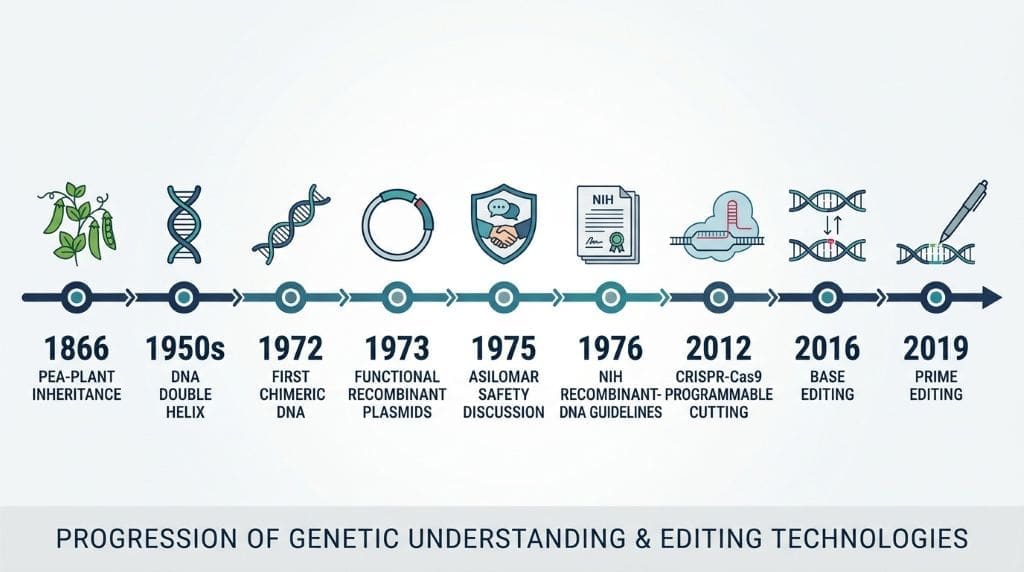
The first chimeric DNA was constructed in the laboratory in 1972 by Paul Berg and his colleagues, who joined DNA from two different sources. In 1973, Stanley Cohen, Annie Chang, Herbert Boyer and Robert Helling made the next advance by cutting separate bacterial plasmids with an enzyme known as EcoRI and then rejoining the pieces. The resulting molecules included genes from both parent strains and were capable of functioning within Escherichia coli bacteria. This experiment of 1973 is generally regarded as the origin of modern genetic engineering and the complete account of these early achievements is kept in the historical timeline of recombinant DNA technology.
From Safety to Precision: The Evolution of Gene Editing.
The field developed rapidly, and concern regarding safety did too. In 1975 scientists gathered at Asilomar in California to talk about the risks and the need for safeguards. The U.S. National Institutes of Health then published its first guidelines for research involving recombinant DNA in 1976. These initial rules have influenced the way the field is regulated even now. At the same time, the tools became better. Instead of using blunt and random methods, researchers turned to more precise editing.

The major breakthrough came in 2012, when Martin Jinek, Jennifer Doudna, Emmanuelle Charpentier, and their colleagues demonstrated that a single guide RNA could direct a protein called Cas9 to cut any desired DNA sequence. This finding turned CRISPR-Cas9 into a practical tool for editing genes. As a result, the Nobel Committee awarded Doudna and Charpentier the 2020 Nobel Prize in Chemistry. In 2016, David Liu’s team introduced base editing, a method that alters a single DNA letter without breaking both strands. In 2019, prime editing was developed, further extending the range of available techniques. Each of these developments made the editing process quicker, less expensive, and more accurate.
How Does Genetic Modification Work? The Core Process
Genetic engineering can involve different methods, but most projects follow a similar basic logic. Researchers first identify the DNA sequence or gene they want to change. They then choose a suitable method to add, remove, replace, or alter the genetic material. After making the change, they check whether it occurred as intended and whether it produced the expected result. This flow appears across plants, microbes, and human cells. Once you understand it, most applications make sense.
The five core steps of genetic engineering
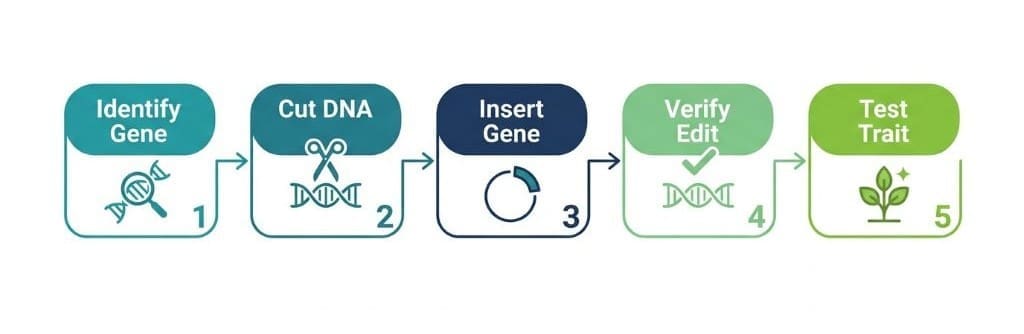
- Identify the target gene and read its DNA sequence.
- Cut the DNA with restriction enzymes or CRISPR-Cas9.
- Insert the new gene using a vector, such as a plasmid.
- Verify the edit by reading the new DNA sequence.
- Test whether the organism now shows the new trait.
Two sets of molecules do most of the physical work. Restriction enzymes are proteins, usually from bacteria, that cut DNA at specific sequences. The enzyme EcoRI, for example, recognizes the sequence GAATTC and cuts it. Its cut is staggered, leaving short single-stranded “sticky ends” that can pair with matching ends. DNA ligase is the glue. It joins the cut ends by forming bonds in the sugar-phosphate backbone of the DNA. Together, restriction enzymes and a ligase allow scientists to break apart DNA and reassemble it into new combinations.
The DNA Toolbox: How Scientists Cut and Paste Genes
| Technique | Main idea | Typical use |
| Recombinant DNA | Combines DNA sequences | Gene cloning and protein production |
| ZFNs | Targeted DNA cutting using zinc-finger proteins | Genome editing |
| TALENs | Targeted DNA cutting using TALE proteins | Genome editing |
| CRISPR-Cas9 | Guide RNA directs Cas9 to a DNA target | Genome editing |
| Base editing | Changes certain DNA bases without a double-strand break | Targeted base changes |
| Prime editing | Uses a Cas9 nickase and reverse transcriptase to write DNA changes | More varied targeted edits |
A plasmid is a small, circular piece of DNA found in bacteria, separate from the main chromosome. Plasmids replicate independently and often carry genes conferring antibiotic resistance. Scientists use them as vectors, the vehicles that carry new genes into a host cell. To build a recombinant plasmid, a researcher cuts the plasmid and the donor DNA with the same enzyme, then seals them together with ligase. The plasmid is then pushed into bacteria through a process called transformation. A more detailed explanation of this procedure appears in ENTECH Online’s guide to recombinant DNA technology.
Selecting Cells with the Desired Gene
Once the gene has entered the host cell, the researchers have to locate the cells that have taken it up. To assist with this, they use antibiotic-resistance genes. If the plasmid includes a resistance gene, scientists grow the bacteria on plates containing an antibiotic, and only the bacteria that have picked up the plasmid survive. Scientists call this process selection. They then sequence the DNA to verify that the new gene sits in the correct position. After that, the host cell begins to show the new characteristic, for example, by producing human insulin.
CRISPR functions a bit differently and it is important to understand it on its own. A short guide RNA matches a target DNA sequence and takes the Cas9 enzyme to that precise location. The Cas9 enzyme then cuts both strands of the DNA. The cell repairs the break by following one of two routes; it might just rejoin the ends, usually causing a small error that inactivates the gene, or if researchers provide a repair template the cell may copy the new sequence into place. This is an example of molecular cut-and-paste.
Major Tools and Techniques in Genetic Engineering
No single tool fits every job. Some tools cut DNA, others change a single letter, and still others join DNA from different species. Choosing the right tool depends on the goal. The table below compares the main techniques and the features that matter most.
Recombinant DNA Technology
Recombinant DNA technology forms one of the basic pillars of genetic engineering since it enables scientists to join DNA sequences from various sources together into a single DNA molecule. Plasmids are frequently employed in order to get the DNA into bacteria or other host cells. For instance, it is possible for scientists to place a human gene into a bacterial plasmid. The bacteria can then use this gene to produce a useful protein, for example human insulin. Scientists commonly use this method to produce medicines, enzymes, and research materials. However, recombinant DNA technology is not the same as modern genome editing. Traditional recombinant DNA methods often introduce a DNA sequence into a host cell without any control over where it lands. In contrast, genome-editing tools can target a specific location in the DNA.
ZFNs and TALENs: The First Programmable Scissors
Before CRISPR became widely adopted, scientists had developed two types of tools: zinc-finger nucleases (ZFNs) and transcription activator-like effector nucleases (TALENs). ZFNs use zinc-finger proteins to identify a specific DNA sequence. Scientists link these proteins to an enzyme called FokI, which then cuts the DNA. TALENs employ DNA-binding proteins referred to as TALEs in order to recognize the target sequences and also involve FokI to carry out the DNA cut. Although both of these technologies are capable of producing targeted changes, it can be quite complicated to design them for a new DNA sequence. CRISPR simplified the process since instead of having to redesign the whole DNA-binding protein the researchers could simply alter the guide RNA.

CRISPR-Cas9 in Genetic Engineering
Humans did not originally invent CRISPR-Cas9. Instead, bacteria developed it as a defence mechanism against viral infections. Once a virus injects its DNA into a bacterium, the bacterium takes in a small part of that viral DNA and keeps it in its own genome, like a most-wanted mugshot. If the same virus attacks again, the bacterium copies the stored snippet into a piece of RNA and uses it to locate and destroy any matching viral DNA before the virus can establish itself. Eventually, scientists realized that they could reprogram this natural search-and-destroy system to target any DNA sequence they desired, not just viral invaders. This is how they created the gene-editing tool now known as CRISPR-Cas9.
The Guide RNA: A Biological GPS
The system consists of two main parts. The first of these is a short segment of guide RNA, which is specially designed in the laboratory to correspond to the exact DNA sequence that the researcher wishes to modify. Since RNA has a natural tendency to pair with matching DNA sequences, the guide RNA functions like an address label, directing the entire complex to the right position in the genome—which can have as many as three billion bases.
Cas9: The Molecular Scissors and Safety Catch
The second component is the Cas9 enzyme, which travels along with the guide RNA and, when it has located the correct address, cuts physically through both strands of the DNA double helix at that position. Yet Cas9 does not cut whenever the guide RNA happens to match; it also looks for a short flanking sequence known as a PAM, a sort of safety mechanism that ensures the site is a real, cuttable target rather than a mere accidental match, and this helps prevent the system from acting on the wrong part of the genome.
The “Sloppy” Repair: Disabling a Gene
After Cas9 has made the cut, the result is entirely determined by the way the cell responds, since CRISPR itself does not “write” new genetic information but only provides an opportunity. The cell has its own internal system for repairing damage and quickly moves to fix any double-strand break, as an unrepai?red break is dangerous and could be fatal. The simplest method of repair involves rejoining the two broken ends, but this process is imprecise and often results in the insertion or deletion of a few random bases. If such an error occurs within a gene, the small mistake is usually sufficient to disrupt the genetic instructions and completely inactivate the gene, a feature that is very useful when the aim is simply to knock out a harmful gene in order to study the consequences.
The Precise Rewrite: Fixing and Inserting DNA
Alternatively, if the researchers at the same time as the cut provide the cell with a specially designed DNA template, the cell can use that template to repair the break with high accuracy, thus copying in the new sequence that the scientists have wanted, whether that involves correcting a mutation which causes a disease or inserting a completely new section of code. It is this dual capability, either inactivating a gene through the cell’s own imprecise repair or rewriting it exactly using a supplied template that makes CRISPR-Cas9 such a versatile tool for use in research, agriculture, and medicine.
Base Editing and Prime Editing
Base editing changes a single DNA letter without cutting both strands. It fuses a catalytically inactive or partially active Cas9 to an enzyme that converts one base into another, usually cytosine to thymine. In the landmark 2016 study, Komor and colleagues used this approach to correct disease-linked mutations with high efficiency and few unwanted insertions or deletions. The full open-access manuscript is available from Komor, Kim, Packer, Zuris, and Liu. Prime editing, introduced in 2019, goes further. It pairs a nickase Cas9 with a reverse transcriptase that writes a new sequence from a template, allowing insertions, deletions, and all twelve base-to-base swaps. Both are still being refined. As genetic-engineering tools become more precise, researchers are exploring new possibilities in medicine, agriculture, synthetic biology, and environmental science. These developments are part of the broader advancements in genetic engineering that may influence the future of biotechnology.
Gene Therapy and Personalized Medicine
Medicine is one of the most promising uses of genetic engineering. The idea is simple: fix the broken gene that causes illness. Doctors call this gene therapy. It can be done in two ways. In ex vivo therapy, doctors remove a patient’s cells, edit them in the lab, and return them. In in vivo therapy, the treatment is delivered directly into the patient’s body. Each approach has strengths and limits.

Vectors as Tools for Gene Delivery
Getting a new gene into cells is the hard part. Cells do not easily absorb foreign DNA. So researchers use vectors, often viruses that have been made harmless. Adeno-associated viruses, or AAVs, are a common choice because they rarely cause disease and do not insert their DNA into random spots. Retroviruses and lentiviruses can also deliver genes, and lentiviruses can enter non-dividing cells. Non-viral methods, such as lipid particles, are improving too. The first human gene-therapy trial for a genetic disease began in 1990 and treated a form of severe combined immunodeficiency, or SCID.
Setbacks and Milestones in Gene Therapy Trials
The road was anything but smooth. In 1999, a patient died from a serious immune reaction during a trial. A few years later, some of the children treated for SCID developed leukemia because the viral vector had inserted itself near a cancer-associated gene. As a result, regulators strengthened oversight, and researchers developed safer vector designs. Since then, the field has produced approved products. For example, doctors used Glybera to treat a rare disorder of fat processing. Likewise, Luxturna restores vision in a particular form of inherited blindness, and Zolgensma treats spinal muscular atrophy in young children. Each of these treatments targets a specific genetic defect.
Gene Editing Strategies for Single‑Gene Disorders
Researchers are testing gene editing for single-gene disorders. They have corrected the CFTR gene in intestinal organoids derived from cystic fibrosis patients. In mice, they restored dystrophin in models of Duchenne muscular dystrophy. Additionally, they disrupted a regulatory region called BCL11A to increase fetal hemoglobin. This approach aims to treat sickle cell disease and beta-thalassemia. Meanwhile, clinical trials are now testing some of these ideas in people. A clinical overview of these applications is provided by Redman and colleagues.
CAR‑T Therapy and the Rise of Personalized Medicine
Cancer treatment employs a powerful version of this science. CAR-T therapy engineers a patient’s immune cells to recognise and attack tumours. First, the cells are collected. Then, they are modified to express a cancer-specific receptor. Finally, the modified cells are infused back into the patient. For example, approved products such as Kymriah and Yescarta treat certain blood cancers. Similarly, personalized medicine applies the same logic. Doctors use a patient’s genetic information to choose the treatment most likely to be effective. Although genetic engineering is not the only tool, it remains a central one.
Genetic Engineering Applications in Agriculture
Even before gene editing reached hospitals, it had already changed farmland. Agricultural scientists were some of the first to take up genetic engineering, employing essentially the same recombinant DNA method previously described in order to transfer a useful gene into a crop plant and then breed that characteristic into commercial strains. This process produces a genetically modified organism, or GMO. Today, farmers grow engineered crops for resistance to insects, tolerance of herbicides, resilience to drought, and improved nutritional value.
Bt Cotton and Insect Resistance
Bt cotton is a good example, particularly in the case of India, since it includes a gene derived from the soil bacterium Bacillus thuringiensis. This gene enables the cotton plant to produce a Bt protein; when some insect pests feed on the plant, the protein has an effect on their digestive system and is capable of killing them, thus giving the crop protection against certain insect pests. India gave the approval for the commercial cultivation of Bt cotton in 2002 and it was the first genetically modified crop to receive such approval for large-scale commercial cultivation. Bt cotton demonstrates how genetic engineering can alter a plant’s biological characteristics by introducing a gene from another organism.

Golden Rice and Better Nutrition
Golden rice is designed to solve a different issue; it has been engineered so as to produce beta-carotene, a substance which the body can convert into vitamin A. A lack of vitamin A can lead to blindness and can weaken the immune system, in particular in children. In order to combat this deficiency, scientists have introduced the relevant genes and as a result have produced rice that can help in fighting it. Other examples of genetically modified characteristics are tolerance to herbicides, which enables farmers to get rid of weeds without damaging the crop, and tolerance to drought, which helps the plants to survive in dry conditions. A comprehensive review of these agricultural applications can be found in the work of Khan and colleagues.
Regulation varies from country to country and this difference is important. In the United States, three agencies carry out the responsibility. The FDA ensures that genetically modified foods are safe to eat. The EPA is in charge of plant-incorporated protectants, for example the Bt protein. The USDA looks after plant health and agriculture. The agencies work together under a framework set up in 1986. A national standard for labelling bioengineered foods came into force in 2022. For more details see the FDA’s page on GMO regulation.
Ethical Questions in Genetic Engineering
Genetic engineering raises genuine ethical issues, and the most important ones concern human reproduction. Most genetic modifications affect somatic cells, the normal cells of the body that do not pass changes to children. In contrast, germline editing would act on eggs, sperm, or embryos, and future generations would inherit the changes. Germline editing could also improve normal characteristics, such as height or intelligence, a possibility that many people find unacceptable. Because of these safety and ethical concerns, the United States and many other countries prohibit germline and embryo editing.

Balancing Progress and Protection: Environmental Impact and Governance
There are also environmental issues involved. Genetically modified plants are capable of crossing with their wild relatives and the genes used in this modification could therefore spread into natural populations. This does represent a real concern with regard to biodiversity. On the other hand, genetically modified crops can lead to a reduction in the use of pesticides and at the same time increase the food supply. Both of these results are genuine and it is necessary to exercise care rather than reach a certain conclusion.
Efforts have been made to keep up with the developments. In December 2018 the World Health Organization established a committee consisting of experts to look at human genome editing. The framework published in 2021 provides advice regarding oversight at institutional, national and global levels. The issue is not one of whether science functions or not but rather about when and how it should be used. For science to be responsible means raising these questions before the tool is put into use, not after.
Genetic Engineering Careers: Your Path from High School to Biotech
The field offers clear pathways from high school into biotechnology. A student first builds a strong base in biology, chemistry, and mathematics. Then comes a BSc in Biotechnology. Next is an MSc in Genetic Engineering or a related field. A PhD opens doors in research and academia. Along the way, students learn lab skills such as PCR, cloning, and cell culture. Data skills and clear writing matter just as much, because modern biology produces enormous amounts of information.
Salaries vary widely by role, sector, and city, so no single figure fits every path. Research and industry roles tend to pay more than teaching roles, but the gap narrows with experience.
Five Skills Worth Building Now
- Biology fundamentals: genetics, cell biology, and biochemistry.
- Lab techniques: accurate pipetting, basic molecular biology techniques, and safe lab practice.
- Data literacy: reading graphs, statistics, and sequencing results.
- Coding basics: Python or R help in modern biology.
- Communication: explaining science clearly to any audience.
These skills compound over time. A student who starts early builds a real advantage. Small habits in high school turn into strong applications later. The key is consistency, not perfection.
The Future of Genetic Editing: What’s Next?
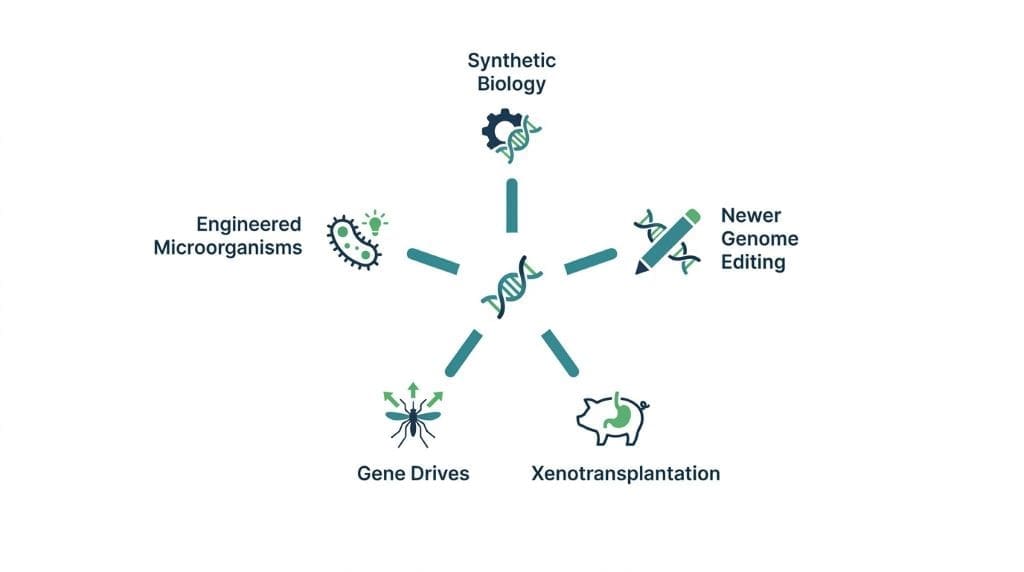
Genetic engineering is moving beyond simply adding or removing genes. Researchers are developing ways to design biological systems, make more controlled DNA changes, and engineer organisms for specific purposes. Some of these technologies are already being studied in laboratories and clinical research, while others remain experimental.
Synthetic Biology
Synthetic biology combines genetic engineering with engineering principles. Scientists can design biological parts and combine them into systems that perform specific functions. For example, researchers can engineer microorganisms to produce useful chemicals, medicines, or other biological products. The long-term goal is to make biological systems more predictable and programmable. This could lead to new approaches in medicine, manufacturing, agriculture, and environmental science.
Newer Forms of Genome Editing
Researchers are developing newer approaches that can make specific DNA changes without relying on the same type of double-strand break used in conventional Cas9 editing. For example, base editing and prime editing are being studied for their ability to produce more controlled genetic modifications. Meanwhile, other CRISPR-based systems are under investigation for applications like gene regulation and RNA editing. These technologies are still evolving. Consequently, researchers focus on improving their safety, accuracy, delivery, and long-term effects.
Xenotransplantation
Xenotransplantation involves using organs, tissues, or cells from another species for human treatment. One major area of research is the use of genetically modified pigs as potential organ donors. Scientists can modify pig genes to reduce biological incompatibility with humans. They can also make changes intended to reduce the risk of immune rejection. This approach could eventually help address the shortage of donor organs. However, significant medical, ethical, and safety challenges remain.
Gene Drives
Researchers design gene drives to increase the likelihood that a particular trait will be inherited. They study gene drives as a potential way to control populations of disease-carrying insects. For example, scientists have investigated whether gene drives could reduce mosquito populations that transmit malaria. However, gene drives raise difficult questions. A genetic change can spread through a wild population and affect ecosystems beyond the original target. Reversing such changes can also be difficult. Due to these risks, scientists consider gene drives an important area for ongoing research in science and ethics.
Engineered Microorganisms
Scientists use genetic engineering to modify microorganisms for environmental purposes. They engineer bacteria that can detect or break down pollutants. For instance, HK44, a strain of Pseudomonas fluorescens, responds to naphthalene by emitting visible bioluminescence. This allows scientists to observe pollutant detection and microbial activity more easily. Furthermore, researchers are developing ways to engineer microorganisms that can produce biofuels, chemicals, and other useful products from renewable resources.
What Does This Mean for Students?
The future of genetic engineering will demand more than just laboratory skills. Researchers now work across molecular biology, genetics, bioinformatics, data science, engineering, and computational biology. For students, this creates many possible directions. You might work with DNA in a laboratory. Alternatively, you could analyze genomes using computers. You might also design biological systems or study the safety and ethics of new technologies. Tools will continue to evolve. However, the underlying questions stay the same: What should we change? How can we change it safely? And, what could happen afterward?
Frequently Asked Questions About Genetic Engineering
General Questions
Genetic engineering is the deliberate modification of an organism’s DNA using biotechnology to add, remove, or alter specific genetic information. Scientists cut, insert, or change genes to give an organism new traits. It is used in medicine, farming, and industry.
Genetic engineering, when conducted under strict regulatory oversight and ethical guidelines, has an established safety record in medicine and agriculture. Approved GM crops undergo years of testing before commercial release. However, each application is evaluated individually, and long-term ecological monitoring remains essential.
No single person discovered genetic engineering. In 1973, Stanley Cohen and Herbert Boyer built the first functional recombinant DNA molecule. Paul Berg created the first chimeric DNA in 1972. Later, Jennifer Doudna and Emmanuelle Charpentier developed CRISPR-Cas9, winning the 2020 Nobel Prize in Chemistry.
Genetic engineering is the broad term for changing an organism’s DNA. Gene editing is one precise form of it. Gene editing makes changes directly at a chosen spot in the genome. CRISPR-Cas9 is a well-known gene-editing tool.
CRISPR-Cas9 cuts DNA at a chosen location. This lets researchers disable, repair, or replace a gene. Scientists study it for cystic fibrosis, sickle cell disease, cancer, and HIV. It is also used in crop research and basic biology.
Applications, Risks & Ethics
Examples include recombinant human insulin made in bacteria, Bt cotton that resists pests, golden rice enriched with vitamin A precursors, CAR-T cell therapy for cancer, and base editing that corrects single-letter DNA errors.
Somatic editing changes cells that do not pass changes to children. It is studied to treat disease. Germline editing changes eggs, sperm, or embryos and would pass changes to future generations. Germline and embryo editing are illegal in the United States and many other countries.
Risks include off-target DNA cuts, unintended effects, and long-term unknowns. Genetically engineered plants could cross-breed with wild plants and spread engineered genes into the environment. Each application is reviewed on a case-by-case basis.
Crops are engineered for insect resistance, herbicide tolerance, drought tolerance, and improved nutrition. Bt cotton carries a bacterial gene that protects it from bollworm. Agencies such as the FDA, EPA, and USDA review GM foods for safety.
Some people worry about editing human embryos, creating designer babies, and harming ecosystems. Others point to medical and agricultural benefits. The debate balances real benefits against real risks, so each use is evaluated carefully.
How This Guide Was Compiled
This guide was compiled using scientific research, open-access reviews, educational resources, and public regulatory sources. It explains the history, tools, medical applications, agricultural uses, ethical concerns, and future possibilities of genetic engineering in a clear format for Grade 10–12 students. Established scientific findings are presented as evidence-based information, while developing topics such as advanced genome editing, synthetic biology, gene drives, and xenotransplantation are identified as emerging areas of research. The guide also considers safety, regulation, environmental effects, and ethical responsibility to provide students with a balanced understanding of genetic engineering.
References
Cohen, S. N., Chang, A. C. Y., Boyer, H. W., & Helling, R. B. (1973). Construction of biologically functional bacterial plasmids in vitro. Proceedings of the National Academy of Sciences, 70(11), 3240–3244. https://doi.org/10.1073/pnas.70.11.3240
Jinek, M., Chylinski, K., Fonfara, I., Hauer, M., Doudna, J. A., & Charpentier, E. (2012). A programmable Dual-RNA–Guided DNA endonuclease in adaptive bacterial immunity. Science, 337(6096), 816–821. https://doi.org/10.1126/science.1225829
Khan, S., Ullah, M. W., Siddique, R., Nabi, G., Manan, S., Yousaf, M., & Hou, H. (2016). Role of recombinant DNA technology to improve life. International Journal of Genomics, 2016, 1–14. https://doi.org/10.1155/2016/2405954
Komor, A. C., Kim, Y. B., Packer, M. S., Zuris, J. A., & Liu, D. R. (2016). Programmable editing of a target base in genomic DNA without double-stranded DNA cleavage. Nature, 533(7603), 420–424. https://doi.org/10.1038/nature17946
Redman, M., King, A., Watson, C., & King, D. (2016). What is CRISPR/Cas9? Archives of Disease in Childhood Education & Practice, 101(4), 213–215.
https://doi.org/10.1136/archdischild-2016-310459
Tamura, R., & Toda, M. (2020). Historic overview of genetic engineering technologies for human gene therapy. Neurologia Medico-chirurgica, 60(10), 483–491.
https://doi.org/10.2176/nmc.ra.2020-0049
Lenzi, R. N., Altevogt, B. M., Gostin, L. O., & Committee, C. O. T. I. R. a. a. O. T. a. O. T. N. R. D. A. (2014, March 27). Historical and policy timelines for recombinant DNA technology. Oversight and Review of Clinical Gene Transfer Protocols – NCBI Bookshelf.
https://www.ncbi.nlm.nih.gov/books/NBK195888/
What are genome editing and CRISPR-Cas9?: MedlinePlus Genetics. (n.d.).
https://medlineplus.gov/genetics/understanding/genomicresearch/genomeediting/
Human genome editing: a framework for governance. (2021, July 12).
https://www.who.int/publications/i/item/9789240030060
Program, H. F. (2024, March 5). How GMOs are regulated in the United States. U.S. Food And Drug Administration.
https://www.fda.gov/food/agricultural-biotechnology/how-gmos-are-regulated-united-states
Sabharwal, P. (2026, June 30). Recombinant DNA technology: a key to genetic advances. Science and Technology Magazine to Explore Your Passion.
https://entechonline.com/recombinant-dna-technology-an-in-depth-explanation/
List of terms
- CRISPR-Cas9