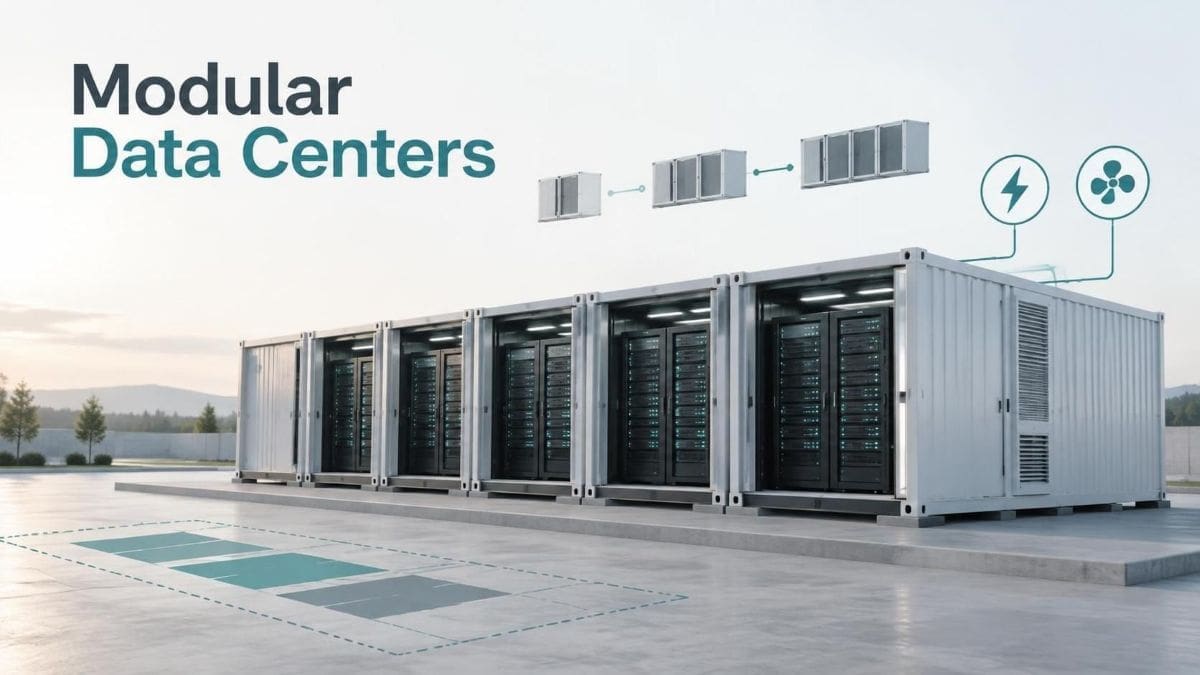
Learn how modular data center fits into project design, installation, operation, monitoring, and long-term maintenance.
Reviewer's noteNote: The article includes external links to third-party services; readers should independently evaluate any referenced platforms before engaging.
When computing demand grows faster than a traditional building project can respond, a modular data center provides a fast, repeatable solution. It organizes IT space and supporting infrastructure into standardized units. However, its success depends on early coordination. You must carefully plan power, cooling, monitoring, and future expansion together. Early decisions about layout, interfaces, and service ultimately shape long-term performance. A sound project brief must clearly define three things: what you will measure, who will respond to alarms, and how you will verify performance after installation.
The central design task is to connect the selected equipment with a clear site requirement.
Coordinate power and cooling inside: Modular Data Center
Power distribution, UPS, batteries, cooling units, airflow paths, as well as monitoring need to work as one package. The designer should verify heat removal, electrical fault isolation, and also service access. A modular shell does not make these engineering interfaces less important; it makes standardization more valuable.
A modular solution may reduce some construction and integration work, but the business case should include transport, foundations, utility connection, commissioning, service, and future expansion. The comparison with a conventional building should use the same IT capacity and availability requirements. Schedule benefits matter, but they should be supported by a realistic project plan. For a closer look at the solution scope, review modular data center and consider how its documented functions fit the site layout, electrical interfaces, and operating plan.
Use evidence rather than headline figures
Published ratings are useful starting points, but they describe performance under defined test conditions. A project team should confirm the load, temperature, operating mode, measurement boundary, and configuration behind any important figure. Engineers must submit site-specific modeling and commissioning records before treating a performance claim as a project outcome.
Factory testing improves repeatability
Preassembly allows selected wiring, controls, environmental systems, and alarms to be tested before delivery. The factory test plan should identify which functions can be verified offsite and which depend on the final site. A complete handover includes configuration records, test results, and clear responsibility for unresolved items.
Performance should always be assessed against the actual installation conditions and the complete system boundary.
Design monitoring for multiple modules in Data Center
As the site grows, operators need a consistent way to compare energy use, temperatures, alarms, and equipment health across all modules. Standard naming, time synchronization, and configuration control make it easier to manage a larger footprint. Monitoring should also identify which alarms require immediate response and which can be addressed during planned maintenance. A project specification for modular data center should identify the applicable configuration, installation limits, commissioning checks, and service responsibilities.
Keep redundancy consistent across interfaces
A module may contain redundant UPS or cooling components, but the overall site can still have shared points of failure in utility supply, network, controls, or distribution. Engineers should map the failure domains across modules and common infrastructure. Redundancy should be evaluated against the services that must remain available during maintenance and faults.
Modular data centers are prefabricated IT infrastructure units that integrate computing space, power, cooling, and monitoring systems for scalable deployment.
2. How do modular data centers support scalability?
Modular data centers support scalability by allowing organizations to expand IT capacity through additional modules with standardized infrastructure and interfaces.
3. What factors should be considered when designing modular data centers?
Design considerations include power distribution, cooling, airflow, monitoring, site requirements, service access, redundancy, and future expansion.
4. How can modular data centers help reduce deployment time?
Factory preassembly and testing can reduce onsite integration work, while actual deployment time depends on transportation, site preparation, utility connections, and commissioning.
5. How is reliability maintained in modular data centers?
Reliability depends on appropriate redundancy, coordinated infrastructure, consistent monitoring, commissioning tests, and clear maintenance responsibilities.
Sun, J., Gong, Z., Agarwal, A., Noghabi, S., Chandra, R., Snir, M., & Huang, J. (2024). Exploring the efficiency of renewable energy-based modular data centers at scale. ACM Symposium on Cloud Computing (SoCC), 552–569. https://doi.org/10.1145/3698038.3698544
I am Manjunath Madkekar, a lifelong learner with a background in Information Technology from Datta Meghe College of Engineering. I have always been curious about how technology works and how it can be used to create meaningful and practical solutions. My interest in technology has encouraged me to explore different areas of the field, learn new skills, and continuously expand my understanding beyond what is taught academically.
I enjoy learning through hands-on experience and experimenting with different technologies. My interests include software development, web technologies, cybersecurity, emerging technologies, and exploring new ideas that can turn into useful solutions. I particularly enjoy working on projects because they give me an opportunity to apply what I learn, understand challenges from a practical perspective, and improve my problem-solving skills.
I believe that technology is constantly evolving, and keeping up with these changes requires a mindset of continuous learning. This is why I consider myself a lifelong learner. I enjoy discovering new concepts, trying unfamiliar tools, and learning from both successful projects and mistakes. I believe every new experience provides an opportunity to improve and develop a better understanding of the field.
I am also interested in understanding how different areas of technology can work together. Rather than limiting myself to a single domain, I like exploring different concepts and finding connections between them. This approach helps me stay adaptable and gives me the opportunity to discover areas that I may want to pursue further in the future.
Currently, I am particularly interested in cybersecurity and the challenges involved in protecting digital systems, networks, applications, and data. My interest in this area comes from its combination of technology, problem-solving, analytical thinking, and real-world applications. I enjoy learning about security vulnerabilities, ethical hacking, network security, and different approaches used to identify and prevent cyber threats.
Through my learning journey, I aim to develop strong technical and problem-solving abilities while gaining practical experience in cybersecurity. I also value curiosity, creativity, and the willingness to keep learning. I believe that becoming good at technology is not only about knowing programming languages or tools, but also about understanding problems, thinking critically, and finding effective ways to solve them.
As I continue my journey in Information Technology, I hope to work on meaningful cybersecurity projects, learn from new experiences, and continuously improve myself. I see every project, challenge, and new technology as an opportunity to learn something valuable and take another step forward in my growth.