
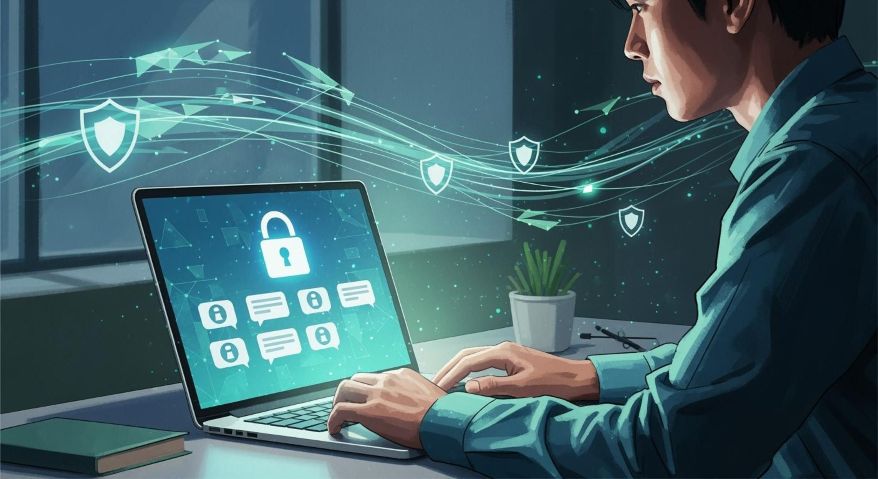
End to end encryption keeps digital communications safe from prying eyes. Many platforms now use end-to-end encryption because security threats keep growing. Messaging apps like WhatsApp and Signal lead this change. The rise of mobile devices and End-to-End Encrypted IoT Message Distribution Rese also push this trend. People trust their communication more with strong encryption.
Key Takeaways
- End-to-end encryption keeps your messages safe from hackers. Only the sender and receiver can read them.
- Using end-to-end encryption helps companies protect sensitive data and build trust with their customers.
- Everyone deserves privacy. End-to-end encryption ensures that your conversations remain private, even from service providers.
Why End-to-End Encryption Matters in Cybersecurity

Protecting Sensitive Data with End-to-End Encryption
This technology plays a key role in protecting sensitive data. Many organizations handle important information every day. They need strong methods to keep this data safe from cyber threats. End-to-end encryption ensures that only the sender and the receiver can read the message. No one else can access the content during transmission.
Sensitive data often includes:
- Emails
- Customer records
- Payment details
- Intellectual property
- Confidential contracts
These types of information need the highest level of protection. Fortunately, end-to-end encryption provides this by making the data unreadable to outsiders. Consequently, this method helps companies avoid data leaks and keeps their reputation strong.
Preventing Unauthorized Access via End-to-End Encryption
Cyber attacks often target data as it moves between users. This technology stops attackers from reading or changing the data during this process. It also blocks service providers and other third parties from seeing the content.
The table below shows how end-to-end encryption compares to other methods:
| Feature | End-to-End Encryption | Other Encryption Methods |
|---|---|---|
| Encryption at Rest | Yes | Varies |
| Encryption in Transit | Yes | Yes (but not always) |
| Protection from Service Providers | Yes | No |
End-to-end encryption secures data during transmission. Only the sender and receiver can access it. This greatly reduces the risk of unauthorized access. However, it does not protect against all types of attacks. For example, it cannot stop attacks on the devices themselves.
Enhancing Privacy for Users
End-to-end encryption gives users true privacy. Specifically, only the people in the conversation can read the messages. This means that service providers and even government agencies cannot access the content. Ultimately, this makes users feel safe and builds trust in the platform.
The table below explains the impact on privacy:
| Aspect | Description |
|---|---|
| User Privacy | End-to-end encryption ensures only the communicating parties can access their messages. |
| Protection from Third Parties | Prevents access from service providers and government entities. |
| User Assurance | Users feel secure knowing their communications are private. |
| Public Safety Concerns | Limits law enforcement’s ability to monitor criminal activities. |
End-to-end encryption also keeps conversations safe from eavesdropping. It maintains the integrity of messages in both individual and group chats. As a result, users can communicate freely without fear of being watched.
How End-to-End Encryption Works and Its Benefits
End-to-End Encryption Process Overview
This technology uses strong math to keep messages safe. When a user installs a messaging app like WhatsApp, the app creates two keys. One key is public, and the other is private. The public key can be shared, but the private key stays on the device. When someone sends a message, the app uses the recipient’s public key to lock the message. Only the private key on the recipient’s device can unlock it.
Popular apps like WhatsApp and Signal use the Signal Protocol. Specifically, this protocol uses public key cryptography and a session setup called X3DH. Consequently, the process makes sure that only the sender and receiver can read the message. Ultimately, the message stays safe even as it travels through servers.
Here is a simple table showing the steps:
| Step | Description |
|---|---|
| Key Generation | The app creates a public and private key pair for each user. |
| Key Exchange | Devices share public keys to set up secure communication. |
| Message Encryption | The sender uses the recipient’s public key to encrypt the message. |
| Server Relay | The encrypted message travels through servers but stays locked. |
| Message Decryption | The recipient’s device uses the private key to unlock the message. |
Some apps use extra steps for more safety:
- Diffie-Hellman Ratchet: The app creates new keys for each message.
- Symmetric Ratchet: Each message gets a unique key.
- Forward Secrecy: If a key is stolen, only a few messages are at risk.
This process makes end-to-end encryption different from server-side encryption. With server-side encryption, the server can see the message. With end-to-end encryption, only the sender and receiver can read it.
Data Integrity and Confidentiality
This technology does more than hide messages. It also keeps them safe from changes. The app uses AES encryption to turn messages into unreadable code. Only the right key can change the code back to the message.
The app also uses SHA-256 hashing. This tool checks if the message has changed. If someone tries to change the message, the app will know. This keeps the message safe and true.
Key points:
- Only the right person can read the message.
- The message does not change during travel.
- The app checks for any tampering.
This technology gives both confidentiality and integrity. The message stays private and correct from start to finish.
Compliance with Privacy Regulations
Many laws now require strong protection for personal data. End-to-end encryption helps companies follow these rules. For example, the General Data Protection Regulation (GDPR) in Europe says companies must encrypt personal data. The Health Insurance Portability and Accountability Act (HIPAA) in the United States also requires encryption for health data.
Here is a table showing some rules:
| Regulation | Requirement | Description |
|---|---|---|
| GDPR | Encryption | Companies must encrypt personal data to stop unauthorized access. |
| HIPAA | Encrypt PHI | Health data must be encrypted during storage and transmission. |
If a company does not follow these rules, it can face large fines. For example:
| Violation Type | Penalty Amount |
|---|---|
| Failure to adopt reasonable safeguards | ₹250 crore |
| Violating children’s data obligations | ₹200 crore |
| Other general violations | ₹50 crore |
This technology helps companies avoid these penalties. It also shows that they care about user privacy and security.
Building Customer Trust
People want to feel safe when they use digital services. This technology builds trust between users and companies. When people know their messages are safe, they are more likely to use the service.
A secure platform can help companies in many ways:
| Evidence Type | Statistic |
|---|---|
| Customer Trust | 61% of online shoppers in India leave if a site feels unsafe. |
| Conversion Rates | A secure checkout can raise conversion rates by up to 35%. |
| Customer Retention | Brands with strong digital trust can keep 30% more customers. |
This technology protects users and helps companies grow. It creates a safe space for sharing ideas, making purchases, and building relationships.
Risks and Misconceptions About Encryption
Common Myths About End-to-End Encryption
Many people believe myths about this technology. Some think breaking this technology is needed to find illegal content. Experts say this is not true. Breaking encryption makes users less safe. Others believe backdoors can help without hurting security. In reality, backdoors make the whole system weak.
Experts also explain that encryption is not just for tech companies. It protects everyone’s privacy and security. Some say, “If you have nothing to hide, you do not need encryption.” This idea is wrong. Privacy is a basic right for all. The debate is not about choosing between security and privacy. The real choice is between a safe and unsafe digital world.
Limitations of Encryption
This technology has some limits. It cannot protect data if a device is already infected with malware. It also cannot stop someone from sharing their password.
Risks of Not Using End-to-End Encryption
Without this technology, sensitive data faces many risks. Financial institutions can suffer from data breaches and loss of trust. Attackers may steal information or commit fraud. Some breaches are hard to detect, so damage can happen before anyone knows. Outdated systems and weak audit trails make things worse.
| Risk Description | Implication |
|---|---|
| Exposure of sensitive data | Increased chance of data breach and loss of trust |
| Unauthorized access | Risk of fraud and identity theft |
| Silent breaches | Damage before detection |
| Inconsistent patching | Old systems stay weak |
| Insufficient audit trails | Hard to track problems |
| Invisible breaches | Customers may not know right away |
| Delayed detection | Slow response and more harm |
| Exploited third-party checks | Fraud with fake identities |
Regulatory Challenges for End-to-End Encryption
This technology helps protect data privacy. However, it can make it hard for law enforcement to stop crime. Social media platforms work worldwide, but laws differ by country. This makes it hard to fight crime across borders.
Some countries let police ask companies to remove encryption. Others require a court order. The European Union does not force companies to give up encryption keys. In India, laws allow government access to encrypted data.
Companies must find a balance between information security and legal rules. They need to protect users but also follow the law.
This technology protects communication and keeps data private. To implement this effectively, organizations should use strong encryption, multi-factor authentication, and secure tools. Similarly, individuals can review security settings and join training programs. Furthermore, experts recommend ongoing education and monitoring. Ultimately, as technology changes, staying alert helps defend against new threats to data security.
FAQ
What is end-to-end encryption?
End-to-end encryption protects messages so only the sender and receiver can read them. No one else can access the content.
Can service providers see encrypted messages?
Service providers cannot see encrypted messages. Only the intended users have the keys to unlock and read the information.
Does end-to-end encryption slow down communication?
Most users notice no delay. Modern encryption works quickly and keeps messages secure without affecting speed.
Reference
Lin, S., Cui, L., & Ke, N. (2024). End-to-End encrypted message distribution system for the internet of things based on conditional proxy Re-Encryption. Sensors, 24(2), 438. https://doi.org/10.3390/s24020438