
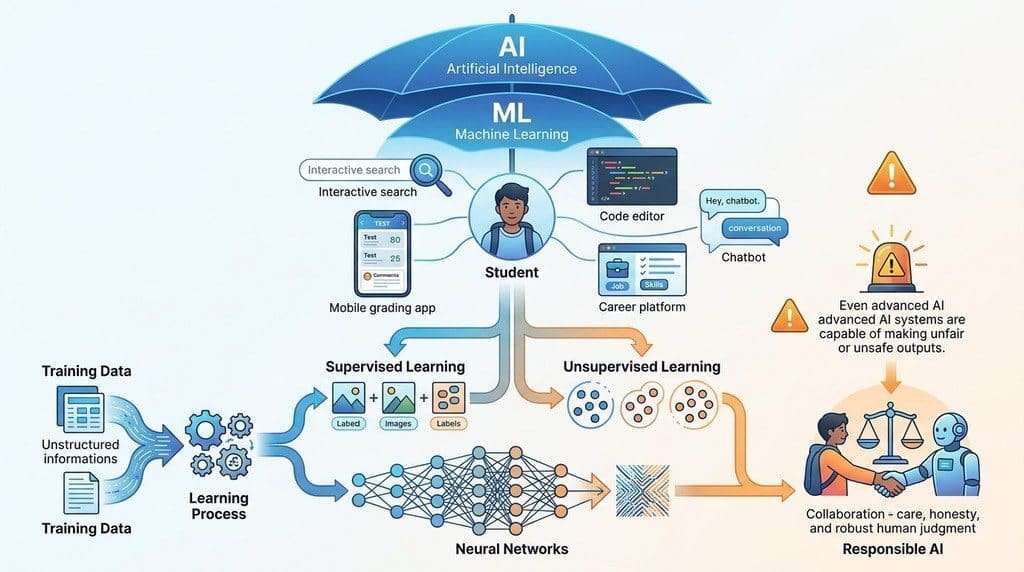
Artificial Intelligence (AI) is the broad field of creating machines that simulate human intelligence, while Machine Learning (ML) is a subset focused on algorithms that learn patterns from data. Students now meet AI in search, grading tools, coding apps, chatbots, and career platforms. So, AI ethics for students is no longer optional. It helps students ask clear questions before trusting a machine. Machine Learning depends on Training Data, patterns, and feedback. At first, students may learn Supervised Learning through labeled examples. After that, they may meet Unsupervised Learning, where systems find clusters. Neural Networks go further by learning layered patterns from data, which supports modern deep learning systems. However, these systems can still make unfair or unsafe choices. That is why responsible AI learning matters. It teaches students to use AI with care, honesty, and human judgment.
Key Takeaways
- AI ethics for students means using AI fairly, safely, and honestly.
- Machine Learning systems learn from data, not human values.
- Biased Training Data can create biased results.
- Students must protect privacy and credit sources.
- Teachers should discuss AI limits, not just AI tools.
- Responsible AI skills support future careers.
- Human judgment must remain central.
What is AI ethics for students?
AI ethics for students means learning how AI affects fairness, privacy, safety, truth, and opportunity. In simple words, it asks one question. Should this AI tool be used here? That question matters in classrooms. It also matters in internships, research, healthcare, design, business, and engineering. As a result, students need more than tool skills. They need judgment. A chatbot can draft an answer. However, it cannot take responsibility for that answer. A grading tool can mark patterns. Yet, it may miss context, language barriers, or effort. To explain the field clearly, students should first separate AI, Machine Learning, and deep learning. The classic deep learning review by LeCun, Bengio, and Hinton explains how layered models learn representations from data. With this in mind, ethics begins when students ask who benefits, who may be harmed, and who checks the result.
AI
AI is the broad field of machines performing human-like tasks.
Machine Learning
Machine Learning uses algorithms that learn patterns from data.
Deep Learning
Deep Learning uses many-layered Neural Networks for complex patterns.

Why does AI ethics for students begin with definitions?
Clear definitions prevent confusion. Many students call every smart app “AI.” However, that habit hides important differences. A rule-based calculator follows fixed instructions. By comparison, a Machine Learning model changes behavior after training. A deep learning model may learn hidden patterns across images, speech, or text. Therefore, students must ask how the system learned. They should also ask what Training Data shaped it. To illustrate, a model trained on narrow examples may fail outside them. A classroom image tool may label common objects well. Yet, it may fail on local foods, regional clothing, or low-light photos. This is not magic. This is a data restriction. In fact, ethical AI learning starts by naming the system correctly. After that, students can test it properly. For background reading, students can study digital ethics and algorithmic bias in everyday technology.
Why does responsible AI matter in classrooms?
Responsible AI matters because students use AI as they form learning habits. A school tool can help explain fractions, translate text, summarize chapters, or suggest code. However, it can also produce false answers. It may also expose private data. As a matter of fact, student work carries personal signals. It can show learning gaps, language level, interests, location, and health concerns. Therefore, classrooms need clear rules. Students should know when the use of AI is allowed. They should also know how to cite AI help. According to Stanford HAI’s 2026 AI Index, more than 80% of U.S. high school and college students use AI for school-related tasks. Yet only about half of middle and high schools have AI policies, and just 6% of teachers say those policies are clear. This gap makes AI ethics for students urgent. Clear classroom guidance protects learning and trust.
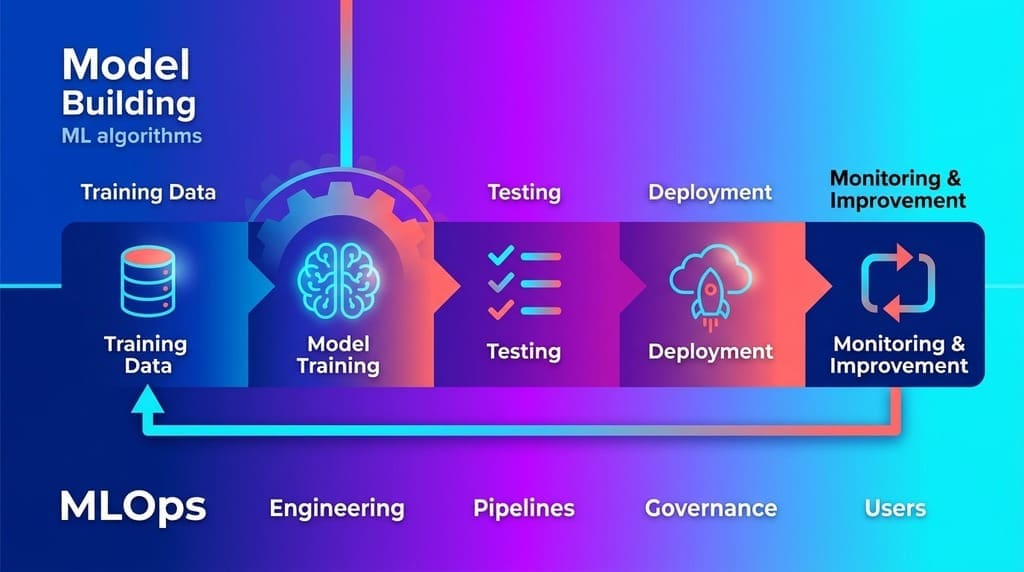
In my classroom observation, students often treat AI answers as polished truth. At first, they check grammar and format. After that, they rarely check sources. During one activity, students asked a chatbot for science project ideas. The tool gave confident suggestions. However, several claims had weak evidence. So, I asked students to mark each claim as verified, doubtful, or unsupported. The room changed quickly. Students stopped copying. Instead, they started questioning. This small shift showed an important lesson. AI literacy grows when students test outputs.
What’s more, they learn better when teachers model doubt without fear. A useful classroom rule is simple. Use AI as a helper, not as an authority. For similar classroom concerns, students can read about AI in assessment and grading fairness.

How can AI ethics for students reduce cheating?
AI ethics for students can reduce cheating by making expectations visible. Students need practical rules, not vague warnings. To put it differently, schools should define acceptable help. Brainstorming may be allowed. Full answer generation may not be allowed. Grammar feedback may be fine. However, hidden authorship can break trust. A good policy requires students to disclose their use of AI. It also asks them to submit prompts, drafts, and reflections. As a result, teachers can assess thinking, not only the final text. This approach works better than fear-based bans. Students should learn that academic honesty protects their own growth. After all, careers reward skill, not copied output. By and large, responsible AI use resembles lab safety. Students can use powerful tools. Yet, they must follow clear procedures. They must document steps. They must also accept responsibility for final work.
How can students identify bias, privacy risks, and misinformation?
Students can identify AI risks by checking data, goals, and impact. Bias often appears when a system learns from unequal history. Obermeyer and colleagues clearly demonstrated this in healthcare. A widely used algorithm used healthcare cost as a proxy for health need. As a result, Black patients with the same risk score were often sicker than White patients. Fixing the target variable reduced that racial bias. This example matters for students. It shows that accuracy alone is not enough. A model can be statistically strong and socially harmful. Therefore, students should ask what the model predicts. They should also ask what it should predict. In education, the same issue can appear in attendance tools, grading systems, scholarship screening, or career platforms. Fairness starts before coding. It begins when humans choose the problem.
A 7-point AI ethics checklist for students
Use this checklist before trusting any AI output. It moves from basic understanding to career impact. To enumerate, students can ask these questions during assignments, projects, internships, and interviews.
- What task is the AI system doing?
- What Training Data shaped the system?
- Who may be excluded by the data?
- Is the answer explainable and testable?
- Does the tool protect privacy?
- Who is accountable for the result?
- How could this choice affect careers?
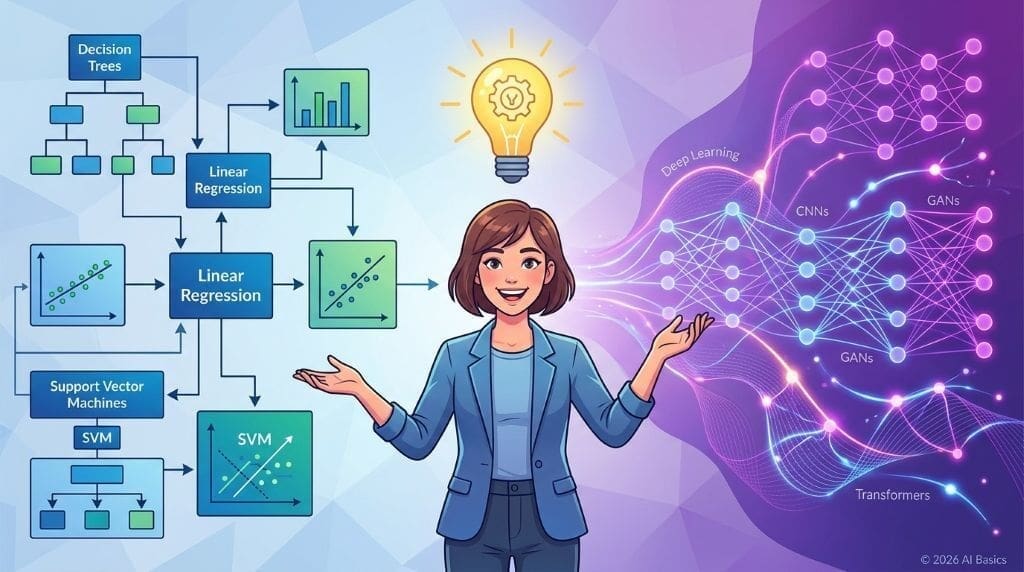
This checklist is short by design. However, it supports deep thinking. At first, students define the task. After that, they inspect data and fairness. Then, they test outputs and protect privacy. At last, they connect technical choices to real people. In effect, this sequence mirrors strong pedagogy. Students first learn concepts. Next, they practice analysis. Finally, they apply judgment in career settings. Seshia’s work on cyber-physical systems education also supports hands-on, systems-based learning. It shows that modern computing education should connect theory, design, testing, and real-world consequences. That lesson applies strongly to AI ethics for students.

What privacy habits should students practice?
Students should treat personal data as sensitive by default. They should not paste private marks, medical details, addresses, passwords, or classmates’ work into AI tools. In addition, they should avoid uploading faces, identity cards, or school records without permission. AI systems may store prompts. Some tools may use inputs for improvement. Therefore, students must read privacy notices before using them. If that sounds boring, use a simple rule. Do not share data you would not post publicly. To be sure, some school-approved tools offer stronger safeguards. Even then, students should share only what is needed. Privacy is not only a legal topic. It is also a respect topic. A classmate’s writing sample is not yours to upload. A group project dataset may include hidden personal details. So, responsible AI use begins with consent, minimization, and care.
How should AI ethics for students guide classroom projects?
AI ethics for students should guide every stage of a project. Students should not add ethics at the end. Instead, they should include it from the first idea. A simple project plan can include purpose, data source, risks, testing method, and human review. For example, a student building a plant disease classifier should ask where images came from. They should ask whether the model works on local plants. They should also test images from different lighting conditions. Similarly, a student building a study chatbot should check for incorrect answers, missing sources, and age-appropriate advice. NIST’s AI RiskThe chance that harm occurs, given the hazard and the exposure. More Management Framework promotes trustworthy and responsible AI, including methods for identifying and managing AI risks. Students can adapt that mindset. They do not need corporate paperwork. However, they do need clear risk questions and repeatable checks.

How can students cite AI use honestly?
Students can cite AI use by naming the tool and task. They should also explain what they changed. For example, a project note may say this. “I used an AI tool to brainstorm headings. I verified facts through academic sources.” This statement is clear. It also protects authorship. However, students should follow school policy first. Some teachers may ban AI for certain tasks. Others may allow it for outlines, coding support, or language feedback. In either case, disclosure builds trust. Above all, students should never cite AI as a source for factual claims. AI tools are not stable evidence. They can generate false references. They can also mix correct and incorrect details. Therefore, students should cite peer-reviewed articles, .edu pages, and .gov sources instead. The final answer must reflect student understanding, not machine output.
How does responsible AI connect to careers?
Responsible AI connects directly to careers because every industry now uses data. Engineers design systems. Doctors review AI suggestions. Lawyers examine automated decisions. Teachers use learning analytics. Designers build AI-powered interfaces. Business teams use AI for hiring, pricing, support, and forecasting. As a result, employers value students who can ask ethical questions early. Technical skill matters. However, judgment makes skill safer. Stanford HAI reports that AI adoption has reached broad organizational use, while student use is also widespread. This means graduates will not simply use AI tools. They will help decide how those tools affect people. Students who understand fairness, privacy, and accountability can become stronger leaders. They can also prevent costly harm. In short, AI ethics for students is career preparation. It is not only a classroom rule.

What AI ethics skills help students get future jobs?
Several ethics skills now support career readiness. First, students should learn to question data. They should ask who collected data, why, and under what limits. Second, they should learn bias testing. This means checking performance across groups, contexts, and edge cases. Third, they should learn explainability. A user should understand why a system suggested something important. Fourth, students should learn documentation. Model cards, data sheets, and project logs help teams review decisions. Fifth, students need communication skills. They must explain technical risks in simple language. To point out, these skills help both coders and non-coders. Product managers, educators, designers, and policy teams need them too. At the same time, students should build projects that show responsible choices. A portfolio with an ethics note can stand out. It shows maturity as well as technical promise.
How can teachers and schools effectively teach AI ethics to students?
Teachers and schools can teach AI ethics well through examples, projects, and discussion. A lecture alone is not enough. Students learn best when they test real outputs. For instance, teachers can compare two AI summaries of the same article. Then students can fact-check both versions. They can mark missing evidence, biased framing, and unclear claims. For example, teachers can ask students to audit a fictional hiring model. Students can inspect features such as grades, activities, location, and language. After that, they can decide which features are fair. This creates active learning. It also connects ethics to design. NIST describes trustworthy AI work through characteristics such as explainability and interpretability. Schools can translate those ideas into age-appropriate activities. In general, the best AI ethics lessons combine computer science, civics, writing, and real-world cases.

How This Guide Was Compiled
This guide was compiled using open-access and peer-reviewed sources. It also uses classroom-facing computer science teaching experience. The statistical foundation comes from Stanford HAI’s 2026 AI Index Report. That report tracks AI capability, adoption, education, policy, and social impact. Its education findings guided the urgency of this article. The technical foundation comes from LeCun, Bengio, and Hinton’s review of deep learning. The fairness case comes from Obermeyer and colleagues’ Science study on racial bias in healthcare algorithms. The pedagogical foundation draws on Seshia’s article on cyber-physical systems education. Finally, NIST’s responsible AI resources informed the practical framing of risk. All things considered, the goal was simple. Students need accurate concepts, practical safeguards, and career-ready judgment.
Verified Resources
- Stanford HAI AI Index 2026 Report
- NIST AI Risk Management Framework
- NIST Trustworthy and Responsible AI
- LeCun, Bengio, and Hinton’s peer-reviewed deep learning article
- Obermeyer and colleagues’ peer-reviewed algorithmic bias study
- Seshia’s peer-reviewed article on computing education
FAQs
References
LeCun, Y., Bengio, Y., & Hinton, G. (2015). Deep learning. Nature, 521(7553), 436–444. https://doi.org/10.1038/nature14539
National Institute of Standards and Technology. (2026). AI Risk Management Framework. https://www.nist.gov/itl/ai-risk-management-framework
National Institute of Standards and Technology. (2026). Trustworthy and responsible AI. https://www.nist.gov/trustworthy-and-responsible-ai
Obermeyer, Z., Powers, B., Vogeli, C., & Mullainathan, S. (2019). Dissecting racial bias in an algorithm used to manage the health of populations. Science, 366(6464), 447–453. https://doi.org/10.1126/science.aax2342
Seshia, S. A. (2022). Explorations in cyber-physical systems education. Communications of the ACM, 65(5). https://doi.org/10.1145/3490442
List of terms
- Risk
