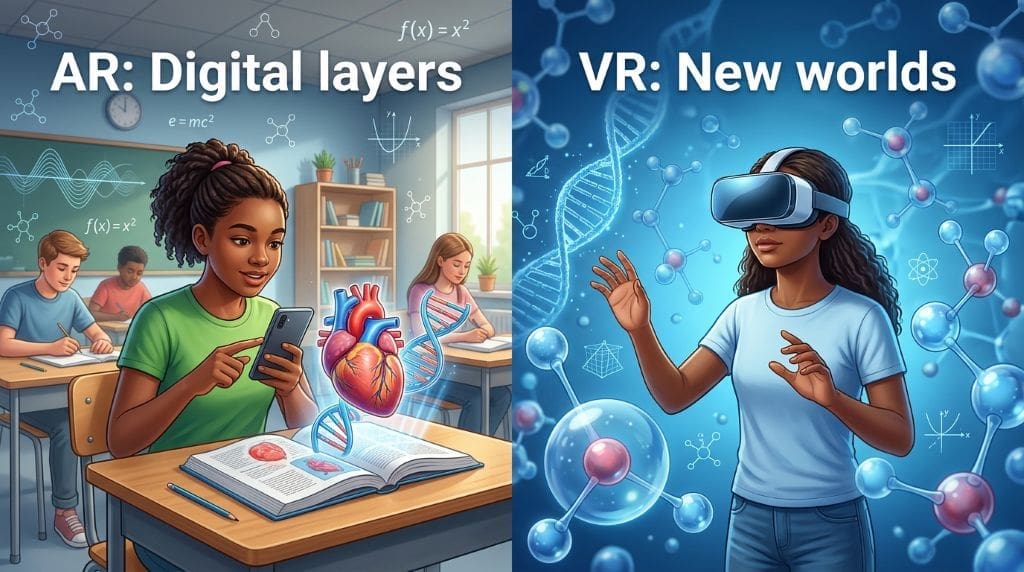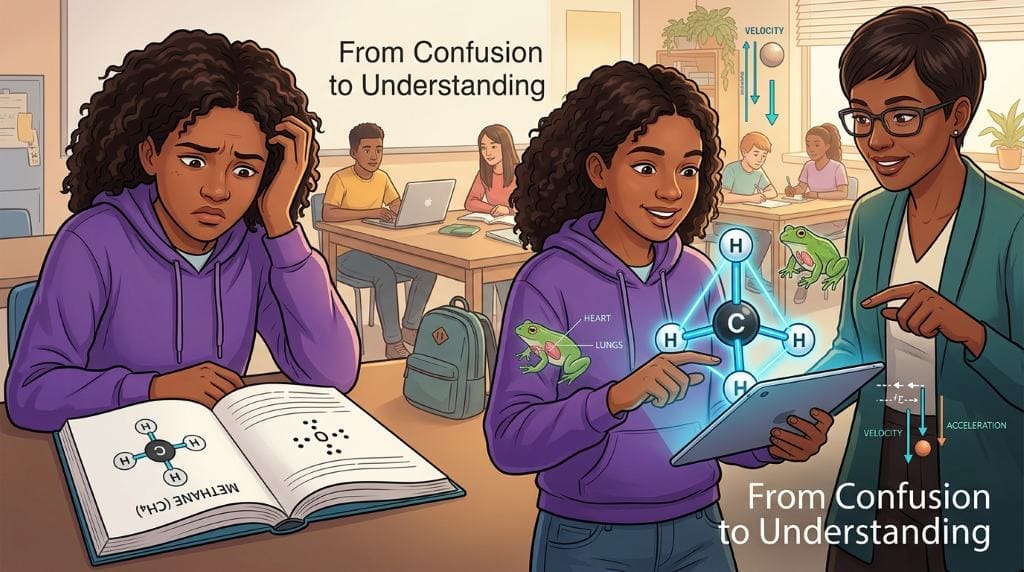

Envision a first-year student pouring acid into a glass beaker. Her hands shake, and she notices a strong smell. A lab partner cautions her to take care. Now, imagine that same student wearing a headset and pouring virtual acid with a controller. Nothing spills, and no hazardous odor remains. These two experiences feel very different, even though both teach chemistry. The brain processes each one differently. Many teachers now wonder: does VR help STEM students as much as real life? This guide explores the question of VR vs real life STEM and compares VR and real-life STEM learning, focusing on senses and thinking. It draws on six peer-reviewed studies. You’ll find out when each method works best and where they overlap. At the end, you’ll get a simple rule to help you decide how to mix both approaches in your lessons.
Key Takeaways
- How we perceive through our senses influences our memories, and real life provides more stimulation.
- VR can increase cognitive load, which can interfere with learning.
- Virtual reality can demonstrate spatial STEM concepts through rotation and scale.
- Real labs develop touch and muscle memory, whereas headsets do not.
- Virtual labs allow safe, low-cost repetition and failure.
- Presence can help a new learner focus or get distracted.
- Careers value both digital fluency and real hands-on skill.
The way the brain deals with VR as opposed to real-life STEM learning
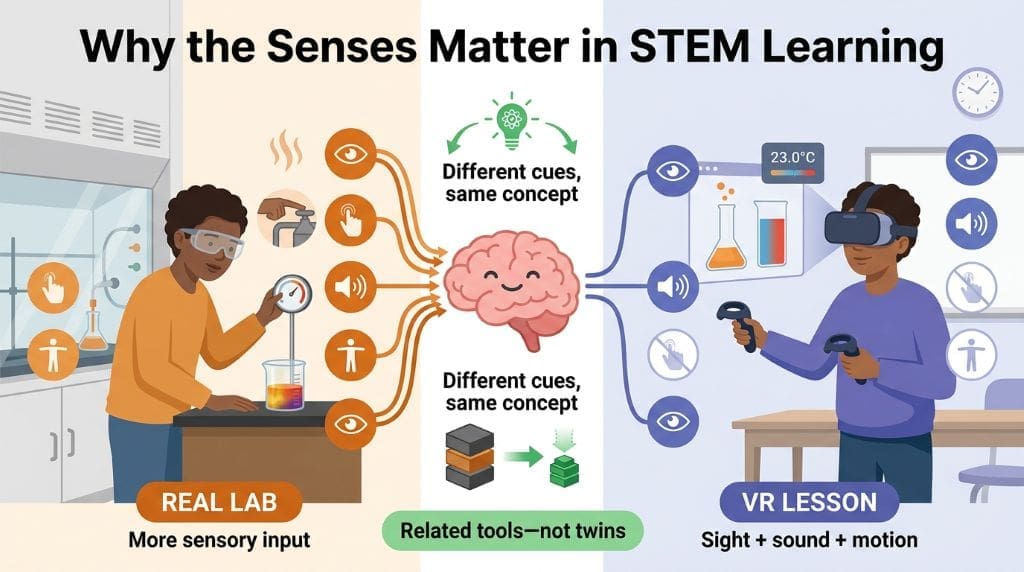
VR lessons and real labs affect the brain in different ways. In real labs, students use sight, sound, touch, smell, and balance. Headsets usually offer sight, sound, and a bit of motion. Because of this, students learn differently in each setting. Studies on multisensory learning in virtual environments show that using more senses can help, especially when tasks are difficult. When more senses are involved, students notice things faster, and their brains don’t have to work as hard.
For example, a real lab reaction in a fume hood uses many senses, while a virtual lab uses only a few. Students use different mental resources for each lesson. In a real lab, a student might read a temperature gauge, while in a virtual lab, a student might see a color change. Both teach the same idea, but the effect is different. This is how multisensory learning works. Teachers should see VR and real labs as related tools, not the same.
Why Multisensory Input Matters in Immersive Learning
The brain uses different senses together to make sense of what’s happening. In a real physics lab, a student hears a pendulum click and feels the table shake. In a headset, most of these details are missing. A study in Scientific Reports found that using three senses at once made students feel more present in a virtual scene. This feeling of presence helps with memory and focus.
When a lesson uses fewer senses, it can feel less interesting. For example, a student who only watches a virtual magnet might learn the rule, but may not remember it as well. Still, virtual systems get better every year. New headsets offer touch-like feedback and surround sound. In general, using more senses makes STEM lessons stronger, whether in real life or in VR.
Presence and Agency in VR vs. Real-Life STEM
It is important to have a sense of presence and to have a degree of agency when it comes to immersive learning. The Cognitive Affective Model of Immersive Learning, or CAMIL, takes both of these into account. Presence refers to feeling as if you are actually there. Agency involves the ability to act and to see the results of those actions. In real laboratories, students have a high level of agency since they mix substances, take measurements, and observe the actual outcomes. A well-designed virtual reality lab can provide a similar level of agency through virtual actions, for example, by pulling a lever and watching a gear turn.
However, if the design is poor, then students will press buttons and become disinterested. The model indicates that the design of the lesson is more important than the technology used. For certain learning objectives, a good virtual lesson can be just as effective as a hands-on one. Agency enables students to move from merely watching to actually taking part.
Working Memory Sets the Real Limit
Since the working memory of a student can only keep a limited number of things at one time, each lesson has to compete for that space. STEM activities take up this space by introducing facts and rules, and therefore additional demands can interfere. Virtual reality introduces extra demands; for example, the need to use menus and to track movements, which can distract the students. A simple diagram can teach a concept more quickly than a complicated simulation. However, a well-designed virtual environment can help by making invisible ideas visible. The important point is design: effective virtual tools make learning easier, whereas poorly designed ones make it harder. Teachers should ensure that the tasks are focused and that the menus are simple, so that students have the opportunity to think and to understand.
Cognitive Load and Cybersickness in VR vs Real Life STEM Learning
Virtual reality can be more mentally demanding than using a regular screen. A study in the Virtual Reality journal tested this by showing the same 360-degree video on a laptop and in a headset. People using the headset felt more mental strain and more cybersickness. Most of the extra strain came from feeling sick, not from feeling present in the scene. This is important for STEM teachers: if a student feels queasy in a headset, they remember less because their brain is busy dealing with discomfort instead of learning.
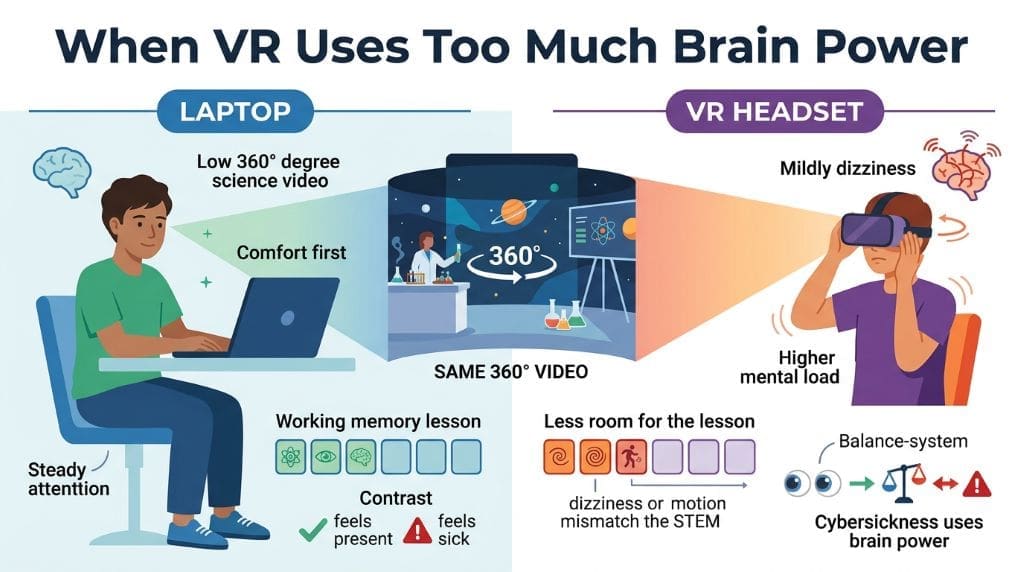
In a real lab, students’ bodies stay still, so their minds can focus better. Teachers can help by keeping VR sessions short and giving frequent breaks. For example, a five-minute dissection is better than a forty-minute session. Cybersickness is a real issue, not a rare problem.
How Cognitive Load Shapes VR vs. Real-Life STEM Retention
Cognitive load is the mental effort needed for a task. Real STEM work already has a built-in load from the content. Virtual reality adds extra load from things like headset weight and navigation. This leaves less mental space for learning science. A study in Computers & Education found that deeper immersion made students feel more present, but it didn’t always improve learning. Interactivity mattered more for good results. So, a simple interactive task is better than a fancy but passive one. Teachers should combine high immersion with easy-to-use controls. Students also need practice with the controls before starting, so they can focus on the science. Interactivity helps students focus on the lesson, not just the headset.
Why Interactivity Beats Passive Immersion
Immersion and interactivity are related but not the same. Immersion is how much a system blocks out the real world, while interactivity is about what the learner can do. For example, a student might stand inside a virtual engine but not touch anything, so she only watches. This passive experience does not use the technology’s full potential. When students interact with objects, such as building a virtual circuit and fixing mistakes, they remember the lesson better. Interactivity makes a lesson powerful, while passive viewing is less memorable. Both immersion and interactivity work best when the lesson is carefully designed. This idea is central to comparing VR vs real life STEM learning.
Managing Cybersickness in the STEM Classroom
Cybersickness may lead to feelings of nausea, sweating, and dizziness, even after only a few minutes in a headset. This is an important consideration when comparing VR vs real life STEM learning. Some students may not mention their symptoms because they feel embarrassed. Teachers need to look out for signs, such as a student who has stopped moving her head. Short sessions and frequent breaks can help reduce the risk. Students often find it easier to cope with a steady horizon line and slow, predictable movements than with sudden spins. Seated activities are more suitable for beginners than activities that involve walking. In VR vs real life STEM education, it is important to prioritize comfort over experimenting with new technology. Taking breaks is free and can do more good than most people realize.
Learning Transfer From VR to the Real Bench
The real test of training is whether skills learned in VR transfer to real-life tasks, which is a key part of comparing VR vs real life STEM education. This transfer does not happen automatically. Research shows that a student might master a virtual pipette but still have trouble with a real one because the grip and weight are different. Teachers should add a step in between: let students practice in VR, then quickly repeat the task with real tools. Short gaps between the two help memory, while long gaps make it harder to remember. Real objects feel different from controllers, but the steps can still transfer. Hands learn the order first, and real practice adds the feel. VR prepares students, while real labs help them master the skill. This balanced approach makes VR vs real life STEM learning more effective.
A comparison of VR and real-life STEM experiences in terms of sensory depth.
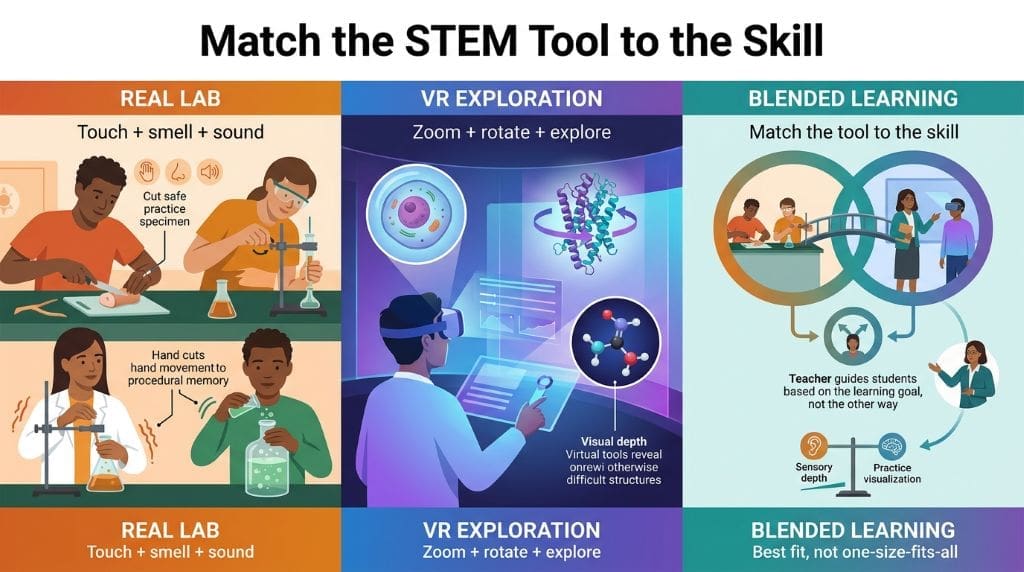
Actual laboratories make use of the senses that virtual ones have not yet managed to replicate. When students cut tissue or tighten a clamp, they are able to feel the resistance. They can smell the chemicals and hear the glass bubbling. These sensations aid in building memory through the hands. On the other hand, virtual systems limit the world to what can be seen and heard. This assists in some objectives but is detrimental to others.

Virtual labs mostly rely on sight and sound, which works well for some things but not for others. A virtual model can zoom into cells or rotate proteins, which real benches cannot do. The two modes often teach different strengths. That’s why many STEM programs now use both. A review of immersive apps in higher education looked at this. The authors reviewed design elements and lessons learned. They found both promise and real gaps. Evidence and teacher training were both limited. Good teaching matches the medium to the skill, not the other way around. Sensory depth guides that choice, which is central to VR vs. real-life STEM.
Touch, Sound, and Balance in Virtual Labs
In most virtual labs, the sense of touch is the most lacking thing. Students are unable to feel the texture of a leaf or the weight of a wrench. Hand controllers provide only simple feedback. Sound functions better in today’s headsets, with spatial audio having the ability to place a beep behind a student or within a circuit. Balance is mostly absent, with the only exception being when a full motion rig is used. Although these missing sensations make the experience less realistic, they also eliminate danger, since a student could pour the wrong chemical and nothing would happen. Therefore, the absence of touch is not always a disadvantage; it can, in fact, be an advantage when safety and practice are most important. Because touch helps to build muscle memory, which virtual labs do not have, this is the primary compromise between VR and real-life STEM.
Safety and Repetition Change the Equation
Since virtual labs enable students to make mistakes without incurring any actual cost, they can drop a flask or short a circuit without causing a mess or posing any danger. This kind of freedom enables a great deal of practice, which in turn helps to develop automatic skills. Real labs cannot provide unlimited opportunities to try things because materials have a cost and equipment is liable to break. That is the reason why virtual practice is suitable for risky procedures; students can safely repeat a procedure in a virtual environment before attempting it once with actual equipment.
This method reduces anxiety when carrying out the experiment in a real lab. The best result is achieved by combining both approaches: virtual labs are useful for repetition, whereas real labs help to build confidence and hands-on ability. Putting the two methods together saves money and reduces stress, thus leading to a more sensible design.
When VR or real-life STEM works best
There is no one method that is best for every lesson since each is suitable for different learning objectives. Virtual reality is excellent when it comes to studying things that are too small, too large, or invisible, for example, molecules or solar systems. On the other hand, real-life laboratories are more appropriate for hands-on and social learning; in such cases, students work with actual objects and collaborate with their classmates. A review of 117 K-12 STEM studies found both benefits and challenges with VR, including distractions, discomfort, and high costs.
In my own classroom, I saw this difference. I taught a friction lesson where half the class used a virtual ramp and the other half used real wooden blocks. The group that used virtual blocks completed the task more quickly and carried out more practice, but those students who had the actual blocks gave a more detailed description of friction. Although both groups passed the quiz, the students who had used the real blocks remembered the sensation of rough wood for weeks.
A Two-Item Rule of Thumb
A simple rule can help you plan STEM lessons. First, decide what skill you want students to learn. Then, think about which senses that skill needs. Use VR for ideas that are invisible, very large, or dangerous. Use real life for skills that need hands-on practice or group work. For example, a virtual model of a plant cell shows its parts in 3D, while a real slide lets students see it under a microscope. Each method teaches something different. Let your lesson goal decide which format to use. This rule works for all ages and types of science. Remember the two points below as you plan.
- Pick VR for huge, invisible, or dangerous concepts.
- Pick real life for touch-heavy and social tasks.
When Does VR vs. Real-Life STEM Fit Your Lesson?
Before each lesson, ask yourself what exact skill the student should remember. If it’s a hands-on skill, like pipetting, students need real practice. If it’s a concept, like protein folding, a rotating virtual model works well. Virtual reality is best for concepts, while real life is best for hands-on skills. You can also split a lesson: use VR to introduce the idea, then confirm it with real practice.
In conclusion, you rarely have to choose just one method. Blending both usually works best. Let your learning goal decide which tool to use. Matching the goal to the method leads to better results. For example, you might use virtual previews on Monday and real practice on Wednesday. This routine helps students connect both experiences. Grading Both Modes Fairly

Fair Assessment in Virtual and Real Labs
The assessments should focus on testing skills rather than the technology used. A virtual lab and a real one can employ the same rubric. For instance, both can evaluate a student’s method, safety, and accuracy. A fair rubric should clearly outline the various steps and then check each one against the established marks. This ensures that marking is fair regardless of the format and prevents any bias in favor of one type of tool.
Teachers ought not to award extra marks for using a headset or deduct marks for using a standard bench; it is the skill that matters. Although creating a shared rubric requires effort, the rewards are significant. Students realize that it is the effort that counts, not the equipment used. This message has a lasting effect and results in more in-depth study. As a result, learners cease trying to get the latest gadget and instead concentrate on the main idea. Fair assessment keeps the emphasis on mastery rather than novelty. Teachers can draw up the rubric once and use it throughout the term.
From Virtual Practice to Real STEM Careers
Today, employers expect employees to have competence in both real-world and digital tools. Engineers use software to simulate bridges before actually constructing them. Surgeons carry out procedures on a screen before performing them on patients. Students who are familiar with both methods have an advantage. Practicing in a virtual environment boosts confidence and reduces early mistakes, while genuine hands-on practice develops the manual ability that employers assess.
Combining Digital and Practical Skills
In many sectors, extended reality is used as part of training, but laboratories still rely on pipettes and multimeters. A student who is only accustomed to wearing a headset may fail to develop practical skills, while one who only works at a bench may miss out on essential digital abilities.
The most suitable candidates use both approaches. They regard VR as a means of practice rather than a substitute for real-world experience. Together, digital fluency and manual skill form a strong combination.
Building a Career Path With VR vs. Real-Life STEM
Here’s a practical plan for STEM students: start by using a virtual classroom to preview tough concepts, then confirm your understanding with real, hands-on tasks. Practice risky steps safely in VR, and work on fine motor skills at a real bench. Review your mistakes in the virtual log and fix them in the real lab. Repeat this process for each topic. This habit helps you build skills steadily and efficiently. Over time, you’ll create a portfolio that shows both digital and hands-on abilities, which impresses employers and graduate schools. Skills in both areas open more opportunities, since employers value people who can work with both technology and real tools.
FAQs
It depends on the skill. Conceptual and spatial ideas often match real life in VR. Tactile and procedural skills usually lag, though. Alignment is the key.
It can. Cybersickness and extraneous load sometimes rise inside a headset. Short sessions and breaks help a lot. Breaks protect the learner’s focus.
Most systems skip smell, balance, and fine touch. That gap matters for hands-on STEM work. Touch is the biggest loss.
Choose VR for invisible, huge, dangerous, or costly topics. Pick real life for fine motor and social practice. Goal drives the choice.
Yes. Virtual practice builds confidence and digital fluency. Employers still test real manual skill, though. Both modes matter.
How This Guide Was Compiled
This article follows Google’s E-E-A-T guidelines for education and science content. It combines first-hand teaching experience with peer-reviewed research. I searched open-access databases for VR and STEM studies, and included six that met the criteria. Each link goes to a stable journal record with a digital object identifier. I read the key parts of every source and matched each finding to a classroom question. This way, the evidence connects directly to teaching decisions. All claims come from open sources, and I kept the scope narrow when needed. The resources below are limited to government and university sites, making the article easy to verify. You can check any claim using the links provided.
Verified Resources
The sources below come from government and university websites, which are trusted for STEM education information. Use them to check facts or find more reading. A .gov or .edu address means the source is official. That’s why I include only these links. Each one is stable and publicly available. For example, the National Science Foundation funds STEM research and publishes clear guides. Teachers can trust these materials because they are reviewed before release. Bookmark the pages that are useful for your field—they make great quick references. Use this list as a starting point for deeper study. It’s short on purpose, and each link leads to a primary source.
- National Science Foundation — federal funding and STEM education research.
- Institute of Education Sciences — the What Works Clearinghouse for teaching evidence.
- MIT OpenCourseWare — free university STEM course materials.
- National Academy of Engineering — engineering education standards and reports.
References
Breves, P., & Stein, J.-P. (2023). Cognitive load in immersive media settings: The role of spatial presence and cybersickness. Virtual Reality, 27(2), 1077–1089. https://doi.org/10.1007/s10055-022-00697-5
Jiang, H., Zhu, D., Chugh, R., Turnbull, D., & Jin, W. (2025). Virtual reality and augmented reality-supported K-12 STEM learning: Trends, advantages and challenges. Education and Information Technologies, 30(9), 12827–12863. https://doi.org/10.1007/s10639-024-13210-z
Makransky, G., & Petersen, G. B. (2021). The Cognitive Affective Model of Immersive Learning (CAMIL): A theoretical research-based model of learning in immersive virtual reality. Educational Psychology Review, 33(3), 937–958. https://doi.org/10.1007/s10648-020-09586-2
Marucci, M., Di Flumeri, G., Borghini, G., Sciaraffa, N., Scandola, M., Pavone, E. F., Babiloni, F., Betti, V., & Aricò, P. (2021). The impact of multisensory integration and perceptual load in virtual reality settings on performance, workload, and presence. Scientific Reports, 11, 4831. https://doi.org/10.1038/s41598-021-84196-8
Petersen, G. B., Petkakis, G., & Makransky, G. (2022). A study of how immersion and interactivity drive VR learning. Computers & Education, 179, 104429. https://doi.org/10.1016/j.compedu.2021.104429
Radianti, J., Majchrzak, T. A., Fromm, J., & Wohlgenannt, I. (2020). A systematic review of immersive virtual reality applications for higher education: Design elements, lessons learned, and research agenda. Computers & Education, 147, 103778. https://doi.org/10.1016/j.compedu.2019.103778