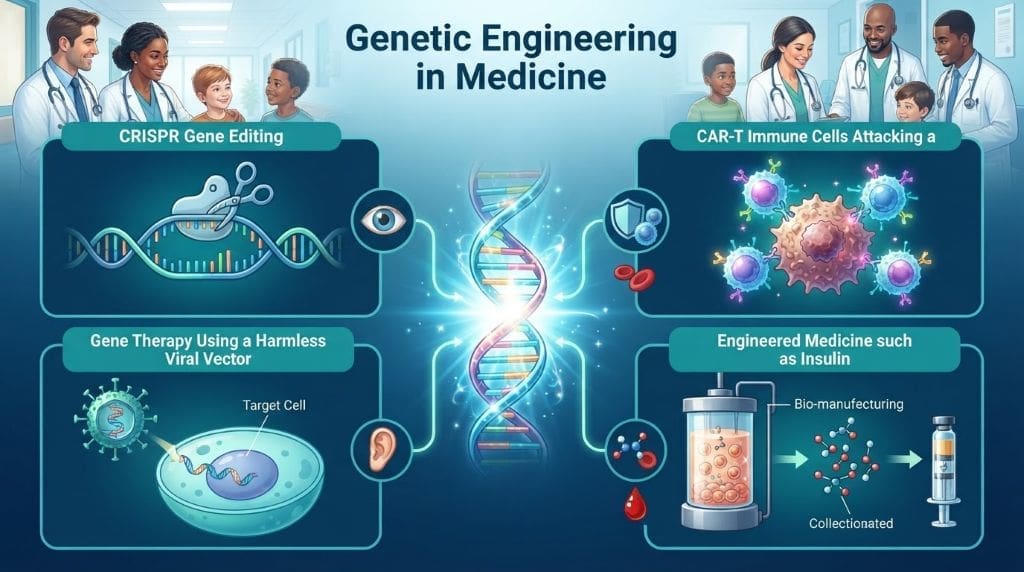
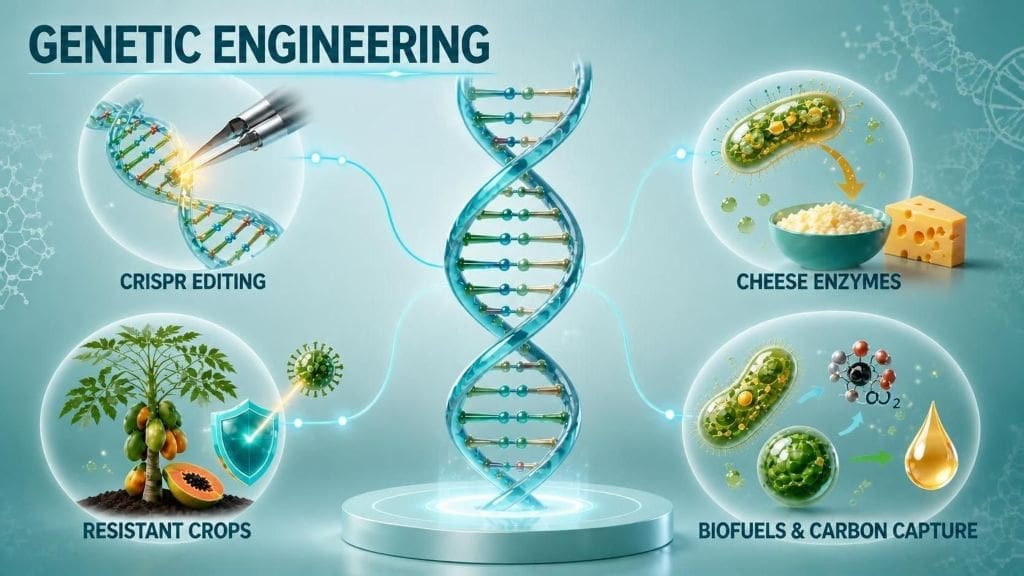
Some mornings, you eat things that would not exist without a little help from science. Take a cheese sandwich, for instance: engineered microbes produce the enzyme that makes much of today’s hard cheese. Or consider a bowl of fruit; a single genetic change once saved the papaya on your supermarket shelf from a ruinous virus. And if you know someone who lives with diabetes, engineered bacteria manufacture the insulin that keeps them healthy. This introduction to genetic engineering explains, in simple terms, how scientists change DNA and why it matters.
None of this is science fiction; it is genetic engineering, and it has quietly shaped everyday life for a long time. In fact, genetic engineering touches daily life more than most people realize, and it has done so for longer than most people assume. Even so, the term still sounds heavy, technical, and a little intimidating. It does not have to be.
Here is a simple introduction to genetic engineering: it deliberately changes an organism’s DNA to give it a new trait, remove a harmful one, or repair a mistake. That is the whole idea. Everything else is just detail — fascinating detail, but detail nonetheless. Ultimately, you have already met the results; this short introduction now lets you meet the idea itself.
An Introduction to Genetic Engineering: Rewriting the Code of Life
DNA — Your Body’s Instruction Manual
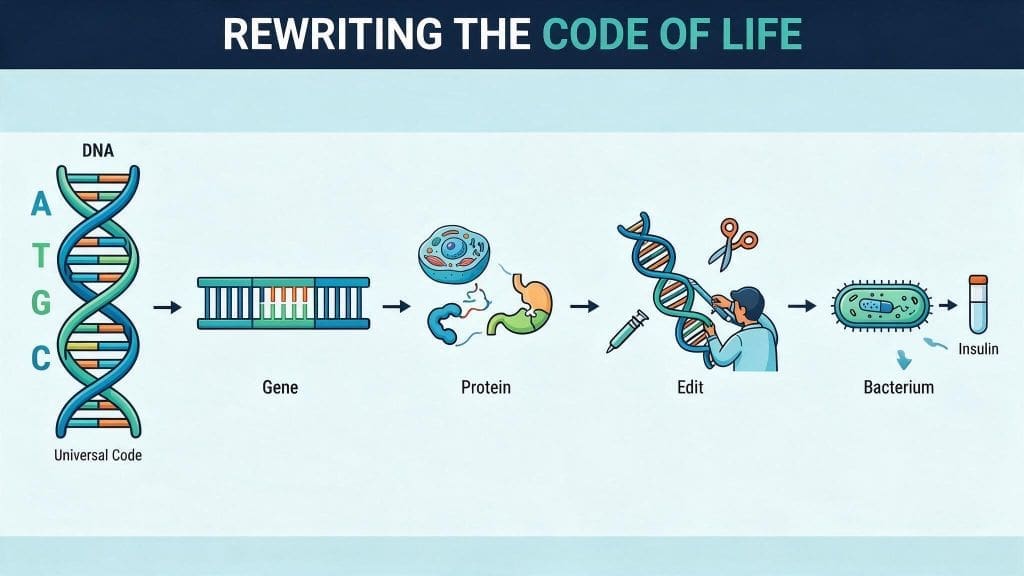
Every living thing- you, your dog, a rose bush, a bacterium carries a set of instructions inside its cells called DNA. These instructions use a chemical alphabet with just four letters: A, T, G, and C. Specifically, a gene is a stretch of these letters that spells out one particular job, such as how to build a protein. For example, your eye color, your height, and how your body handles sugar after a meal all trace back to sentences in this manual. In short, DNA works as an instruction manual for building and running an organism, and genes act as its sentences.
DNA does not do the work itself; instead, it merely holds the plan. Your cells follow that plan to build proteins, the worker molecules that move your muscles, digest your food, and fight off germs. Change the plan, therefore, and you change the work.
What “Engineering” Really Means
In this introduction to genetic engineering, ‘engineering’ means editing that manual on purpose. In other words, picture DNA as one enormous document on a computer, billions of letters long; a gene resembles a single paragraph inside it. To make an edit, genetic engineers use specialized tools to find a specific paragraph and then change it: they can fix a typo, delete a sentence, or paste in a sentence copied from a completely different document. Once they lock in the edit, the organism simply follows its updated instructions.

Why call it “engineering”? Because the work involves deliberate design. Just as an engineer adjusts a bridge’s design to make it stronger, a genetic engineer adjusts DNA to make an organism better suited to a purpose. The key difference, however, is that the materials are alive. Unlike a bridge, moreover, a living design passes itself down: when scientists change an organism’s DNA, the organism hands that change to its offspring, so it becomes a permanent part of what that organism is.
One Code, Shared by All Life
Indeed, one famous example in this introduction to genetic engineering shows how real this is. Human DNA holds the instructions for building insulin, and bacteria carry their own DNA written in the same four-letter code. In the late 1970s, scientists built the insulin gene in the laboratory, placed it into bacteria, and watched the bacteria start producing human insulin. The experiment worked because every living thing shares the same genetic language. Consequently, DNA functions as a universal code, so scientists can move instructions between species: a human gene can run inside a bacterium, and a bacterial gene can protect a crop plant. Once you see that, the field stops looking like magic and starts looking like clever editing of a code that all of life shares.
Why Genetic Engineering Basics Matter?
Health: Better Medicines and Direct Cures
Health comes first, because the stakes run highest here. Small errors in our DNA cause some diseases; after all, a single wrong letter can make a big difference. Genetic engineering attacks these problems from two directions. First, it makes medicines: engineered cells build vaccines and many of the protein medicines on hospital shelves. Second, and more excitingly, it can repair the errors themselves. Doctors have already used gene-editing tools to help patients with sickle cell disease, a painful inherited blood disorder, and with an inherited form of blindness. Simply put, this marks a shift from managing a disease to correcting its cause. The same tools, meanwhile, let researchers study diseases by switching genes on and off in laboratory cells and animals, which speeds up the search for treatments.

Food: Stronger, More Reliable Crops
Food comes second. Farmers have always shaped their crops, but genetic engineering simply does it faster and more precisely. For example, scientists can confer resistance in a plant to viruses, insect pests, drought, or extreme temperatures. They can also improve nutrition or reduce allergens. Notably, researchers are working on peanuts that trigger fewer allergic reactions. As a result, more reliable harvests with fewer losses mean more food reaching the table, and that matters in places where a single bad season can mean hunger.
Industry and Climate: The Quiet Applications
The third reason works more quietly, but it shows up everywhere. Engineered microbes work behind the scenes in industry: they produce enzymes used in cheesemaking and in some stain-removing washing powders. At the same time, in the lab, scientists are exploring engineered algae and microbes for biofuels and carbon dioxide capture from the air. In short, the same technology that shapes your lunch now targets the climate too.
Examples of Genetic Engineering in Everyday Life
Insulin Made by Bacteria
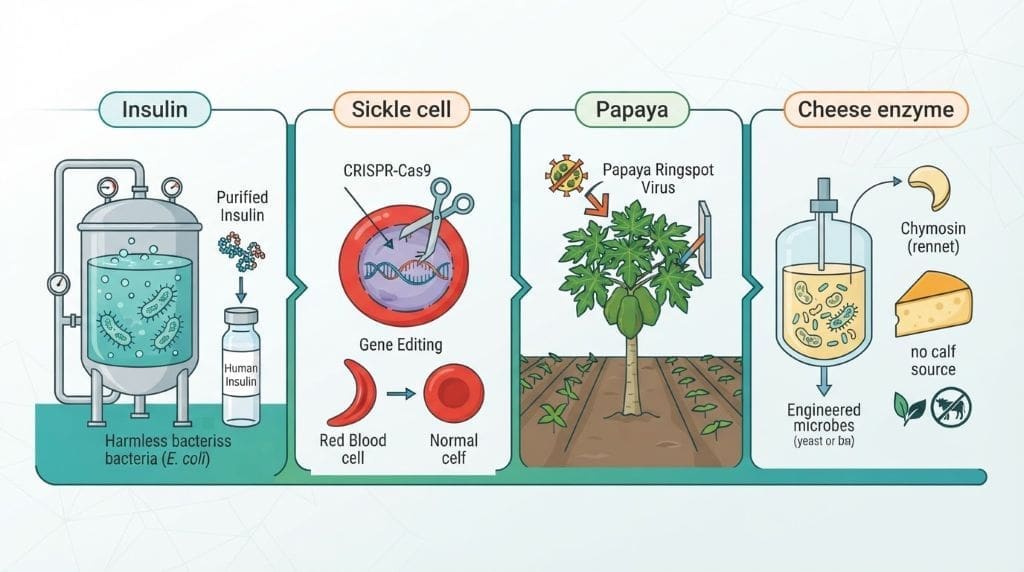
People with diabetes need the protein insulin to control their blood sugar. Before genetic engineering, doctors relied on insulin collected from the pancreases of pigs and cattle, a supply that was difficult to maintain and could trigger reactions. In 1979, scientists first coaxed bacteria into building the two chains of human insulin — the original paper is still freely readable. Today, however, harmless bacteria carrying the human insulin gene grow in steel tanks, read the human instructions, and produce the protein, which technicians then purify into medicine. Because the protein matches the human one exactly, the body accepts it as its own. The same approach now supplies other medicines too, including human growth hormone.
A Treatment for Sickle Cell Disease
Sickle cell disease comes from a typo in a single gene, and that typo makes red blood cells stiff and misshapen. Using CRISPR, a gene-editing tool that acts like a pair of molecular scissors, scientists can correct the fault directly in a patient’s own blood cells. Already, this approach has helped real patients, and the list of treatable conditions keeps growing every year. In the end, that marks the difference between treating symptoms and fixing the underlying code.
The Papaya That Fought Back
In some parts of the world, a virus nearly wiped out papaya farming. In response, scientists inserted a small piece of the virus’s own genetic code into the papaya’s DNA, and the plants became resistant. It needed no sprays or chemicals; instead, the plant’s own instructions provided the protection. Now, much of the papaya sold worldwide traces back to that single change, and it remains one of the technology’s best-known success stories.
The Cheese in Your Sandwich
Traditional cheese-making relied on rennet, an enzyme that workers once collected from calves’ stomachs. These days, microbes that carry the right gene produce that same enzyme, so most hard cheese no longer needs an animal source. The cheese still tastes the same, yet it involves no calves at all. In turn, fermentation with engineered microbes now constitutes a standard practice in the food industry.
Genetic Engineering Basics: How It Works in Brief
Genetic Engineering Explained: The Molecular Scissors of CRISPR
Here is the short version, on purpose. Inside cells, there are natural enzymes that cut DNA at specific spots — you can think of them as molecular scissors. Notably, the most famous modern pair comes from an unexpected place: bacteria. Bacteria use a system called CRISPR to remember the viruses that infect them and to slice up those viruses’ DNA if they ever return. From there, scientists adapted that system so the scissors could cut at any spot they choose.
From Cut to Repair
Once the scissors make a cut, the cell’s own repair machinery jumps in. Scientists can then steer that repair to delete a section of DNA, swap in a new one, or paste in extra instructions. Put simply, the tools cut and the cell patches, with the edit built right in. The result amounts to a single precise change in a code billions of letters long, more like a word processor than a wrecking ball. Newer tools can even swap a single letter without breaking the DNA at all, a trick called prime editing that makes “search and replace” literal. Afterward, scientists read the DNA back to make sure the edit landed exactly where it was meant to — and nowhere else. That checking step matters a lot: even the best tools occasionally cut in the wrong place, and avoiding that is an active area of research.


This introduction to genetic engineering goes only so deep, on purpose. That said, the full mechanics of how the tools find their target, how DNA fragments are copied and joined, and how edits reach the right cells are explained step by step in our Complete Guide to Genetic Engineering, which also tells the story of how these tools came to be.
Introduction to Genetic Engineering: Common Questions
No. Cloning makes a copy of a whole organism, while genetic engineering changes specific instructions inside one. The two share some laboratory tools; even so, they perform very different jobs, and genetic engineering is the one you meet in medicine and food.
Not yet. In fact, the toolbox works powerfully but imperfectly: researchers still struggle to deliver the tools to the right cells in a living body and to ensure every edit lands exactly where intended. Still, they are actively working on both problems.
In principle, the technology could go there, which is exactly why it raises serious questions. Across dozens of surveys in many countries, most people support using gene editing to treat or prevent disease, yet they oppose using it for “enhancement,” such as choosing appearance. For now, how far society should go remains a live conversation.
What to Read Next
Why This Topic Will Keep Coming Up
Genetic engineering no longer belongs only to specialists. Instead, it shows up in the medicine cabinet, the supermarket, the farm, and the lab next door. Soon, the people it affects, all of us, will make decisions about it. Understanding the basics, therefore, offers the easiest way to join those conversations without fear and without hype.
Soon you will notice how often the subject shows up in the news, for instance, a new therapy, a drought-resistant crop, or a debate about rules and safety. When it does, you will already recognize the basics behind the headline.
How This Guide Was Compiled
To keep this guide simple yet accurate, we’ve cross-referenced every section with peer-reviewed and authoritative sources. We drew on landmark research, including the first successful use of bacteria to produce insulin and insights from Nobel laureates on CRISPR. The content is further supported by detailed guides on DNA cloning, reviews of protein medicines, and the latest breakthroughs in prime editing, along with a wide-scale review of public opinion on genetic engineering. All our references are open-access, ensuring that vetted scientific data back every fact presented here.
References
1. Alberts, B., Johnson, A., Lewis, J., Raff, M., Roberts, K., & Walter, P. (2002). Isolating, cloning, and sequencing DNA. Molecular Biology of the Cell – NCBI Bookshelf. https://www.ncbi.nlm.nih.gov/books/NBK26837/
2. Anzalone, A. V., Randolph, P. B., Davis, J. R., Sousa, A. A., Koblan, L. W., Levy, J. M., Chen, P. J., Wilson, C., Newby, G. A., Raguram, A., & Liu, D. R. (2019). Search-and-replace genome editing without double-strand breaks or donor DNA. Nature, 576(7785), 149–157. https://doi.org/10.1038/s41586-019-1711-4
3. Doudna, J. A. (2024). The CRISPR revolution: Can we change genes for the better? Frontiers for Young Minds, 12. https://doi.org/10.3389/frym.2024.1063878
4. Gaj, T., Gersbach, C. A., & Barbas, C. F. (2013). ZFN, TALEN, and CRISPR/Cas-based methods for genome engineering. Trends in Biotechnology, 31(7), 397–405. https://doi.org/10.1016/j.tibtech.2013.04.004
5. Goeddel, D. V., Kleid, D. G., Bolivar, F., Heyneker, H. L., Yansura, D. G., Crea, R., Hirose, T., Kraszewski, A., Itakura, K., & Riggs, A. D. (1979). Expression of chemically synthesized genes for human insulin in Escherichia coli. Proceedings of the National Academy of Sciences, 76(1), 106–110. https://doi.org/10.1073/pnas.76.1.106
6. Lee, Y., Lee, Y., Oh, Y., & Lee, S. H. (2024). Recent advances in genome engineering by CRISPR technology. BMB Reports, 57(1), 12–18. https://doi.org/10.5483/bmbrep.2023-0157
7. Ramos, P. D., Almeida, M. S., & Olsson, I. a. S. (2023). What do people think about genetic engineering? A systematic review of questionnaire surveys before and after the introduction of CRISPR. Frontiers in Genome Editing, 5, 1284547. https://doi.org/10.3389/fgeed.2023.1284547
8. Tripathi, N. K., & Shrivastava, A. (2019). Recent developments in bioprocessing of recombinant proteins: expression hosts and process development. Frontiers in Bioengineering and Biotechnology, 7, 420. https://doi.org/10.3389/fbioe.2019.00420