
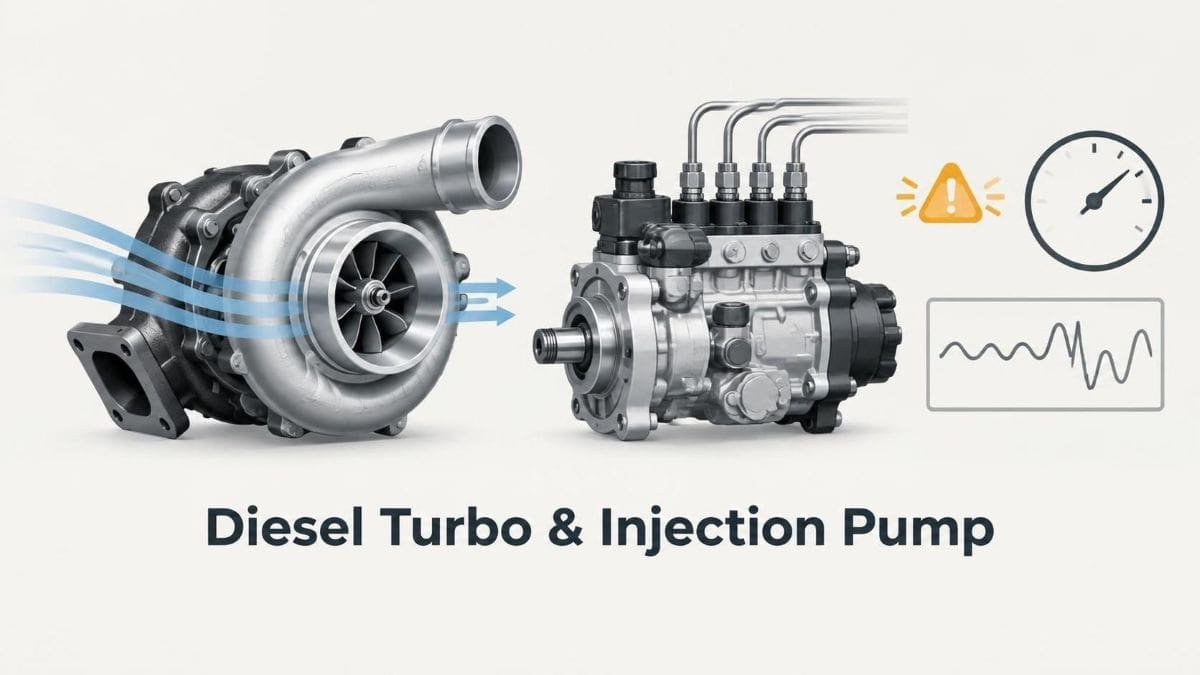
Editor's noteThe article was edited for clarity, readability, and alignment. Maintained objective and concept-first approach, with minor structural improvements. Note: The article includes external links to third-party services; readers should independently evaluate any referenced platforms before engaging.
Estimated reading time: 7 minutes
A diesel turbo engine is really two pressure systems working in step. One of them pushes air in faster than the piston could ever draw it; the other meters fuel into that air with timing measured in fractions of a degree of crankshaft rotation. When a diesel turbo engine loses power, smokes, or refuses to start, the fault almost always lives in one of those two systems — the turbocharger or the fuel injection pump. Understanding how they work makes the difference between a methodical diagnosis and an expensive guess.
Diesel Turbocharger: How the Turbo Works
A Diesel turbocharger is elegantly simple in concept. Exhaust gas leaving the cylinders still carries a large amount of energy as heat and pressure. Route that gas through a turbine wheel and it spins; connect that wheel by a common shaft to a compressor wheel in the intake tract, and you get compressed air feeding the engine. More oxygen per cycle means more fuel can be burned usefully, which is why a turbocharged diesel of a given displacement can produce substantially more torque than a naturally aspirated one.
The engineering challenge is in the extremes. Turbine inlet temperatures commonly sit in the 600–750 °C range under load, while shaft speeds can exceed 100,000 rpm. The rotating assembly — the centre housing and rotating assembly, or CHRA — floats on a thin film of pressurised engine oil only microns thick. Nothing in that assembly tolerates dirty oil, oil starvation at startup, or a hot shutdown that lets heat soak into a stationary bearing. Most diesel turbos that fail prematurely were not defeated by their own design; they were starved, contaminated, or over-sped by something upstream.
Diesel Turbo Warning Signs to Take Seriously
- A rising whine or siren-like note that changes pitch with load — often shaft bearing wear or a damaged compressor wheel.
- Blue-grey smoke on acceleration, with oil in the intake pipework — seal or bearing failure letting oil past into the charge air.
- Low boost with sluggish throttle response — a stuck variable-geometry mechanism, a leaking wastegate, or a split charge-air hose.
- Oil weeping from the compressor housing, which frequently points to a restricted crankcase breather or blocked drain line rather than the turbo itself.
Before condemning a unit, do the cheap checks. Pull the intake pipe and spin the wheel by hand: it should turn freely with no scraping. Check axial and radial shaft play against the manufacturer’s spec. Inspect the air filter and every clamp and hose between filter and intake manifold, because a hairline leak downstream of the compressor looks exactly like a failing turbo on a boost gauge. Then verify oil feed pressure and the condition of the drain. A diesel turbo that failed because of a collapsed oil feed line will fail again in a week if the line is reused.
Injection Pump Diagnosis: Metering, Timing and Pressure
Fuel systems have evolved into three main families, and each fails differently. Firstly, inline pumps use one camshaft-driven plunger-and-barrel element per cylinder, while delivery valves end the injection. Consequently, these rugged mechanical units respond well to dial indicators and clean fuel. Secondly, rotary distributor pumps feed each cylinder sequentially using a single pumping element. Although this design keeps them compact, water in the fuel and hydraulic head wear easily damage them. Similarly, modern diesel turbo setups rely heavily on precision fuel delivery, so any pressure drop under boost causes immediate hesitation. Finally, common rail systems completely separate pressure generation from injection timing. Specifically, a high-pressure injection pump charges the rail past 1,500 to 2,000 bar, and the ECM commands solenoid or piezo injectors to open.

Across all three families, the pump is rarely the first suspect in a running fault. Instead, the fuel supply usually causes the issue. Specifically, air enters through a weeping banjo washer, a partly blocked filter, a tired lift pump, or a tank pickup drawing air during corners. Consequently, these leaks cause misfires, hard starting, and a hunting idle that mimic internal pump wear. Therefore, check inlet restriction with a vacuum gauge before touching a pump adjustment screw. Additionally, measure the return flow volume and inspect clear return tubing for air bubbles. Finally, log actual versus desired rail pressure on common rail engines at idle, steady cruise, and snap acceleration. Ultimately, the shape of that pressure deviation reveals whether you face a faulty pressure control valve, a leaking injector, or genuine pump wear.
Testing in the right order
- Confirm fuel quality and filtration; drain a sample and look for water, wax, or black debris.
- Measure inlet supply pressure and return flow against spec.
- Carry out a cylinder contribution or balance-rate test where the ECM supports it.
- Perform a static injector leak-back test before deciding anything about the pump.
- Only then verify pump timing and, if needed, send the unit for bench testing on calibrated equipment.
Quality of replacement parts matters more here than almost anywhere else on the engine. Trade reporting on the risks of poorly reconditioned high-pressure components, including this cautionary analysis of remanufactured common-rail injectors, is a useful reminder that a rebuild is only as good as the test bench and the tolerances behind it. Clearances in a modern injector nozzle are measured in single-digit microns; there is no room for optimism.
Sourcing the replacement for Diesel Turbo
Once you confirm a diagnosis, economics guide the repair choice. Specifically, new diesel turbo units offer maximum predictability. However, properly rebuilt pumps and turbos—tested to exact specifications – make sense for older equipment when new parts become scarce. Similarly, quality used parts work well for low-hour backup generators. Furthermore, fleets often use known-good cores to keep trucks earning while shops rebuild the original units. Three main factors dictate your choice: the engine’s duty cycle, specific part availability, and whether you fixed the root failure cause.
This is where a specialist supplier proves its value. Specifically, Goldfarb & Associates in Rockville, Maryland, has supplied new, rebuilt, and used diesel fuel injection pumps since 1997. Furthermore, their inventory covers rotary, common rail, and inline pump types. In addition, they provide turbochargers, CHRA cartridges, injectors, nozzles, camshafts, and ECMs. Finally, you can also source delivery valves, plungers, and barrels from their catalog. Their parts finder searches inventory with cross-reference part numbers, which is genuinely useful when the tag on a 30-year-old pump is illegible, and their published guidance on turbocharger problems is the kind of symptom-to-cause reference worth reading before ordering anything. Additionally, they buy rebuildable pump cores from remanufacturers, brokers, and fleets. To simplify this process, they publish a monthly core buying guide alongside clear quality requirements. Therefore, you can easily sell a shelf of tired units instead of letting them gather dust.
Build the habit, not just the repair
Most preventive maintenance is unglamorous. Specifically, you need clean fuel, fresh oil on schedule, a cool-down period after heavy loads, and sealed intake joints. Furthermore, you should record boost and rail pressure values while the engine runs well. Consequently, this baseline makes future deviations obvious. Finally, readers asking about engine systems and testing procedures can explore our collection of engineering and testing basics, where we explain the underlying physics in detail.

Treat the diesel turbo and the injection pump as instruments rather than black boxes, and they become surprisingly honest about their condition. The noise, the smoke colour, the pressure trace and the leak-back volume all point somewhere specific. The craft is in reading them in the right order.
FAQs
Listen for a whine that changes with load. Also watch for blue-grey smoke and oil in the intake pipework.
A stuck variable-geometry mechanism is a common cause. So is a leaking wastegate or a split charge-air hose.
Check fuel supply first. Look for air leaks, a blocked filter, or a weak lift pump before touching the pump.
Do the cheap checks first. Spin the wheel by hand, check shaft play, and inspect every hose and clamp.
It depends on duty cycle and part availability. Rebuilt and used units make sense when new parts are scarce and the root cause is fixed.