

Reviewer's noteThe article provides a clear, balanced look at five emerging genetic engineering technologies. Each topic is tied to a real trial, study, or partnership, so nothing feels like hype. It excites readers about what's possible without pretending any of it is finished.Edited by Sailee Pakhare
Estimated reading time: 14 minutes
In 2024, malaria made an estimated 282 million people sick and killed about 610,000. The WHO African Region accounted for 95% of those deaths. At the same time, scientists in Tanzania have been working in a high-security insectary made from two shipping containers. They are developing mosquitoes that fight the malaria parasite instead of spreading it. This contrast—between a huge global problem and a genetic solution gradually moving beyond the laboratory—is precisely why the future of genetic engineering technologies deserves attention.
Our last post walked through genetic engineering that has already reached hospitals and pharmacies — the approved treatments changing medicine today. This post covers the “what’s next”: five genetic engineering research topics that are still in laboratories, early trials, or pilot partnerships, yet each could reshape public health, conservation, or the environment if it succeeds. None of these entries is science fiction, and none is finished either. Every topic below ends with a plain answer to the question that matters most: how close is this, really? If you are brand new to the field, our beginner’s introduction to genetic engineering is the best place to start.
Five Genetic Engineering Technologies to Watch
1. Gene-Drive Mosquitoes That Block Malaria
Scientists in Tanzania have engineered Anopheles gambiae mosquitoes that sharply suppress the malaria parasite inside their own bodies — a real step toward self-spreading mosquito populations that could break malaria’s transmission cycle.
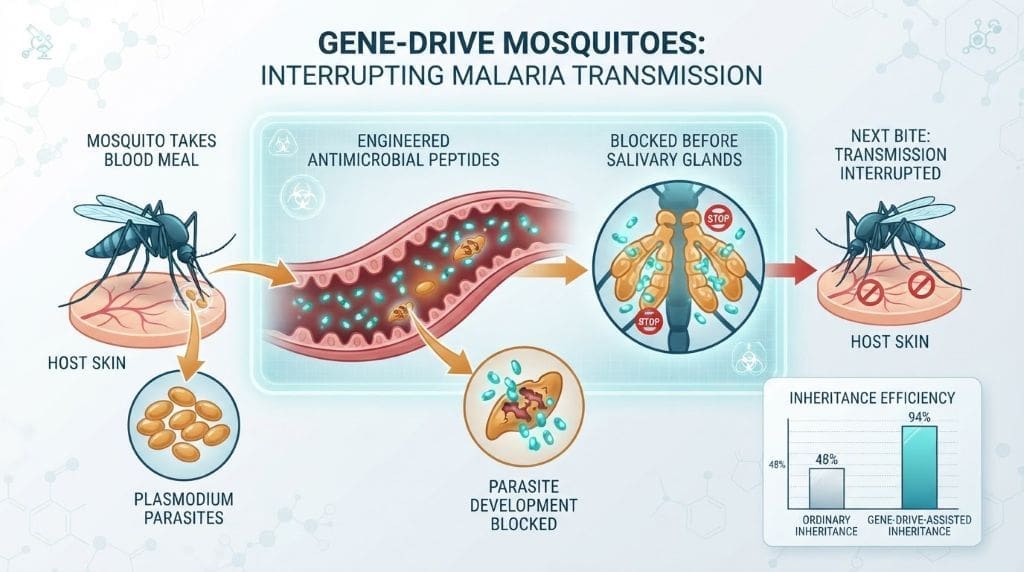
Mosquitoes do not cause malaria; they transmit the disease. The Plasmodium falciparum parasite must undergo a complex journey through the mosquito’s gut and salivary glands before it can infect a person with the next bite. It follows that a mosquito that stops the parasite midway through this journey ceases to be a danger. This is the principle on which “population modification” is based: rather than killing the mosquitoes, you alter their genetics.
How the anti-malaria mosquito was engineered
A study published in Nature on January 8, 2026, described the new mosquitoes. Teams from Imperial College London and Tanzania’s Ifakara Health Institute developed them in Africa. The work formed part of the Gates Foundation-funded Transmission Zero project. The star is a strain called MM-CP, engineered to switch on two antimicrobial peptides after a blood meal. A second helper strain, zpg-CC, supplies the CRISPR-Cas9The term CRISPR stands for "clustered regularly interspaced short palindromic repeats" and Cas9 refers to the enzyme that cuts DNA. More machinery, allowing the change to spread far faster than normal inheritance would. Indeed, when paired with Cas9, the anti-malaria trait passed to about 94% of offspring, versus roughly 48% for ordinary inheritance.

Crucially, the team also tested MM-CP against parasites from real patients. The samples came from schoolchildren in three northeastern Tanzanian villages: Wami Mkoko, Miono Kikalo, and Kibindu. Those blood samples carried genetically diverse parasites, which makes the test far more realistic than a lab strain. The results held up: in engineered mosquitoes, parasite oocysts grew to a median diameter of 22.2 micrometers versus 57.3 in normal mosquitoes, and in one replicate none of 42 engineered mosquitoes developed parasites in the head and thorax — the route to the salivary glands — compared with 35% of controls. A second replicate found parasites in just 7% of cases, versus 55% in the first replicate.
Why field release is still off the table
This is still contained laboratory work. The modified mosquitoes pay fitness costs — they lay fewer eggs and survive worse after a blood meal — and researchers could not fully rule out rare, low-level parasite development. As a result, no gene drive has ever been released into the wild. Scientists publishing in the American Journal of Tropical Medicine and Hygiene argue that any release must come with years of baseline ecological data, carefully selected indicator species, and adaptive monitoring of effects on other wildlife. Those plans are already being written — and that is precisely what makes this one of the most consequential genetic engineering technologies on Earth.
2. Engineered Pig Kidneys That Could End the Organ Waitlist
Over 90,000 Americans are currently on the waiting list for a kidney transplant, with around 12 people dying every day before they receive one. In 2024, U.S. doctors performed approximately 28,000 kidney transplants, a number that remains far short of the number required. More than 800,000 Americans suffer from end-stage kidney disease, and more than half of those receiving dialysis die within five years. Since human kidneys are so scarce, scientists are investigating whether kidneys from genetically modified pigs could be of some help. Although pig kidneys are about the same size as human kidneys, the human immune system usually attacks them. Gene editing might make the organs less likely to be rejected. Gene-edited organs represent one of the most promising applications of genetic engineering technologies.
What the first human transplants have shown
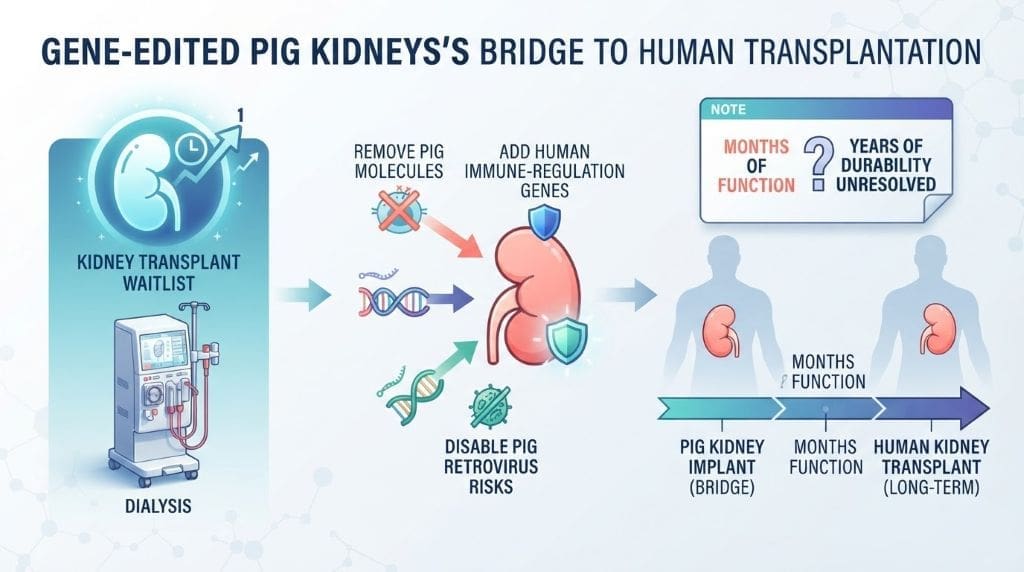
Scientists are currently conducting tests on genetically modified pig kidneys because their size is similar to that of human kidneys. Gene editing removes molecules that trigger rapid immune rejection. It can also add human genes that regulate the immune response. Some approaches may disable pig retroviruses as well. Two companies are pursuing different methods: UKidney from United Therapeutics and EGEN-2784 from eGenesis.
Early results have been promising but limited. Tim Andrews received an EGEN-2784 kidney in January 2025, and it worked for 271 days before permanent rejection required its removal. He later received a human kidney, becoming the first known person to transition from a pig kidney to a human transplant successfully. According to eGenesis’s September 2026 clinical update, five patients had received EGEN-2784 kidneys through an Expanded Access program. Three maintained kidney function for more than eight months without dialysis, and one passed nine months—a new global record. Two patients, including Andrews, later received kidneys from human donors, suggesting that a pig kidney could serve as a temporary bridge while a patient waits for a transplant. The Lancet published Andrews’s case that same week.
The question doctors still cannot answer
In a nutshell, durability remains an unsolved problem. Antibody-mediated rejection continues to cause most failures, and researchers have not yet published results from formal, controlled trials. So far, small expanded-access programs have produced all the record-setting cases. Larger randomized studies are still underway. That is to say, pig kidneys now work in humans, but forthcoming trials must show whether they can last for years rather than just months.
3. Epigenetic Reprogramming: Emerging Gene-Editing Technologies for Longevity
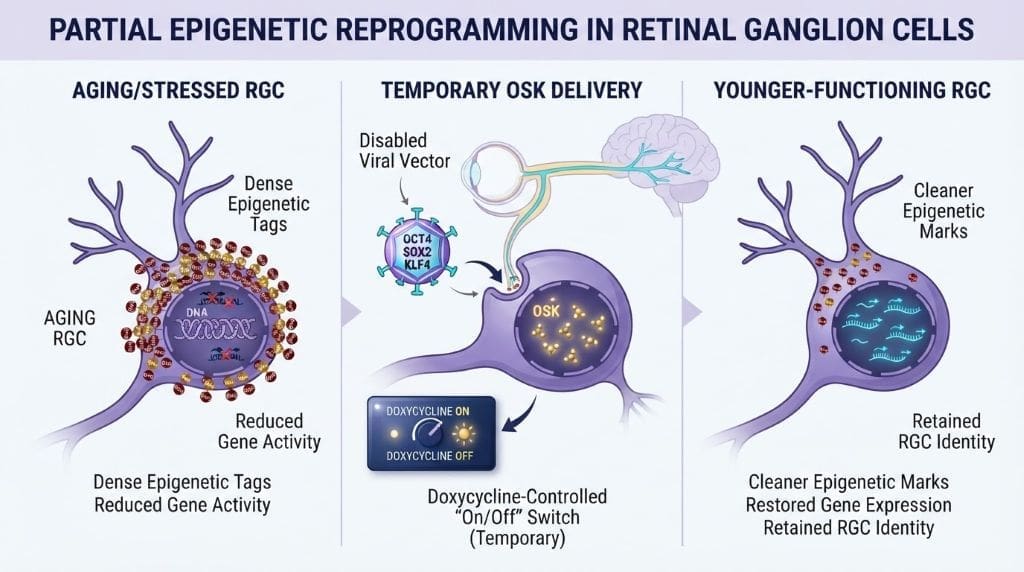
Epigenetic reprogramming is one of the most experimental gene-editing technologies now entering human trials. In January 2026, the FDA cleared the first clinical trial of a therapy designed to make aging cells act young again — a milestone for the entire field of longevity science. Cells accumulate “epigenetic marks” — chemical tags that change which genes are active — as they age, suffer injury, or face stress. In open-angle glaucoma, a leading cause of irreversible blindness, and in NAION — sometimes called a “stroke of the eye” — retinal ganglion cells, the neurons that connect the eye to the brain, die and never regenerate. Because no approved therapy directly stops that degeneration, the unmet need is enormous.
How partial reprogramming works
Partial epigenetic reprogramming aims to erase some of those marks. The technique borrows three of the four “Yamanaka factors” (OCT4, SOX2, and KLF4 — collectively OSK), proteins made famous for turning ordinary cells into stem cells. Used partially and temporarily, they may restore youthful function without wiping out a cell’s identity. Accordingly, Life Biosciences, a Boston biotechnology company, built ER-100: a disabled virus that delivers OSK instructions to cells in the eye, switched on by an eight-week course of the antibiotic doxycycline — a built-in off switch.
The trial (NCT07290244) opened March 2, 2026, enrolling up to 18 adults aged 40 to 85 at four U.S. sites, including Mass Eye and Ear in Boston and Columbia University in New York. Twelve glaucoma patients receive one of two single injections in one eye (2×10¹¹ or 6×10¹¹ viral genomes per eye), and six NAION patients follow at the chosen dose; researchers plan to track everyone for up to five years, with primary results expected in May 2027. On June 9, 2026, Life Biosciences dosed its first patient, moving ER-100 from a cleared protocol on paper to an actual therapy running in a human eye — a distinction that matters, since trial clearances and first doses can sit months apart.
What the first trial cannot prove yet
The Phase 1 safety study does not show that researchers can reverse human aging. Since the participants’ genes have not been altered, and researchers still do not know whether the treatment will improve vision, the results remain limited. That said, ER-100 is the first cellular rejuvenation therapy based on epigenetic reprogramming to enter human trials. It marks the point where the future of medicine meets the biology of aging, and the entire field will be watching the results.
4. Plastic-Eating Enzymes: Genetic Engineering Technologies for the Environment
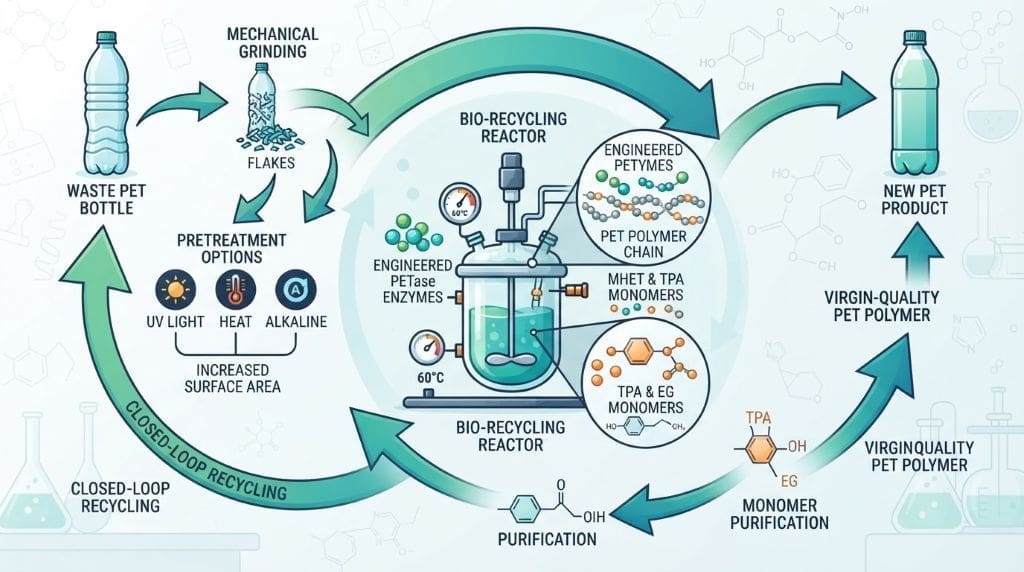
Enzymes first found in a bacterium living near a Japanese recycling plant can chew plastic back into its raw ingredients — and researchers are now engineering them to work faster. In 2016, a Japanese team reported a surprising discovery in the journal Science: a new bacterium, Ideonella sakaiensis 201-F6, collected from sediment outside a PET-bottle recycling facility in Sakai, Japan, had evolved two enzymes — PETase and MHETase — that break down PET plastic into molecules the microbe can eat. PET is the polyester used in drink bottles, and in nature it can persist for centuries. Because of this, the enzymes’ presence hinted at a biological solution to a problem that recycling plants still struggle with. Engineered enzymes show how gene-editing technologies could contribute to solving environmental problems.
How scientists are improving the enzymes
Engineering has since supercharged the idea. A 2025 review in ACS Environmental Au, published by the American Chemical Society, summarizes the current research. Protein engineers have modified PETase variants to improve their heat tolerance. Researchers have also built “whole-cell factories.” For example, an engineered Clostridium thermocellum converted more than 60% of a PET film’s mass into soluble building blocks within 14 days at 60°C. Pretreatments such as UV light, alkali, and mechanical grinding also improve enzyme performance because enzymes can only reach the plastic’s surface. In principle, manufacturers could recycle the resulting monomers into new plastic, thereby closing the loop instead of sending waste to landfills.
Why laboratory results do not equal industrial recycling
None of this is close to replacing today’s recycling industry. Large-scale enzyme processing still costs too much, enzymes are hard to recover and reuse, and highly crystalline plastics resist attack. Moreover, a lab reactor is nothing like a polluted ocean, where degrading microplastics with enzymes remains a distant hope rather than a plan. Even so, the field has moved from curiosity to engineering in under a decade — a pace worth watching in any survey of biotechnology innovations.
5. Biobanking and Genomics for Endangered Species
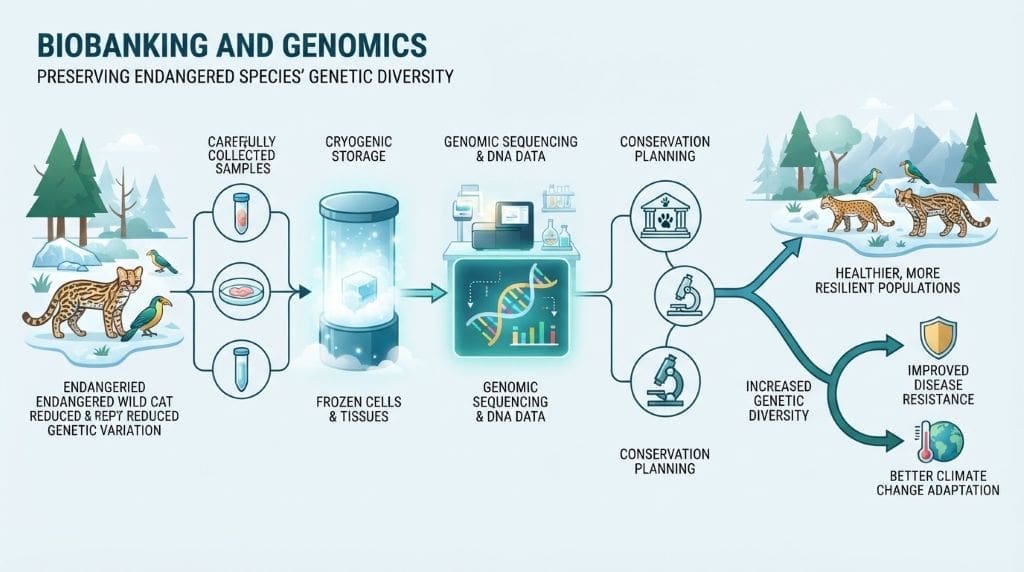
Conservation genomics is expanding the use of genetic engineering technologies for endangered species. In 2026, the U.S. Fish and Wildlife Service partnered with Colossal Biosciences to freeze and study the genetic material of America’s most endangered species. The partnership aims to create a biological safety net for conservation purposes. Biobanking involves collecting and freezing living material—such as tissues and cell lines that contain an organism’s genetic information—for future scientific research. For species approaching extinction, this frozen record preserves genetic diversity that might otherwise disappear. Genetic diversity provides resilience because small and inbred populations need genetic variation to adapt to disease and climate change.
Inside the new conservation partnership
What makes the new agreement notable is its scale and its partner. Under a Memorandum of Understanding the agencies announced on June 25, 2026, the Fish and Wildlife Service and Colossal — the Texas-based company best known for its de-extinction projects — will work together. They will identify priority species, expand biobanking efforts, and include genomic data in conservation planning. The partners will also establish data-management practices and train future conservation geneticists. As a result, biobanking applies the same emerging genetic technology toolkit to ecosystems rather than patients.
Why the agreement is only a first step
A memorandum of understanding is only a framework. It does not commit the federal government to provide funding. Any future projects would require separate agreements and legal review. To put it simply, this is the starting point for an idea—one which has the potential to become one of the most significant and subtle applications of genetic engineering research—but has not yet done so.
How These Genetic Engineering Technologies Connect
If you step back, a clear pattern appears. Genetic engineering is no longer focused only on treating individuals. Across these five areas, scientists are utilizing various genetic engineering technologies to affect entire systems. These systems include disease-carrying insects, organ supplies, aging cells, the materials economy, and global biodiversity. This broad scale sets the current period apart from previous decades of gene-editing breakthroughs.
Just as important is the fact that all these programs have in common in practice: each is carried out through named institutions, involves registered trials, is based on published data, and includes oversight and an honest timetable. Some are already in human trials, others are still in cages or test tubes, and none offers certainty. On the contrary, this combination of ambition and caution is the most positive sign in the field.
The Future of Genetic Engineering Research: Where to Go Next
For anyone who wants to understand how the editing itself works — what CRISPR actually does inside a cell, and how the mechanics compare — our complete guide to genetic engineering covers the technical foundations in depth. And if you would rather see where this technology has already arrived, revisit our post on FDA-approved genetic engineering treatments changing medicine today. The approved therapies of 2025 were the research topics of 2015; the five frontiers above are the leading candidates for what comes next.
FAQs
The most advanced of the various areas listed is xenotransplantation, since gene-edited pig kidneys are currently undergoing formal clinical trials; gene-drive mosquitoes, on the other hand, are less advanced as they have never been released into the wild.
No. The study carried out in Tanzania in 2026 examined the mosquitoes only under containment conditions, and experts say that years of baseline ecological monitoring and community engagement should take place before any release in the wild.
Not yet — and possibly never completely. ER-100 is the first partial epigenetic reprogramming therapy in human trials, but it is a Phase 1 safety study targeting vision, not a whole-body anti-aging treatment.
Lab-engineered enzymes and bacteria can break down PET, but cost, speed, and scale remain far from industrial recycling today.
How This Guide Was Compiled
The topics discussed in this post are supported by primary and verifiable documents, including the peer-reviewed study published in Nature on gene-drive mosquitoes in Tanzania (the publication date being January 8, 2026); the perspective article in the American Journal of Tropical Medicine and Hygiene on post-release monitoring (from 2026); the press releases issued by eGenesis and the U.S. Department of the Interior (the former on September 2025 and the latter on June 25, 2026); the press release from Life Biosciences together with the record NCT07290244 on ClinicalTrials.gov; the 2025 review of plastic biodegradation by the ACS Environmental Au; the news article in Artificial Organs regarding kidney xenotransplantation trials; and the 2016 Science paper which describes Ideonella sakaiensis. In the post, there are no invented statistics, dates, or program names, and where sources differ or provide no information, it refers to the situation in general terms.
References
Abram, P. K., Bouyer, J., Dass, B., Ogoyi, D., Okumu, F., Overcash, J., & James, S. L. (2026). Considerations for postrelease environmental safety monitoring of gene drive-modified mosquitoes as a tool for malaria control in sub-Saharan Africa. American Journal of Tropical Medicine and Hygiene. Advance online publication. https://doi.org/10.4269/ajtmh.26-0049
eGenesis. (2025, September 8). eGenesis announces IND clearance for EGEN-2784 in kidney transplant and landmark patient updates in ongoing expanded access study [Press release]. https://egenesisbio.com/news-media/press-releases/
Gupta, G. K., Dixit, M., Chot, E., & Shukla, P. (2025). Insights into microbial enzymatic biodegradation of plastics and microplastics: Technological updates. ACS Environmental Au, 5(6), 520–542. https://doi.org/10.1021/acsenvironau.5c00033
Habtewold, T., Lwetoijera, D. W., Hoermann, A., Mashauri, R., Matwewe, F., Mwanga, R., Christophides, G. K. (2026). Gene-drive-capable mosquitoes suppress patient-derived malaria in Tanzania. Nature, 649. https://doi.org/10.1038/s41586-025-09685-6
Life Biosciences. (2026, January 28). Life Biosciences announces FDA clearance of IND application for ER-100 in optic neuropathies [Press release]. https://www.lifebiosciences.com/life-biosciences-announces-fda-clearance-of-ind-application-for-er-100-in-optic-neuropathies/
U.S. National Library of Medicine. (2026). Evaluating ER-100 for safety in people with glaucoma or non-arteritic anterior ischemic optic neuropathy (optic nerve conditions) (NCT07290244). ClinicalTrials.gov. https://clinicaltrials.gov/study/NCT07290244
Woolley, B. E. (2026). Kidney xenotransplantation enters the clinical trial era. Artificial Organs, 50, 1205–1206. https://doi.org/10.1111/aor.70217.
World Health Organization. (2025). World malaria report 2025. https://www.who.int/teams/global-malaria-programme/reports/world-malaria-report-2025
Yoshida, S., Hiraga, K., Takehana, T., Taniguchi, I., Yamaji, H., Maeda, Y., Toyohara, K., Miyamoto, K., Kimura, Y., & Oda, K. (2016). A bacterium that degrades and assimilates poly(ethylene terephthalate). Science, 351(6278), 1196–1199. https://doi.org/10.1126/science.aad6359
List of terms
- CRISPR-Cas9