
Mathematics in Nature Conference: Track Overview
The Mathematics in Nature Conference Track offers students and researchers an opportunity to explore how mathematical concepts describe patterns, structures, and processes found in nature. This free virtual mathematics in nature conference 2026 brings together mathematicians, physicists, biologists, and interdisciplinary researchers who study the mathematical foundations of natural phenomena.
Participants will explore how mathematical principles such as fractals, symmetry, chaos theory, differential equations, and geometric structures help explain patterns found in ecosystems, weather systems, biological growth, and physical processes.
By attending, students can:
- Discover career opportunities in applied mathematics and scientific research
- Learn how mathematics explains patterns and structures in natural systems
- Build academic connections with researchers studying mathematical modeling
- Develop analytical and research presentation skills
This track encourages the next generation of innovators to explore how mathematical thinking can support scientific discovery, modeling of complex systems, and interdisciplinary research, making it a key International Mathematics Conference 2026 event.
Key Topics
Latest Blogs & Insights
Explore expert articles, research highlights, and insights into the fascinating connections between mathematics and natural phenomena.
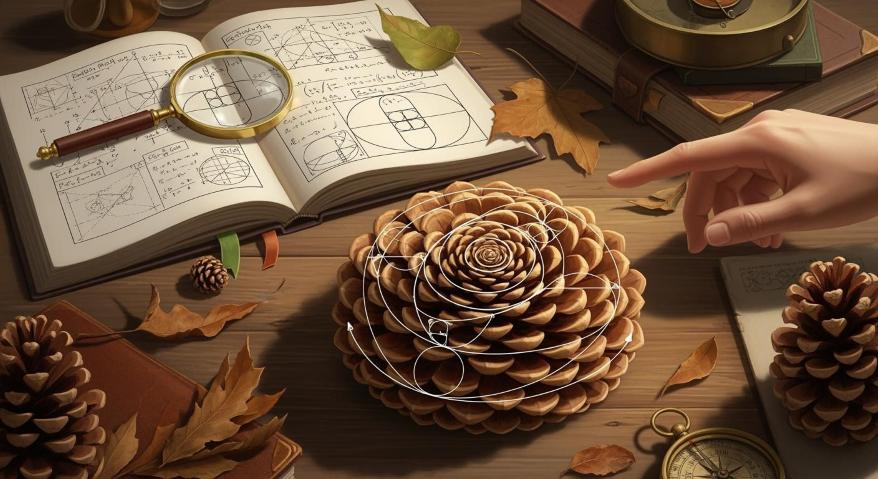
Golden Ratio Pine Cones and Their Impact on Discovery
Have you ever noticed the spirals on golden ratio pine cones? Interestingly, these shapes often…

Nature’s Math: The Golden Ratio and Fibonacci Sequence
Fig 1: Nature\’s Maths A sunflower shows how mathematics in nature works. Specifically, its seeds…
Who Should Attend
“For researchers, mathematicians, and scientists exploring the mathematical foundations of natural phenomena.”
Important Dates
Submission Guidelines For Presentation (PPT)
Frequently Asked Questions
Mathematics in Nature Conference – NYC STEM 2026
Mathematics in Nature Conference Track Overview
The Mathematics in Nature Conference track at NYC STEM 2026 serves as a platform for mathematicians, scientists, and interdisciplinary researchers exploring how mathematical principles explain natural phenomena. Events like the free virtual mathematics in nature conference 2026 provide an opportunity for experts to present research, exchange ideas, and collaborate on understanding complex systems through mathematical modeling.
The Mathematics in Nature Conference focuses on interdisciplinary research that combines applied mathematics, physics, biology, environmental science, and computational modeling. Participants will explore how mathematical models help scientists analyze natural processes such as fluid flow, population dynamics, climate systems, and biological growth patterns.
At the free virtual mathematics in nature conference 2026, researchers will present work related to fractal geometry, chaos theory, biomathematics, mathematical ecology, and computational simulations of natural systems.
Key Research Areas at the Mathematics in Nature Conference
Fractals and Natural Geometry
Fractal patterns appear in many natural structures such as coastlines, snowflakes, clouds, and plant growth patterns. At the Mathematics in Nature Conference, researchers explore how fractal geometry helps explain the complexity of natural forms.
Mathematical Modeling of Natural Systems
Mathematical models allow scientists to simulate and analyze natural processes. Researchers at the free virtual mathematics in nature conference 2026 – NYC STEM examine how mathematical models are used to study population dynamics, climate systems, and ecological interactions.
Chaos and Complex Systems
Many natural systems behave in unpredictable ways due to complex interactions. At the Mathematics in Nature Conference, experts discuss how chaos theory and nonlinear mathematics help explain dynamic systems such as weather patterns and fluid flows.
Emerging Innovations in Mathematical Modeling
Mathematical research continues to expand as scientists apply advanced computational methods and data analysis to natural systems. The Mathematics in Nature Conference at NYC STEM 2026, highlights innovations in computational mathematics, mathematical biology, environmental modeling, and large-scale simulations of complex systems.
These innovations are helping researchers better understand natural phenomena and predict changes in ecological and environmental systems.
Why Attend the Mathematics in Nature Conference
The free virtual mathematics in nature conference 2026 provides students and professionals an opportunity to explore the fascinating connections between mathematics and the natural world.
Connect with Mathematical Researchers
Participants can network with mathematicians, physicists, and interdisciplinary scientists studying patterns and models in natural systems.
Showcase Mathematical Research
Researchers are encouraged to submit presentations highlighting innovative work in mathematical modeling, natural pattern analysis, and complex systems research.
Contribute to Scientific Discovery
By participating in the Mathematics in Nature Conference 2026, attendees contribute to global efforts focused on advancing mathematical understanding of natural phenomena and complex systems.
Discovering Mathematical Patterns in Nature
Nature often follows patterns that can be described using mathematics. The Mathematics in Nature track at NYC STEM 2026 highlights research exploring how mathematical models help scientists understand natural phenomena such as plant growth patterns, fluid dynamics, ecological systems, and climate processes.
Through research presentations and interdisciplinary discussions, participants will explore how mathematical tools reveal hidden structures in natural environments and support scientific understanding of complex systems.
Participate in the NYC STEM 2026 Mathematics in Nature Conference
The free virtual mathematics in nature conference 2026 – NYC STEM welcomes participation from students, mathematicians, researchers, and scientists interested in applied mathematics and natural systems.
Participants are invited to submit presentations and innovative ideas related to mathematical modeling and natural patterns.
Whether your work focuses on fractals, chaos theory, ecological modeling, or computational simulations, the Mathematics in Nature Conference 2026 provides a platform to share knowledge and collaborate with experts exploring the mathematics behind nature.