

Types of mathematical models show that mathematics is more than numbers—it’s the language of understanding, prediction, and decision-making. Scientists, engineers, economists, and even app developers use these models to simulate the world. Consequently, these types of mathematical models allow us to study complex systems, predict future events, and solve problems that would otherwise be impossible to tackle.
A model is essentially a simplified version of reality. It focuses on essential variables and relationships while ignoring irrelevant noise. Therefore, this simplification allows us to test hypotheses, forecast outcomes, and make informed decisions. Whether it’s your weather app predicting tomorrow’s rain, an algorithm suggesting what movie to watch, or a financial system tracking stock prices, types of mathematical models are at work behind the scenes.

There are countless types of mathematical models, each serving unique purposes. We can classify them based on their origin, structure, behavior, or level of complexity. Understanding these distinctions is crucial for anyone working with data or trying to make accurate predictions.
Theoretical vs Empirical Types of Mathematical Models
The first major distinction is where the model comes from. Does it arise from fundamental principles or purely from observed data? For example, this is the basis of separating theoretical and empirical types of mathematical models.
The Power of Theory of Mathematical Models
Theoretical types of mathematical models rely on well-established scientific laws. Physics provides a prime example. Newton’s laws of motion and the law of gravity are used to predict the trajectory of projectiles without needing new observations. Thus, theoretical models explain why something happens.
For instance, engineers designing a suspension bridge don’t need to collect new data on every possible weight scenario. Instead, they use principles of mechanics to calculate load distributions and stress points. These models are precise, robust, and provide insights into the inner workings of systems.
Data-Driven Reality
In contrast, empirical types of mathematical models are based entirely on data. They don’t start with theory but with observation. Consequently, these models detect patterns in historical data and fit mathematical relationships to them.
Marketing analytics often use empirical models. Businesses track customer purchases, identify trends, and predict future buying behavior. For example, a company might notice that sales spike on Fridays and model this behavior. While the model doesn’t explain why customers act a certain way, it predicts what is likely to happen next.
Hybrid Approaches of Mathematical Models
Moreover, many modern types of mathematical models combine both approaches. Hybrid models use theoretical frameworks as a base and then fine-tune predictions using real-world data. Weather forecasting is a great example. Meteorologists use laws of physics to model atmospheric dynamics, but they constantly adjust the model based on incoming observational data. This combination improves both accuracy and understanding.
Static vs Dynamic Types of Mathematical Models
Time is another key factor in modeling. Some systems remain relatively constant, while others evolve continuously. Therefore, this distinction divides models into static and dynamic categories.
Snapshots in Time
Static types of mathematical models provide a single, time-independent view of a system. Think of them as a photograph capturing equilibrium. Engineers analyzing a building’s load-bearing capacity often use static models. The structure isn’t moving, and forces are balanced, so the calculations focus on stability rather than change.
Static models are simpler to build, faster to solve, and less prone to error accumulation. However, they cannot capture the evolution of a system or predict what happens over time.
The Flow of Change
Dynamic types of mathematical models, on the other hand, account for change over time. These models simulate processes that evolve, using time as a key variable. Population growth, spread of diseases, planetary orbits, and rocket trajectories all require dynamic modeling.
Dynamic models are more complex, often involving differential equations. They require careful consideration of rates of change and initial conditions. Small errors can accumulate over time, but they provide a realistic picture of how systems behave in motion.
Why Time Matters in Mathematical Models
Dynamic types of mathematical models are essential when the path matters, not just the outcome. For instance, in epidemiology, it is not enough to know how many people are infected at the end of the year; public health officials need to understand how infections spread daily to implement effective interventions.
Deterministic vs Stochastic Types of Mathematical Models
Next, we consider predictability. Does the system behave with certainty, or does randomness play a role?
Absolute Certainty
Deterministic types of mathematical models assume complete certainty. Given a set of inputs, the output is always the same. For example, a chemical reaction with fixed reactants produces a predictable yield. Engineers use deterministic models to design machinery or circuits where precision is essential.
Deterministic models are predictable, easy to analyze, and suitable for controlled systems. However, they cannot capture randomness or uncertainty.
The Role of Chance
Stochastic types of mathematical models embrace randomness. Many real-world systems, such as stock markets, traffic flows, and weather patterns, involve probabilistic behavior. Stochastic models generate a range of possible outcomes with associated probabilities.
For instance, financial analysts use stochastic models to assess investment risks. Instead of predicting a single future price, they estimate the likelihood of different price ranges. As a result, this approach helps decision-makers plan for uncertainty.
Linear vs Non-Linear Types of Mathematical Models
The way variables interact defines another type of classification: linear or non-linear.
Straight Lines Rule
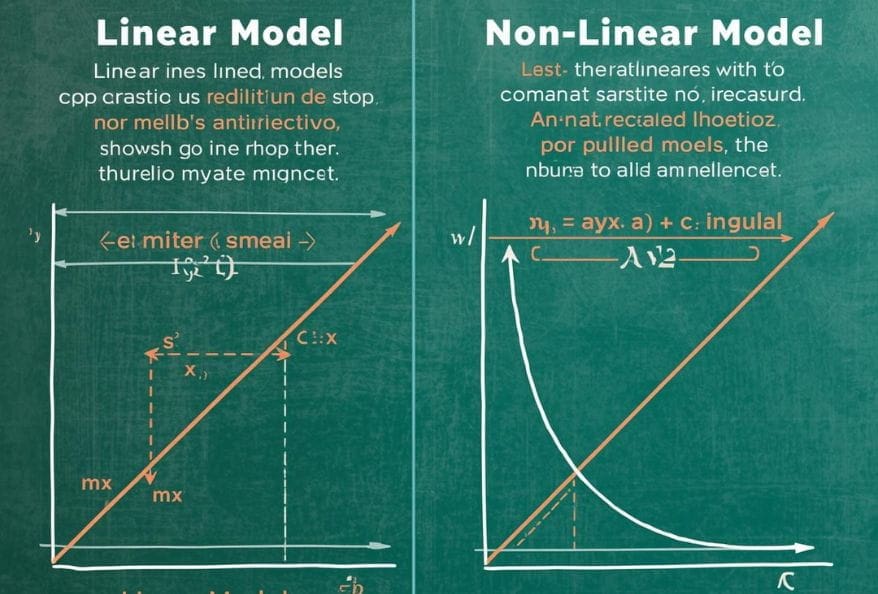
Linear types of mathematical models assume a proportional relationship between variables. Doubling one variable doubles the effect on another. These models are simple, predictable, and computationally efficient. Linear equations are widely used in physics, engineering, and economics, where relationships are proportional.
Curves and Chaos
In contrast, non-linear types of mathematical models deal with complex relationships where small changes can lead to disproportionately large effects. For example, weather systems, ecological populations, and chaotic financial markets illustrate this behavior. Consequently, non-linear models often require iterative computational methods and can be sensitive to initial conditions—a phenomenon famously known as the butterfly effect.
While non-linear models are harder to solve, they are essential for capturing the intricacies of real-world systems.
Discrete vs Continuous Types of Mathematical Models
The final distinction lies in how variables are measured: in steps or as smooth flows.
Stepping Stones
Discrete types of mathematical models work with countable units. You can have 5 people or 6 apples, but not 5.7 people. Computers, which operate on binary states, are also inherently discrete. Discrete models often use difference equations and stepwise simulations.
Smooth Flows
Continuous types of mathematical models, on the other hand, treat variables as smooth and uninterrupted. For instance, water flow, temperature changes, or motion in physics are modeled continuously. Moreover, calculus-based differential equations allow us to calculate rates of change and understand fluid or energy dynamics.
Choosing the Right Model
Selecting between discrete and continuous models depends on the problem context. Counting objects, inventory management, and digital systems favor discrete modeling. Flow dynamics, temperature, or speed measurements require continuous approaches.
Why Understanding Model Types Matters
Mathematical models are not one-size-fits-all. Using the wrong type can lead to inaccurate predictions or wasted effort. Therefore, choosing the right types of mathematical models requires understanding the system’s nature, the data available, and the problem to solve.
- Theoretical models are best for understanding mechanisms.
- Empirical models excel at predicting observed outcomes.
- Static models provide quick snapshots.
- Dynamic models reveal system evolution.
- Deterministic models are precise and predictable.
- Stochastic models manage uncertainty.
- Linear models are simple and proportional.
- Non-linear models capture complexity.
- Discrete and continuous models reflect the type of data or process.
By combining these insights, scientists, engineers, and analysts can design more accurate, efficient, and useful types of mathematical models.
Real-World Applications

- Weather Forecasting: Dynamic, stochastic, non-linear, continuous models.
- Bridge Engineering: Static, deterministic, linear models.
- Marketing Analytics: Empirical, discrete, stochastic models.
- Epidemiology: Hybrid, dynamic, stochastic models track disease spread.
- Rocket Trajectories: Dynamic, deterministic, non-linear, continuous systems.
- Financial RiskThe chance that harm occurs, given the hazard and the exposure. More Assessment: Stochastic, non-linear, discrete or continuous.
- Population Biology: Dynamic, non-linear, discrete or continuous models predict growth and decline.
Understanding these applications illustrates how choosing the right models directly impacts effectiveness and accuracy in real-world scenarios.
References:
- Krawitz, J., Schukajlow, S., Yang, X., & Geiger, V. (2025). A systematic review of international perspectives on mathematical modelling: Modelling goals and task characteristics. ZDM – Mathematics Education, 57(2–3), 193–212. https://doi.org/10.1007/s11858-025-01683-2
- Taite, G., & DiNapoli, J. (2025). Perspectives on mathematical modeling education: Conceptions and research. Encyclopedia, 5(3), 138. https://doi.org/10.3390/encyclopedia5030138
- Mathematical modeling of pressure‑dependent variation … (2026). Modelling, 7(1), 30. https://doi.org/10.3390/modelling7010030
List of terms
- Risk