

Before you even step outside, your phone flashes a rain warning. Then a mapping app quietly reroutes you around an accident. Later a nurse tweaks your dosage to match your exact weight and age. These everyday moments aren’t luck, they’re Applications of mathematical modelling working overtime behind the scenes.
Models take the messy complexity of real life and turn it into clear, useful numbers. Industries lean on these tools every day without ever announcing them. Banks use them to set loan rates. Hospitals apply them when they plan vaccine distribution. Delivery companies rely on them to sort parcels at lightning speed. Engineers run stress tests on bridges long before the concrete trucks arrive.
This guide walks you through Applications of mathematical modelling across eight different industries. Each card breaks down one key idea in plain language and points you straight to open research so you can dig deeper yourself. Think of the page as a ready-made study outline: you’ll walk away able to name a model, explain what it does, and connect it to a real-world job.

Adoption has increased in all the various areas. The Society for Industrial and Applied Mathematics says that most mathematics graduates now hold jobs in fields other than academia. Regulators have also begun to place trust in simulation. In 2023, the FDA accepted evidence from computational models when assessing medical devices. Furthermore, McKinsey thinks that quantum-enabled modelling could generate as much as $2.7 trillion in value by 2035. Because of this, modelling skills now give access to almost every field.
Mathematical Modeling Applications Across Eight Industries
Here are eight industry cards, moving from public health to food supply. Each card gives the core model, a real use, and a verified citation.
Healthcare and Epidemiology: Models That Track Disease
Previously doctors had some understanding of how viruses were spread, but at present they employ compartmental models. The traditional SIR model splits the population into three groups: susceptible, infected, and recovered. Researchers watch how the size of each group changes with time. A single value, R0, indicates how fast an infection spreads; if R0 is greater than one the number of cases goes up, but if it drops below one the outbreaks cease. Kermack and McKendrick introduced this method in 1927 and it is still being used by public health teams today. Thanks to Applications of mathematical modelling techniques like this, guessing has been replaced by a planning-based approach. Authorities use them to decide when to introduce lockdowns and to stock hospitals; they also predict the peak of cases weeks in advance. The mathematics is kept simple on purpose because fewer assumptions result in clearer insights.

Disease models are not limited to instances of epidemic outbreaks. Pharmacokinetics models are employed in order to illustrate the route that a drug takes through the body. When they are prescribing, clinicians consider the patient’s body weight and the state of their organs. Imaging models then produce a scan from the raw data collected by the sensors. Researchers also need to examine their assumptions. Divoli and his colleagues showed how conflicting biological views can influence a cancer model. In fact, in real terms, an incorrect assumption is always more harmful than an incorrect equation. The FDA now looks at this kind of simulation evidence and has set up a credibility framework for submissions based on models in its 2023 guidance. For a more detailed look at healthcare modelling, see our companion article for beginners on epidemiology.
Finance and Economics: Pricing Risk With Mathematical Modeling Applications
Banks have no way of knowing the true value of a loan or an option; for this reason they rely on models to price them. The Black-Scholes model calculates the value of an option by using five inputs, namely the strike price, the time until expiry and volatility. Traders evaluate risk by means of a measure called value at risk. Monte Carlo simulation then carries out thousands of random market paths, each of which results in one possible future outcome. The analysts calculate the average of the results in order to estimate the likely losses. This approach is applied in modern risk modelling on all the trading desks. Macro forecasters also use similar tools in order to project growth and inflation. Applications of mathematical modelling ensure that the markets remain fair and comparable and also show potential dangers before they arise.

The extent to which clear constraints are useful can be seen in the work carried out by Jezeie and his colleagues, who created a knapsack-type model for selecting stocks. Rather than allowing for fractional shares, their model offers whole shares, a point which becomes important in the case of costly stocks. The problem is then solved quickly by means of a dynamic programming algorithm, so that investors get practical and realistic results. It is obviously true that all models make assumptions about risk, and the analysts verify these assumptions by means of stress scenarios. If you want to find out more, see the article on how mathematical modelling affects decision-making in competitive markets. For a full explanation of finance, keep an eye out for our upcoming in-depth guide to quantitative finance.
Climate Science and Environmental Modeling: Simulating a Warming Planet
Climate models are among the largest simulations that have ever been made. General circulation models, or GCMs, divide the atmosphere into millions of cells and within each cell the fluid and energy equations are solved over time. The basic physics is derived from the Navier-Stokes equations and radiative transfer is employed in order to deal with the way heat moves through the air. Balaji and his colleagues give the reasons why these models are still important. Because GCMs of different designs have structural uncertainty they remain at the centre of climate research and policy. Applications of mathematical modelling in this field have a real influence on decisions. Countries set their carbon targets on the basis of these projections and insurers also use them when setting flood and drought risk premiums.
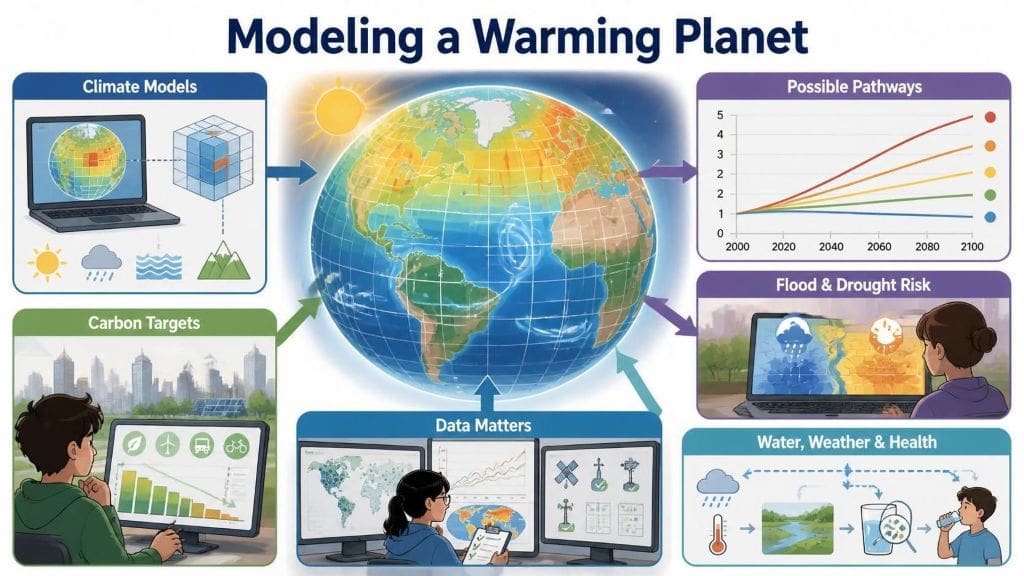
Environmental models also connect climate with human health. Lo Iacono and his co-workers examined the models concerning water-borne diseases and grouped the various methods into two main categories. Those based on processes are appropriate for well-known pathogens such as cholera, while time-series and spatial models are used in cases where there is greater uncertainty. Their review pointed out the major shortcomings in the field, the most important of which were poor data quality and reporting bias. Rainfall and temperature influence the way in which these diseases spread. In practice, modelers have to tell the difference between transmission of the disease from the environment to people and transmission from person to person. This distinction is crucial for controlling outbreaks. For more information on climate modelling, please see our upcoming in-depth guide to climate and Earth-system simulation.
Engineering and Manufacturing: Digital Twins and Simulation
It is not typical for engineers to build a first prototype without having any previous information; rather, they begin by simulating it on a computer. The finite element method, or FEA, breaks down a structure into small parts and the software then determines the stress and strain for each part. In a similar way, the finite volume method carries out the same procedure for fluid flow; this field, called computational fluid dynamics, is employed when testing wings and engines. Designers nowadays use a tool known as the digital twin. A digital twin is a virtual representation in real time of a physical machine and it is kept up to date with data obtained from the machine’s sensors. The researchers Soori and his colleagues examined the role of digital twins in smart manufacturing and discovered that factories are thus able to detect faults before they cause downtime.
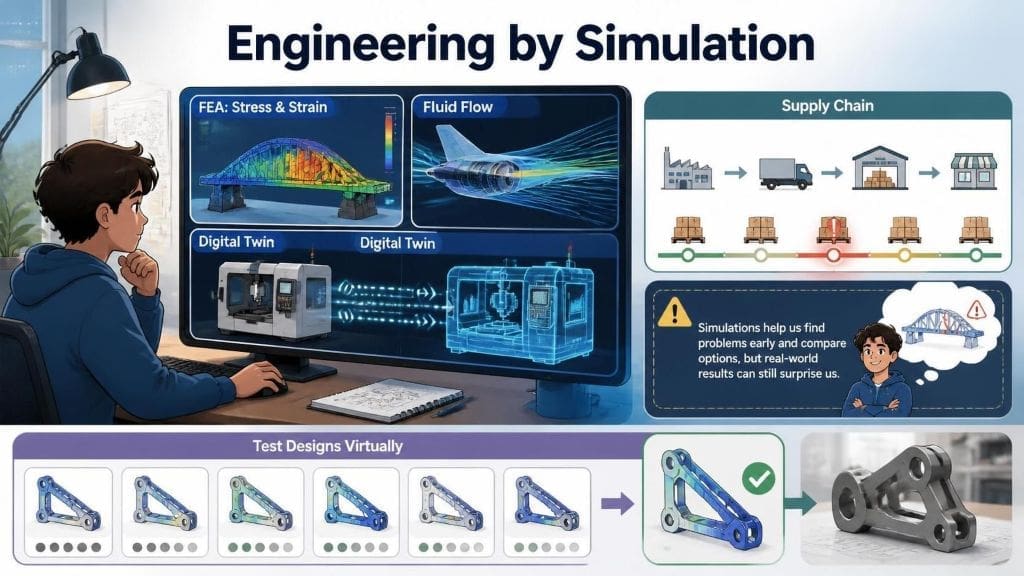

Applications of mathematical modelling are also applied to supply chains. During the planning process, demand, inventory levels and lead times are all simulated together. A well-designed model can identify possible bottlenecks many months before they turn into actual problems. This means that supply chain optimization leads to a reduction in both costs and waste. Engineers are able to test thousands of different design alternatives in just a few hours whereas physical testing would take weeks and be considerably more expensive. In practice, simulation lowers both the level of risk and the costs. Students can start off by using free tools and working on small projects. If you want some hands-on coding practice, see our guide for engineering students on MATLAB. For a more thorough understanding, check out our in-depth guide on simulation in modern engineering.
Technology and Data Science: Mathematical Modeling Applications in Everyday Apps
The streaming service seems to know what you like, this being the result of the use of a recommender model. One common method involves finding users who have similar viewing habits and then suggesting the items that these similar users have liked. Zhou and his team carried out a survey of deep-learning recommender systems. Their study shows how the models combine data concerning the users, the items and the context. At present, the systems also consider the number of clicks, the length of time spent viewing and the number of skips. As a result, a simple concept evolves into a complex model. Applications of mathematical modelling like this work quietly on a large scale.

Other technological models are also at work behind the scenes. Graphs are used to show friendships, payments, and network traffic; they allow companies to identify fraud and to send data quickly. Cryptography ensures that messages stay private by applying number theory. Breiner and his colleagues describe how category theory can be used to organize complex systems. The framework that they suggest helps engineers to combine small models into bigger ones and this approach reduces the number of errors in large-scale projects. Encryption models protect all the online payments you make. To conclude, mathematics makes sure that your apps are both useful and safe. For more details on model building, see our explainer article on the mathematical model behind AI. Our upcoming guide on Modeling versus machine learning will examine the differences next.
Transportation and Logistics: Routing the Modern Supply Chain
Applications of mathematical modelling power the routing of all overnight parcels, which relies on a set of equations that are not made public. Route planners face a well-known issue known as the travelling salesman problem, this being the problem of a salesperson who has to visit a number of cities at the lowest possible cost. In practice, companies use a more complicated version of this problem, referred to as the vehicle routing problem. Gasset and his colleagues created a model for an open form of this problem. In their study they examine various heuristic methods such as nearest neighbour and 2-opt. These methods achieve substantial speed gains by making only a small compromise in accuracy. It is for this reason that planners are able to solve huge routes in just a few seconds.

Logistics models are also applied in the management of waiting times and in the arrangement of schedules. Using queuing theory, it is possible to predict how long trucks will wait at a dock. Queue models correlate the number of staff with the rate at which vehicles arrive. In order to reduce congestion during rush hour, traffic-flow models are used. The settings for ramp meters and the timing of traffic signals are determined by these equations. Airlines use scheduling models to allocate crews to planes. Rail companies develop models of track usage in order to avoid delays. In practice, small improvements over a large number of trips accumulate rapidly. A one-per-cent saving across the whole fleet is considerable. For further details, see our planned in-depth guide to operations research in logistics.
Energy and Utilities: Mathematical Modeling Applications in Power Systems
The power grid must keep supply and demand in balance every second, and for this purpose optimization models are employed to achieve that balance. Operators prepare forecasts of demand by taking into account weather conditions and past usage patterns before selecting the cheapest type of generation. Multi-objective models consider both cost and environmental impact. Ullah and Nehring created one for an irrigation project; their model was designed to maximize net return while at the same time minimizing environmental harm. The trade-offs were addressed using a genetic algorithm known as NSGA-II. Applications of mathematical modelling such as this one are helpful for managing scarce water and power resources.
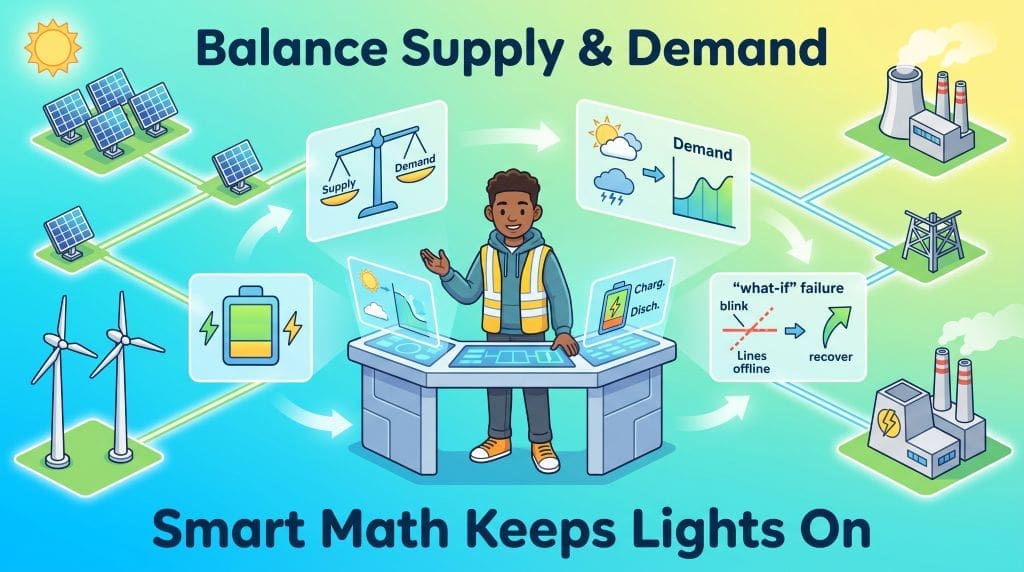
Using renewable energy makes it harder to keep the supply stable since the amount of power produced by solar and wind energy depends on weather conditions. Load forecasting models predict these changes several hours ahead of time. Storage models decide when to charge and when to discharge. Additionally, grid planners examine for possible failures before they happen by using contingency models to simulate a situation in which a power line or a power plant goes off line. In practice, the models make sure that electricity remains on during heat waves while at the same time reducing waste and lowering customers’ bills. For more details on clean-energy modelling, please look out for our in-depth guide to smart grids.
Agriculture and Food Systems: Growing More With Less
Applications of mathematical modelling now guide farmers as often as soil itself. Crop models can predict yields from data on rainfall, heat, and nutrients. Katchali and his colleagues examined the models relating to organic fertiliser. The review covered simulation, regression and machine-learning methods.
Studies often use random forests and neural networks. Researchers use these tools to estimate nutrient release and predict crop responses. Farmers thus apply the right amount at the right time. The use of mathematical modelling in this situation leads to an increase in output and a reduction in pollution.

Food systems also involve the simulation of pests, weather, and transport. Disease models keep an eye on how blight or locusts spread. Pest models help farmers act before pests ruin their fields. Supply models then speed up the process of getting the harvest to market. Cold-chain models keep produce fresh during transport. Moreover, IoT sensors supply the models with real-time data. Researchers update the models as field conditions change. In practice, this combination results in reduced losses and water conservation. For further reading, see our upcoming in-depth article on precision agriculture.
Mathematical Modeling Applications Beyond the Textbook: Skills and Careers
It is essential to use models when students have the opportunity to build them. In my classroom, I observed a group of students carrying out a model of a queue in a school canteen. They recorded the times when people arrived and kept a count of the service points. The first model they made was far too simple since, for example, it assumed that everyone waited in one single line. In the next version, the team divided the queue by payment type. This small change cut the predicted waiting time in two. The students then understood the real lesson, which is that a model is a guess that you keep testing.

Students can advance their skills in modelling in three stages. Firstly, they should study the mathematics which underlies standard models, the key areas being linear algebra, calculus and probability. Then, they have to learn to programme in either Python or R. After that, they should select a field which they genuinely enjoy; fields such as health, sport, gaming and finance are all accessible to modelers. When someone has knowledge of a specific domain, a general model becomes a useful one.
Today’s careers span a great many different areas. Every day data scientists build predictive models. To price risk, actuaries make use of probability models.
Operations researchers optimise routes and schedules. Quantitative analysts create models of markets and of trading activities. Climate scientists carry out Earth-system simulations. Teachers also model the way in which students learn. The diverse applications of mathematical modelling offer access to all of these jobs. Across all these fields, the same fundamental approach holds: simplify a complex problem and then check your solution.
Frequently asked questions
There are methods by which you can apply mathematics to the examination of actual problems. You convert a real system into a set of equations and then solve those equations in order to gain insight.
No industry ends up as the winner; all the major ones—healthcare, finance, climate, and logistics, depend on them strongly and usage is continuing to increase in all areas.
Well, initially basic algebra and probability are all that is needed; you can then add calculus and statistics when the projects become larger.
Test it against real data. Change the assumptions and see if it still works. A strong model survives small changes.
Most failures are due to poor data and incorrect assumptions, and real systems do change over time, which is why good modelers make it a practice to update their work.
How This Guide Was Compiled
The guide follows a simple and consistent method. First, I selected eight sectors where people use models to make daily decisions and linked each sector to peer-reviewed research or government publications. I gathered the references from Crossref records and publishers’ websites. For each DOI that I intended to cite, I checked it against the most up-to-date online version. I chose open-access journals such as PLOS and MDPI. I also included two official FDA documents relating to simulation credibility. Finally, I wrote each card in plain language appropriate for students and only used technical terms after having defined them first.
Verified resources
- Centers for Disease Control and Prevention — cdc.gov (public health data and outbreak tools).
- U.S. Food and Drug Administration — fda.gov (guidance on model credibility for devices).
- National Oceanic and Atmospheric Administration—www.noaa.gov (climate and weather model data).
- Society for Industrial and Applied Mathematics, at siam.org (industry career reports).
- The PLOS journals (modelling research, open access), available at journals.plos.org.
- PNAS, at pnas.org, publishes peer-reviewed research on climate and systems.
References
- Balaji, V., Couvreux, F., Deshayes, J., Gautrais, J., Hourdin, F., & Rio, C. (2022). Are general circulation models obsolete? Proceedings of the National Academy of Sciences, 119(47), e2202075119. https://doi.org/10.1073/pnas.2202075119
- Breiner, S., Subrahmanian, E., & Sriram, R. D. (2023). Category theory. In A. M. Madni, N. Augustine, & M. Sievers (Eds.), Handbook of model-based systems engineering (pp. 1259–1299). Springer. https://doi.org/10.1007/978-3-030-93582-5_85
- Divoli, A., Mendonça, E. A., Evans, J. A., & Rzhetsky, A. (2011). Conflicting biomedical assumptions for mathematical Modeling: The case of cancer metastasis. PLoS Computational Biology, 7(10), e1002132. https://doi.org/10.1371/journal.pcbi.1002132
- Gasset, D., Paillalef, F., Payacán, S., Gatica, G., Herrera-Vidal, G., Linfati, R., & Coronado-Hernández, J. R. (2024). Route optimization for open vehicle routing problem (OVRP): A mathematical and solution approach. Applied Sciences, 14(16), 6931. https://doi.org/10.3390/app14166931
- Jezeie, F. V., Sadjadi, S. J., & Makui, A. (2022). Constrained portfolio optimization with discrete variables: An algorithmic method based on dynamic programming. PLoS ONE, 17(7), e0271811. https://doi.org/10.1371/journal.pone.0271811
- Katchali, M., Richard, E., Tonnang, H. E. Z., Tanga, C. M., Beesigamukama, D., & Senagi, K. (2025). Mathematical and computational Modeling for organic and insect frass fertilizer production: A systematic review. PLoS ONE, 20(1), e0292418. https://doi.org/10.1371/journal.pone.0292418
- Kermack, W. O., & McKendrick, A. G. (1991). Contributions to the mathematical theory of epidemics—I. Bulletin of Mathematical Biology, 53(1–2), 33–55. https://doi.org/10.1007/BF02464423
- Lo Iacono, G., Armstrong, B., Fleming, L. E., Elson, R., Kovats, S., Vardoulakis, S., & Nichols, G. L. (2017). Challenges in developing methods for quantifying the effects of weather and climate on water-associated diseases: A systematic review. PLoS Neglected Tropical Diseases, 11(6), e0005659. https://doi.org/10.1371/journal.pntd.0005659
- Smith, D. L., Battle, K. E., Hay, S. I., Barker, C. M., Scott, T. W., & McKenzie, F. E. (2012). Ross, Macdonald, and a theory for the dynamics and control of mosquito-transmitted pathogens. PLoS Pathogens, 8(4), e1002588. https://doi.org/10.1371/journal.ppat.1002588
- Soori, M., Arezoo, B., & Dastres, R. (2023). Digital twin for smart manufacturing: A review. Sustainable Manufacturing and Service Economics, 2, 100017. https://doi.org/10.1016/j.smse.2023.100017
- Ullah, G. M. W., & Nehring, M. (2021). A multi-objective mathematical model of a water management problem with environmental impacts: An application in an irrigation project. PLoS ONE, 16(8), e0255441. https://doi.org/10.1371/journal.pone.0255441
- U.S. Food and Drug Administration. (2023). Assessing the credibility of computational Modeling and simulation in medical device submissions: Guidance for industry and Food and Drug Administration staff. https://www.fda.gov/regulatory-information/search-fda-guidance-documents/assessing-credibility-computational-Modeling-and-simulation-medical-device-submissions
- U.S. Food and Drug Administration. (2023). Assessing the credibility of computational Modeling and simulation in medical device submissions [PDF report]. https://www.fda.gov/media/154985/download
- Zhou, H., Xiong, F., & Chen, H. (2023). A comprehensive survey of recommender systems based on deep learning. Applied Sciences, 13(20), 11378. https://doi.org/10.3390/app132011378