

In essence, quantum physics lets you peek into the secrets of the universe. To visualize this, imagine everything around you, even the air, made of tiny pieces you cannot see. Specifically, quantum explores these building blocks of matter and energy. However, you will not see quantum effects in your daily life. They seem strange compared to regular physics.
Notably, teachers say that hands-on, interactive quantum activities—like Art and Polarization—spark student interest and ultimately lead to great classroom discussions.
Quantum makes you question what reality means. You join a journey that science still explores today.

Key Takeaways
- At its core, quantum physics reveals the universe’s secrets by studying tiny particles that behave in surprising ways.
- In particular, key concepts like wave-particle duality and superposition challenge your understanding of reality and show that particles can exist in multiple states.
- The uncertainty principle teaches that you cannot know both the position and momentum of a particle at the same time, emphasizing the probabilistic nature of quantum mechanics.
- In fact, quantum technology already impacts daily life. For example, it powers devices like smartphones, MRI machines, and GPS systems. Ultimately, this makes it essential for modern science and innovation.
- Moreover, engaging with quantum concepts through hands-on activities and interactive tools can spark curiosity and inspire future careers in science and technology.
What Is Quantum Physics?
Matter and Energy Basics
You step into the quantum realm when you look at the smallest particles. Quantum physics studies the building blocks of atoms and energy. You find that matter and energy behave in surprising ways.
- Energy comes in tiny packets called quanta.
- Matter and energy do not flow smoothly. They jump in steps, like climbing stairs instead of sliding down a ramp.
- Each quantum has a minimum value. You cannot break it into smaller pieces.
- Photons are quanta of light. Each photon carries a fixed amount of energy.

You see that quantum mechanics helps you understand how particles form everything in the universe. The quantum realm shows you that the smallest particles act differently than things you see every day.
Quantum Mechanics Origins
Historically, quantum mechanics began when scientists tried to explain how light and atoms work. In this process, you learn that classical physics could not answer some questions about the formation of the universe. Specifically, quantum mechanics started with the study of light and energy. Eventually, scientists found that energy does not act like a wave or a particle alone. Instead, it acts like both. Ultimately, this discovery changed how you think about the universe.
Clearly, you see that quantum mechanics helps you explore the smallest particles. Specifically, it explains how atoms and energy behave. Ultimately, quantum mechanics lets you ask new questions about the universe.
Why Quantum Is Unique
Fundamentally, quantum physics stands apart from classical physics. Specifically, you notice that quantum mechanics does not always follow the rules you expect.
Crucially, in the quantum world, your intuition does not always work. This is because quantum objects do not move in predictable ways. For example, you cannot track a quantum spacecraft like a regular one. Instead, you can only predict where it might go using probabilities.
- Quantum mechanics is probabilistic. You can only guess what will happen next.
- Classical physics is deterministic. You can predict future states exactly.
- Measuring a quantum system changes it. In classical physics, measurement does not affect the system.
Commonly, many students think quantum physics is impossible to understand. However, you find that superposition and entanglement can be explained with simple math. In fact, quantum mechanics challenges your ideas about reality. Intriguingly, some scientists even ask if consciousness is part of the universe itself.
You discover that quantum physics helps you see the universe in a new way. The quantum realm opens your mind to new possibilities.
Key Ideas in Quantum Mechanics

Quantum physics introduces you to ideas that seem strange at first. These ideas help you understand the behavior of particles at the smallest scales. Let’s explore four key concepts that shape your view of reality.
Wave-Particle Duality
You might think that light acts only as a wave or a particle. However, in quantum physics, you learn that light and matter can act as both. Technically, this is called wave-particle duality. For instance, sometimes particles like electrons behave like tiny balls. On the other hand, at other times, they spread out like waves.
Here are some famous examples from science:
| Example | Description |
|---|---|
| Einstein’s Photon Theory (1905) | Light has particle-like properties, packed in energy bundles. |
| Compton Effect (1922) | Light’s behavior shows both wave and particle features. |
| de Broglie’s Proposal (1924) | Electrons have wave properties, like wavelength and frequency. |
| Davisson-Germer Experiment (1927) | Proved electrons act as waves in experiments. |
| Bohr’s Complementarity Principle (1928) | Wave and particle aspects are both needed to explain quantum phenomena. |
You see wave-particle duality in many experiments. For example, photons can show both wave and particle traits at the same time. This idea helps you explain the behavior of particles that classical physics cannot.
The Uncertainty Principle
In quantum physics, you cannot know everything about a particle at once. The uncertainty principle says that if you know a particle’s position very well, you cannot know its momentum as well. If you know its momentum, you lose track of its position.
Scientists have tested this idea in many ways. One method uses a single slit to let particles through. When the slit gets smaller, the spread in momentum gets bigger. This shows the link between position and momentum uncertainties.
| Aspect | Description |
|---|---|
| Experimental Method | Diffraction of particles by a single slit. |
| Key Findings | Momentum spread increases as slit width decreases. |
| Inequalities | σpΔx≥ħ and σpΔx≥πħ show measurement limits. |
| Experimental Results | Values like 1.128ħ, 2.464ħ, and 2.723ħ match theory. |
Specifically, the uncertainty principle sets limits on what you can measure. Furthermore, it tells you that the behavior of particles is not fixed. Instead, you deal with probabilities, not certainties.
Superposition
Superposition is one of the most surprising ideas in quantum physics. It means that particles can exist in many states at once. Only when you measure them do they pick one state.
You can see superposition in real-world experiments:
| Phenomenon Description | Notes |
|---|---|
| Beryllium ion trapped in a superposed state | Shows superposition with a large ion. |
| Double slit experiment with large molecules (buckyballs) | Superposition in bigger molecules. |
| Superposition of molecules over 10,000 mass and 810 atoms | Superposition can happen in large systems. |
| Superconducting quantum interference devices (SQUIDs) | Use quantum interference for sensitive measurements. |
| Piezoelectric tuning fork in superposition of vibrating and non-vibrating | About 10 trillion atoms, showing superposition in big objects. |
| Chlorophyll in plants using superposition for energy transport | Shows that even biology uses quantum superposition. |
Superposition helps you understand why particles do not follow fixed paths. They exist in all possible states until you check them. This idea explains many strange effects in the quantum world.
Entanglement Explained
Entanglement is a special link between particles. When two particles become entangled, the state of one affects the other, no matter how far apart they are. This is not just a theory. Many experiments have shown that entanglement is real.
Some important experiments include:
- John Clauser’s work showed that quantum particles do not use hidden signals.
- Alain Aspect’s tests ruled out classical explanations for quantum correlations.
- Anton Zeilinger’s research led to quantum teleportation and secure communication.
- A team from MIT and the University of Vienna used ancient starlight to test entanglement. They found strong support for quantum entanglement.
Fundamentally, entanglement means that reality at the quantum level is deeply connected. In fact, you cannot explain the behavior of particles without it. Moreover, entanglement helps you understand how information and energy move in the universe.
Fundamentally, quantum mechanics uses wave-particle duality, the uncertainty principle, superposition, and entanglement to explain the behavior of particles at the atomic scale. Consequently, these ideas show you that particles do not follow fixed paths. Instead, their behavior is probabilistic. For instance, superposition lets particles exist in many states, whereas entanglement links particles across space. Furthermore, the uncertainty principle sets limits on what you can know. Ultimately, quantum physics gives you a new way to see reality.
Quantum vs. Classical Physics
Classical Physics Limits
You might wonder why classical physics cannot explain everything. Classical physics works well for big objects like cars or planets. When you look at tiny particles, things change. Classical ideas do not always fit the quantum world. Here are some main limits:
- Classical concepts do not work for quantum mechanics, especially when you see quantization.
- You cannot use classical ideas to describe independent properties of quantum objects.
- Classical physics only helps with large-scale measurements, not with the behavior of small particles.
You see that classical physics cannot answer every question about the universe. Quantum steps in where classical rules break down.
Why Quantum Is Needed
You need quantum physics to understand the world of particles. Classical physics gives you tools to measure objects you can see and touch. It does not help with the strange behavior of quantum reality. For example, you cannot use a ruler to measure a quantum particle. You face uncertainty instead of clear answers.
Quantum physics helps you see things that classical physics cannot. When you study black holes, you find that classical ideas stop working at the event horizon. Quantum shows you that reality is not always physical. This new way of thinking helps you understand complex things like black holes and the universe itself.
Quantum and the Universe
Quantum physics changes how you see the universe. It explains why particles pop in and out of existence. These vacuum fluctuations fill space with energy. You learn that these particles are part of space, not just floating in it. This idea helps you understand the structure of the universe.
Quantum physics also connects with gravity. When you look at black holes, you see that event horizons create boundaries. Crucially, these boundaries break connections and let parts of the universe become separate. Ultimately, this view helps you see how quantum and gravity work together to shape the universe.
Ultimately, you discover that quantum physics gives you new tools to explore the universe. In fact, it helps you answer questions that classical physics cannot touch.
Quantum Physics in the Universe
Atoms and Particles
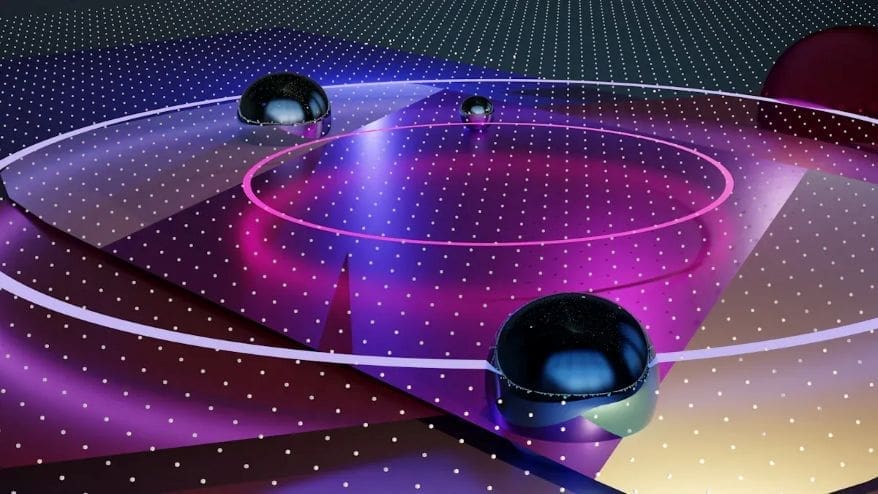
To begin with, you see the universe built from atoms and fundamental particles. Specifically, quantum physics explains how these tiny pieces behave. For example, atoms have electrons that move in strange ways. However, you cannot say exactly where an electron is. Instead, you talk about where it is likely to be. Technically, this is called a probability. Ultimately, quantum shows you that:
- Electrons act like both waves and particles.
- The more you know about an electron’s position, the less you know about its momentum.
- Atomic orbitals are regions where electrons are most likely found, not fixed paths.
These ideas help you understand why atoms and particles do not follow simple rules.
Light and Energy
Quantum physics changes how you see light and energy. Light is made of particles called photons. When photons hit atoms, they can be absorbed. This makes the atom jump to a higher energy state. When atoms drop back down, they release photons. This process is key for many technologies. Quantum optics studies how light and matter interact. You find that:
- Photons can be absorbed or emitted by atoms.
- Atoms use energy in steps, not smooth flows.
- Lasers use a process called stimulated emission to make strong, focused light.
These quantum effects power things like quantum computing and quantum communication.
Quantum in Technology
Quantum technology shapes your world every day. You use devices that rely on quantum effects. Some examples include:
- Quantum magnetometers measure magnetic fields.
- Quantum gravimeters detect changes in gravity.
- Atomic clocks keep GPS systems accurate.
- MRI machines use quantum physics to scan your body.
- Lasers in phones and fiber-optic internet use quantum ideas.
- Quantum-dot displays and USB storage use quantum effects.
- Quantum computing and quantum cryptography protect your data.
- Quantum key distribution keeps messages safe.
You see quantum technology in medicine, science, and even your phone.
Quantum Cosmology
Fundamentally, quantum cosmology helps you explore the universe’s origins. This is crucial because classical physics cannot explain the very beginning. In fact, quantum effects become important at the smallest scales. Consequently, you learn that:
- Quantum cosmology uses quantum ideas to study the early universe.
- Classical physics fails to explain the universe’s first moments.
- Scientists need quantum gravity to understand how the universe began.
Quantum physics gives you new ways to think about space, time, and the universe itself.
Why Quantum Physics Matters
Science and Technology Impact
Fundamentally, quantum physics changes how you see the universe. Today, you use quantum ideas in many areas of science and technology. Moreover, quantum helps you understand the nature of reality and the behavior of particles. For instance, you find quantum in lasers, transistors, and medical imaging. Quantum physics also powers GPS technology. You see quantum in your phone and in hospitals.
Here are some ways quantum shapes modern life:
- Finance and insurance use quantum for better modeling and risk analysis.
- Healthcare and pharma use quantum for faster drug discovery and personalized medicine.
- Transportation and logistics use quantum for smarter route planning.
- Manufacturing and materials use quantum for better production and battery design.
- Sensing and communication use quantum for secure messages and precise navigation.
Quantum physics drives innovation across many industries. You see science and technology grow because of quantum principles.
Future Opportunities
Ultimately, quantum opens new doors for you and for science. Specifically, you see quantum computing changing chemistry and helping you understand chemical reactions. Moreover, quantum lets you simulate particles and study new materials. In fact, you find quantum science at the heart of lasers and transistors.
You will see more quantum advances soon:
- Quantum computers will solve problems faster than regular computers.
- Quantum networks will connect processors for better communication.
- Companies work to build large quantum computers by the end of the decade.
- You need more skilled workers for the growing quantum sector.
- You learn about quantum technology’s potential in school and in industry.
Quantum physics gives you tools to explore the universe and shape the future.
Inspiring Curiosity
Above all, Quantum physics inspires you to ask questions about reality. In doing so, you learn new scientific principles and see the beauty and curiosity to explore quantum ideas.
- You prepare for careers in science and technology.
- You develop critical thinking and problem-solving skills.
- You use creativity to explore the nature of reality.
Surprisingly, physics offers a unique outlet for creativity. In essence, science is an art form where imagination can be just as important as logic.
For instance, programs like QCaMP teach you quantum concepts and let you try hands-on experiments. In doing so, you see practical uses for quantum in your life. Ultimately, quantum physics helps you discover new ideas and inspires you to keep learning.
In essence, quantum physics helps you unlock the universe’s secrets. Specifically, you see how reality works at the smallest scale. Naturally, curiosity drives you to ask new questions and explore science. For example, you can try interactive games or join hands-on programs to learn more:
| Educational Tool | Description |
|---|---|
| Interactive Visualizations and Games | Experience quantum ideas and build mental models. |
| Hands-on Programs | Programs like Quantum for All let you explore quantum in real life. |
Ongoing research keeps revealing new parts of reality. You can join this journey and shape the future of the universe.
Additionally, to present your innovative research and participate in a collaborative learning environment, visit the National Youth Conference on STEM at nycstem.in. Basically, this is our premier platform where we host conferences dedicated to science, technology, engineering, and mathematics. Further, at nycstem.in, you will find a wealth of information regarding our simple four-step process to register, submit your presentation, and receive your official certificate.
FAQs
What makes quantum physics different from classical physics?
You see quantum physics uses probabilities instead of certainties. In classical physics, you predict exact outcomes. In quantum, you only know the chance of something happening.
Quantum rules work best for tiny particles, not for big objects.
Can you see quantum effects in daily life?
You do not see quantum effects in your daily routine. These effects appear only at the atomic or subatomic level.
- Everyday objects follow classical rules.
- Quantum behavior hides in the background.
Why do scientists say particles can be in two places at once?
You learn about superposition. A particle can exist in many states until you measure it.
| Term | Meaning |
|---|---|
| Superposition | Many states at the same time |
| Measurement | Picks one state |
Is quantum physics useful for technology?
You use quantum technology every day.
- Phones use quantum chips.
- Hospitals use MRI machines.
- GPS relies on atomic clocks.Quantum ideas power lasers and secure communication.
How can you start learning more about quantum physics?
You can try interactive games, watch videos, or join hands-on programs.
- Look for online courses.
- Ask your teacher for resources.
- Explore science museums.
Stay curious and keep asking questions!
