
Have you ever noticed the spirals on golden ratio pine cones? Interestingly, these shapes often adhere to the golden ratio pine cone pattern. Furthermore, many pine cones exhibit spirals that correspond to Fibonacci numbers. In fact, research on the Golden Ratio and Fibonacci Sequence reveals that this pattern aids plants in growing efficiently and, consequently, utilizing their resources more effectively.
Golden Ratio Pine Cone Patterns

What Is the Golden Ratio?
The golden ratio pine cone pattern appears in many natural forms. The golden ratio describes a special relationship between two numbers. When the sum of two numbers divided by the larger number equals the larger number divided by the smaller, this ratio is called the golden ratio. Its value is about 1.618. People use the Greek letter phi to represent it. The golden ratio is an irrational number, so it cannot be written as a simple fraction.
Scientists have found the golden ratio in the growth of pine cones and other plants. The golden ratio pine cone pattern helps explain why these shapes look so pleasing and balanced. This pattern also connects to the fibonacci sequence, a series of numbers that often appears in nature.
Spiral Arrangements in Golden Ratio Pine Cones
Pine cones show a clear spiral pattern. If someone looks closely, they can see spirals going in two directions. These spirals are not random. The number of spirals in each direction usually matches fibonacci numbers. For example, a pine cone may have 8 spirals going one way and 13 going the other. This arrangement is called a phyllotactic spiral.
Botanists study these patterns by counting the spirals. They find that the angle between each scale is close to 137.5 degrees. This angle, indeed is known as the golden angle. It helps the scales fit together tightly. Ultimately, the golden ratio pine cone pattern allows the plant to use space and sunlight well.
The spiral pattern in pine cones is not just beautiful. It also helps the plant grow strong and healthy.
| Spiral Configuration | Fibonacci Numbers |
|---|---|
| 3 steep and 5 gradual spirals | 5/8 |
| 5 gradual and 8 steep spirals | 8/13 |
| 5 gradual and 13 steep spirals | 5/13 |
Also Read: Nature’s Math: The Golden Ratio and Fibonacci Sequence
Fibonacci Numbers in Nature
Fibonacci numbers are a sequence where each number is the sum of the two before it. In pine cones, the number of spirals in each direction often matches two fibonacci numbers. For example, someone may count 5 spirals one way and 8 the other. This fibonacci pattern appears in many plants, not just pine cones.
- Counting spirals in both directions shows two fibonacci numbers.
- Common pairs are 5 and 8, or 8 and 13.
- This arrangement helps the plant get more sunlight and grow better.
The golden ratio pine cone pattern gives the plant a strong structure. It also helps the plant avoid gaps between scales. This makes the pine cone more efficient and sturdy. The golden ratio pine cone pattern is a key part of how plants grow and survive.
Fibonacci Sequence and Natural Design
Sequence Explained
The fibonacci sequence was first shared by Leonardo Pisano, who is called Fibonacci. He wrote about it in his book Liber Abaci. The sequence begins with 1 and 1. Each new number is made by adding the two numbers before it. The formula is: Fn = Fn-1 + Fn-2 for all n ≥ 3. The numbers go 1, 1, 2, 3, 5, 8, 13, 21, and keep going.
- Fibonacci talked about this sequence when solving a rabbit problem.
- The sequence was found in older math books, so it has a long history.
- Fibonacci’s work brought together ideas from different cultures.
| Contribution | Description |
|---|---|
| Popularization of the Fibonacci Sequence | In Liber Abaci, Fibonacci used the sequence to solve a rabbit problem and showed how it connects to nature. |
| Influence on Mathematics | Fibonacci’s work joined math ideas from the Middle East, India, and Europe, changing how people did math and business. |
| Legacy | His work helped start new math ideas during the Renaissance. |
Ratio and Growth Optimization
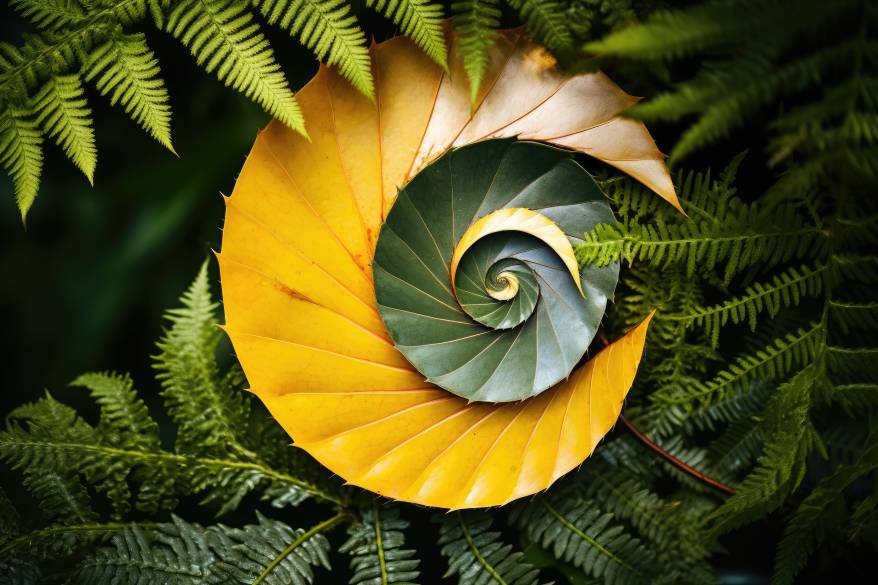
Plants use the fibonacci sequence to grow in the best way. The golden ratio helps leaves, seeds, and scales fit together well. This pattern lets plants get more sunlight and stay strong. For example, the veins in leaves often follow the golden ratio. This makes the leaf stiffer and helps it catch more sunlight.
| Evidence Description | Findings | Implications |
|---|---|---|
| GR distribution of leaf veins | Makes leaves stronger | Helps leaves bend less and get more sunlight for photosynthesis |
| Average measurements of length ratio | Shows a trend toward GR in leaf shapes | Makes leaves stronger and helps them get more sunlight |
| Evolution of GR distributed veins | Leaves are stiffer | Means plants can do photosynthesis better |
Sunflower seeds also show this pattern. The seeds make spirals that match fibonacci numbers, like 21 and 34. this helps the plant pack seeds close together and use space well. Furthermore, Golden Ratio pine cones have the same pattern, with spirals that match Fibonacci numbers. Consequently, this design helps the plant live and grow.
Mathematical Beauty in Nature
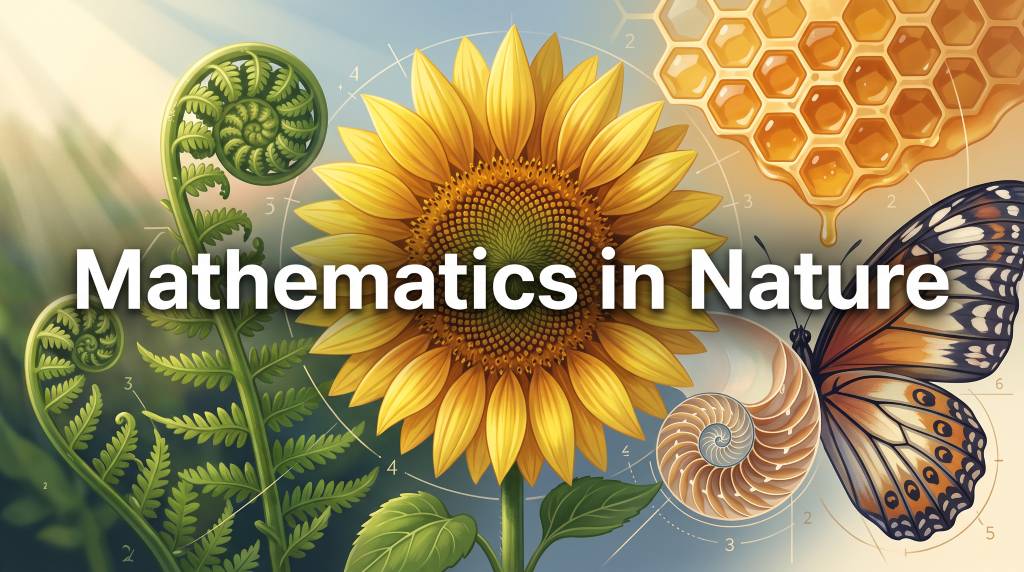
Fibonacci numbers show up in many places in nature. For example, sunflowers have 55 spirals one way and 34 or 89 the other way. Additionally, fiddleheads, which are young ferns, curl in a spiral that follows the golden ratio. Furthermore, Romanesco broccoli grows in spiral shapes, and each spiral gets farther from the center by the golden ratio. Likewise, seashells, like the nautilus, have spiral patterns that match the golden ratio. Finally, honeybees build honeycombs with shapes that connect to the Fibonacci sequence.
Artists and builders have used these patterns for a long time. Leonardo da Vinci used the golden ratio in his art. The Parthenon in Greece and the Great Pyramid of Giza also show this ratio. These examples show how math and nature can inspire people.
Observing Patterns Yourself
Anyone can find fibonacci spirals in pine cones at home. Try this easy activity:
- Get a pine cone and look at the bottom.
- Use colored tape to mark one spiral going clockwise.
- Count the scales in that spiral.
- Mark a spiral going the other way and count those scales.
- Write down both numbers. They are often fibonacci numbers.
- Check your numbers with the fibonacci sequence: 1, 1, 2, 3, 5, 8, 13, 21, 34, 55, 89, 144, 233.
Many people see that the spirals match numbers in the fibonacci sequence. This is a real-life example of the fibonacci pattern.
Some people think it is hard to see the pattern at first. Kids may need help to find the spirals. Using sticks or colored tape can make it easier. Teachers can use pine cones in class to teach counting and sorting. They can also compare pine cones of different sizes and shapes.
- The golden ratio and fibonacci numbers are found in many plants.
- Leaves, flowers, and shells all show these patterns.
- These patterns help plants grow and stay alive.
Finding these patterns in pine cones and other plants shows a strong link between math and nature.
Seeing the golden ratio in pine cones shows how mathematics is, indeed, part of nature. Furthermore, pine cones have spiral patterns with 8 arms and, additionally, 13 arms. Consequently, you can see this in the table below:
| Clockwise Spirals | Counter-Clockwise Spirals |
|---|---|
| 8 | 13 |
People also find these patterns in flowers and sunflowers. Snowflakes and honeycombs have special math designs too.
- Pine cones have spiral arms that match Fibonacci numbers.
- Flowers and sunflowers show these patterns as well.
- Snowflakes and honeycombs have their own math shapes.
If you are curious, you can learn more from Nature Glows Science or the Slate School blog. Looking at these patterns helps you see how math connects to nature.
If you are passionate about innovation, you should explore opportunities like NYC STEM 2026, where participants can present ideas and connect globally.
FAQs
1. What is the golden ratio in pine cones?
The golden ratio is about 1.618. Furthermore, pine cones show this ratio in their spiral patterns. As a result, these patterns help the plant grow strong.
2. Why do Fibonacci numbers appear in pine cones?
Fibonacci numbers help pine cones arrange their scales. Consequently, this pattern lets the plant use space and sunlight well. Moreover, many plants use this design.
3. Can students find these patterns at home?
Yes! Students can count spirals on pine cones. They can see Fibonacci numbers in real life. This activity makes math fun.
Tip: Use colored tape to mark each spiral for easy counting.
Reference:
- Basak, R. (2022). GOLDEN RATIO AND FIBONACCI SEQUENCE: UNIVERSAL FOOTPRINTS OF THE GOLDEN FLOW. The Turkish Online Journal of Design Art and Communication, 12(4), 1092–1107. https://doi.org/10.7456/11204100/013